
The AI Governance Gap: Agents Deployed Faster Than Controlled

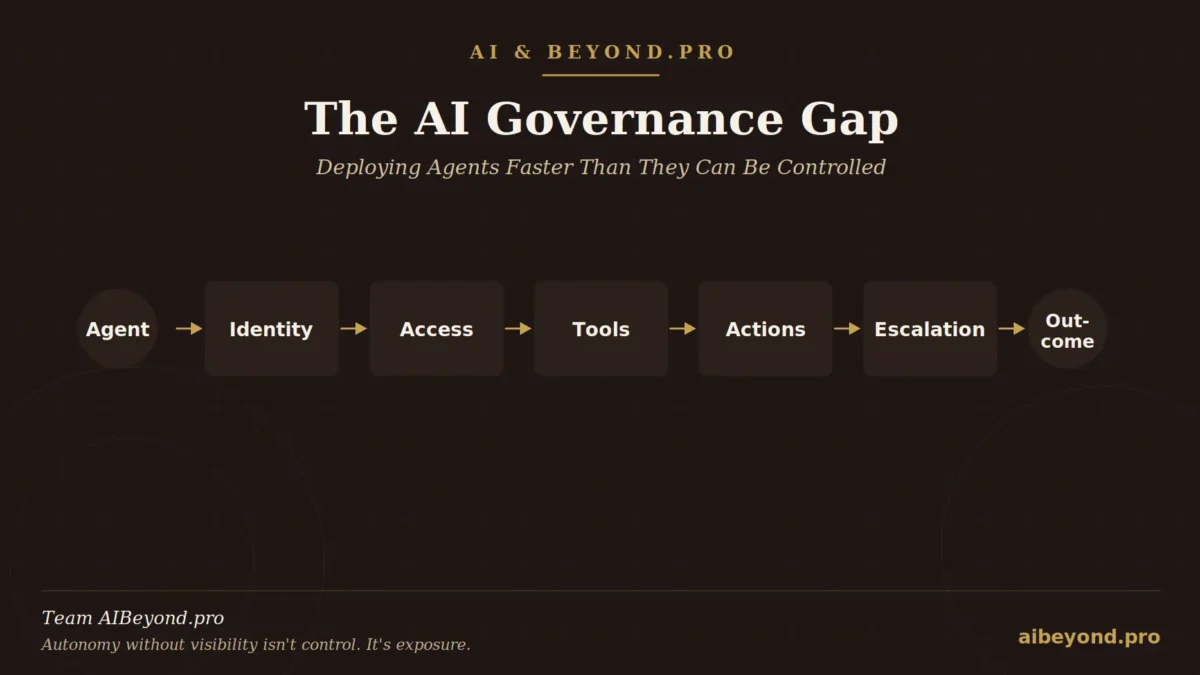
Enterprises are deploying AI agents faster than they can govern them. Why agent governance differs from model governance and the eight layers it needs.
The first wave of enterprise AI was about getting a model into a workflow: a chatbot answering questions, a copilot drafting text, a classifier flagging documents. The governance question that came with it was relatively contained: is the model accurate enough, private enough, and fair enough to trust with this task.
That question hasn’t gone away. But it’s no longer the whole question, because a growing share of what gets deployed now doesn’t just answer. An agent can retrieve information, call an API, update a record, trigger a workflow, and chain several of those steps together with limited human involvement in between.
That changes what “governing” the system actually means. It’s no longer just: is the output correct? It becomes: what can this system access, what can it change, what did it just do, who authorized it, and who’s accountable if it did the wrong thing.
Most organizations still have an answer for the first question and a much weaker one for the rest. That gap between how fast agentic systems are being deployed and how well organizations can actually see and constrain what those systems do is the subject of this article.
The Governance Model Was Built for a Different Kind of AI
Enterprise AI governance, as most organizations currently practice it, grew up around a specific set of concerns: model approval, data privacy, bias testing, security review, human review of outputs, and acceptable-use policy. All of that remains necessary. None of it disappears with agents.
What changes is that this model was built around a single moment approving a system before it goes live and a single kind of output: something a human reads and decides whether to act on. A chatbot recommending that a customer receive a refund is a governance question about output quality. An agent that actually initiates the refund is a different question entirely, because now the system’s mistake doesn’t stop at being wrong, it becomes a transaction that already happened.
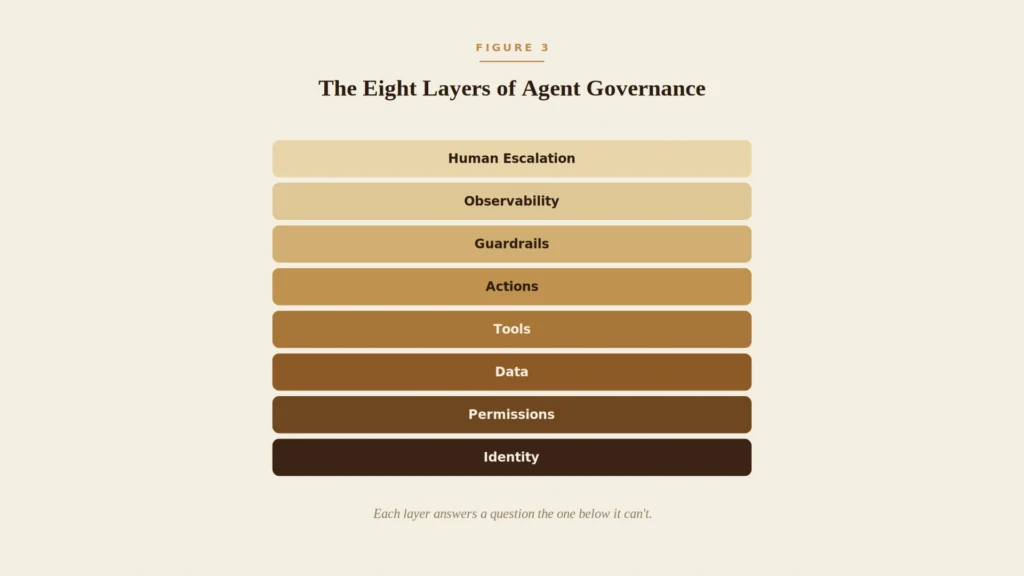
The same shift shows up across functions. A marketing assistant suggesting a campaign angle is advice a person evaluates. An agent that launches the campaign has acted. An analytics tool flagging a pricing anomaly is information. An agent that adjusts the pricing rule in response has changed something in the business. In each pair, the underlying model might be doing similar reasoning; the governance boundary has moved from what the system said to what it did.
That’s the distinction this article is built around: the boundary has moved from output to action. Governance frameworks designed to evaluate outputs don’t automatically extend to evaluating actions, and treating them as interchangeable is where the gap starts.
The Agentic AI Governance Gap
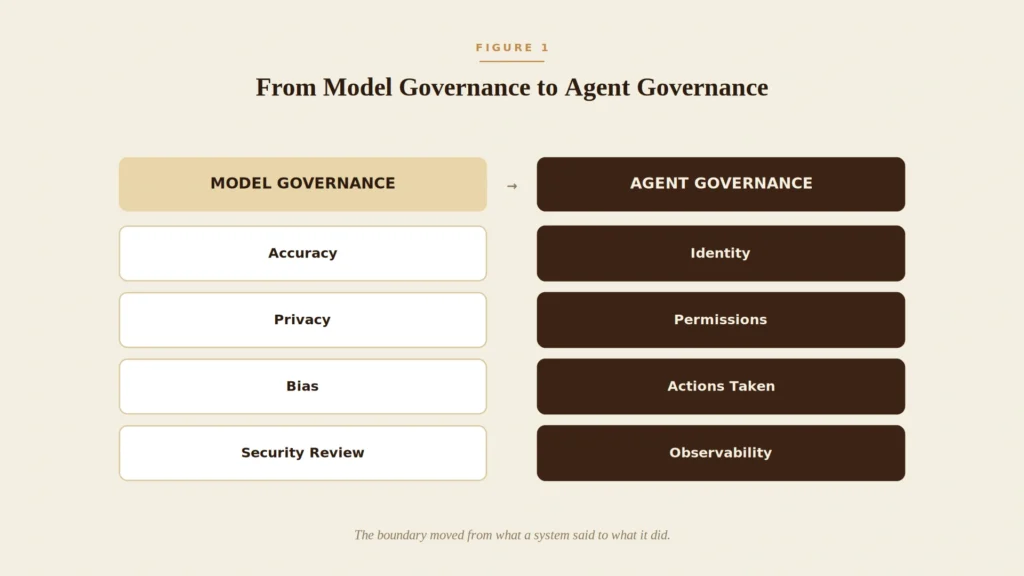
Call it what it is: many organizations have real AI governance infrastructure policies, review committees, model documentation, security sign-off and still have limited visibility into what their autonomous agents actually do once deployed. Governance work concentrated almost entirely at one point in time: before launch. Comparatively little of it continues once the system is live and operating inside real workflows.
Cloud Security Alliance’s 2026 analysis of NIST’s framework against agentic architectures makes a related point directly: the original AI Risk Management Framework was built with “defined operational boundaries, predictable behavior envelopes, and human oversight at most interaction points” in mind assumptions that hold much less reliably once a system is planning its own sequence of steps at runtime. NIST’s own CAISI unit acknowledged this directly, announcing an AI Agent Standards Initiative in February 2026 specifically to address what the same research describes as an “agentic fitness gap” in the existing framework.
This is the core distinction worth sitting with: governance before deployment answers whether a system should have been allowed to launch. Governance during operation answers whether it’s still behaving the way it was approved to behave, under conditions nobody fully specified in advance. Most enterprise AI governance today is heavily weighted toward the first and thin on the second which was a tolerable gap when systems mostly produced text for a human to evaluate, and is a much less tolerable one once they’re taking actions directly.
Why AI Agents Create a Different Control Problem
Not every agent has every one of these characteristics; capability varies significantly by architecture and by how much access a given deployment has been given. But taken together, they explain why agent governance can’t simply be an extension of model governance.
Agents can make decisions. Rather than producing one output for a human to evaluate, an agent decides what to do next based on what just happened, without a person necessarily reviewing that decision before it’s acted on.
Agents can access tools. A model that can only generate text is limited to what a person is willing to type in and act on manually. A model connected to tools can query systems, call APIs, and take real actions inside them.
Agents can operate across systems. A single task can touch a CRM, a billing system, and an internal database in sequence, meaning the governance question isn’t about one system’s access controls but about how permissions compose across several.
Agents can chain multiple actions. A plan with several steps means an error early in the sequence can propagate into everything downstream before anyone notices, rather than being caught at a single output.
Agents can encounter unexpected situations. A rigid workflow fails predictably. An agent reasoning through a novel situation can produce a response nobody explicitly anticipated or tested for which is part of the value and part of the risk.
Agents can act faster than human review. A multi-step task that would take a person an afternoon to work through manually can execute in minutes, which compresses the window in which a human could realistically catch a problem before it compounds.
The Eight Things Enterprises Need to Govern
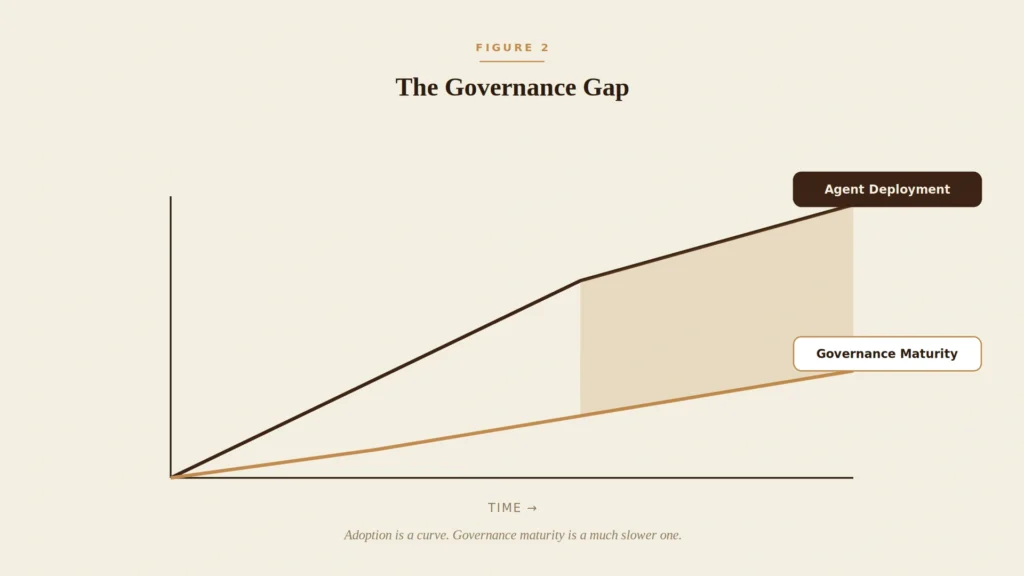
Model-level governance asks whether a system is accurate and fair. Agent governance has to answer a broader set of questions, organized around eight areas.
1. Identity. Which agent performed a given action, under whose authority, and for which workflow? Without a clear answer, “the AI did it” becomes an unaccountable, untraceable event rather than an attributable one. A financial services firm running several agents against the same core banking system needs to know, after the fact, exactly which agent touched which record, not just that “an agent” did.
2. Permissions. What is this specific agent allowed to do, distinct from what it’s technically capable of doing? An agent built on a capable model can, in principle, attempt almost anything its tools allow; permissions are what actually constrain it. Missing this control means an agent’s behavior is bounded only by its instructions, which is a much weaker boundary than it sounds.
3. Tool access. Which systems can the agent actually call, and what can each of those calls do? An agent connected to a CRM through a read-only integration is a fundamentally different risk than one connected through an integration that can also delete or export records.
4. Data access. What information can the agent see, and does that scope match what the task actually requires? An agent handling customer support tickets doesn’t need visibility into unrelated financial systems just because both happen to be reachable from the same platform.
5. Action boundaries. Of everything an agent is technically able to do, which actions are irreversible or high-stakes enough that they need an explicit boundary, a required approval, a spending cap, a rate limit regardless of how confident the agent is? Without this, “irreversible” and “routine” actions are executed with the same level of autonomy.
6. Observability. Can the organization see what an agent actually did, not just what it was asked to do, but the specific sequence of tool calls, decisions, and outputs along the way? Without a usable log of agent actions, a wrong outcome is nearly impossible to diagnose, let alone prevent from recurring.
7. Evaluation. Was the agent’s behavior acceptable, judged against real outcomes rather than just output quality at the point of generation? A response can look fluent and reasonable in isolation while the sequence of actions it triggered was still wrong for the situation.
8. Human escalation. When must a person take over, and is that threshold defined before deployment rather than improvised after something goes wrong? An escalation path that only exists informally, in someone’s head, isn’t a control, it’s a hope.
Identity Is Becoming an AI Governance Problem
Treating an autonomous agent as anonymous automation, a background process with no distinct identity creates an accountability gap that becomes obvious only after something goes wrong. The relevant questions are basic ones any employee’s access would already answer: which agent performed this action, on whose authority, using which credentials, with what permissions, for which workflow.
NIST’s National Cybersecurity Center of Excellence published a concept paper on AI agent identity and authorization in February 2026, treating this specifically as infrastructure that has to exist before broader agentic deployment can be governed responsibly, not a detail to retrofit later. The practical reason is straightforward: without a distinct, auditable identity per agent, incident response after an unwanted action defaults to guesswork about which system, workflow, or credential set was actually responsible.
Permissions Matter More Than Prompts
A well-written system prompt is instruction. It is not access control. An agent said, in its instructions, “only read customer records, never delete them” is still technically capable of issuing a delete call if its underlying tool access permits one the instruction is a request the model is likely to follow, not a barrier it’s structurally unable to cross.
This is the core of least-privilege thinking applied to agents: the safest agent isn’t necessarily the one with the most carefully worded instructions. It’s the one with the most appropriately limited access, so that even a reasoning failure can’t produce a consequential mistake.
In practice: an agent that can read a CRM should not, by default, also be able to delete customer records even if nothing in its instructions asks it to. An agent that can draft an email should not necessarily be able to send it without a checkpoint. An agent that can analyze invoices for discrepancies should not automatically be permitted to approve payments based on its own analysis. In each case, separating the capability that creates value from the capability that creates risk is a permissions decision, not a prompting one.
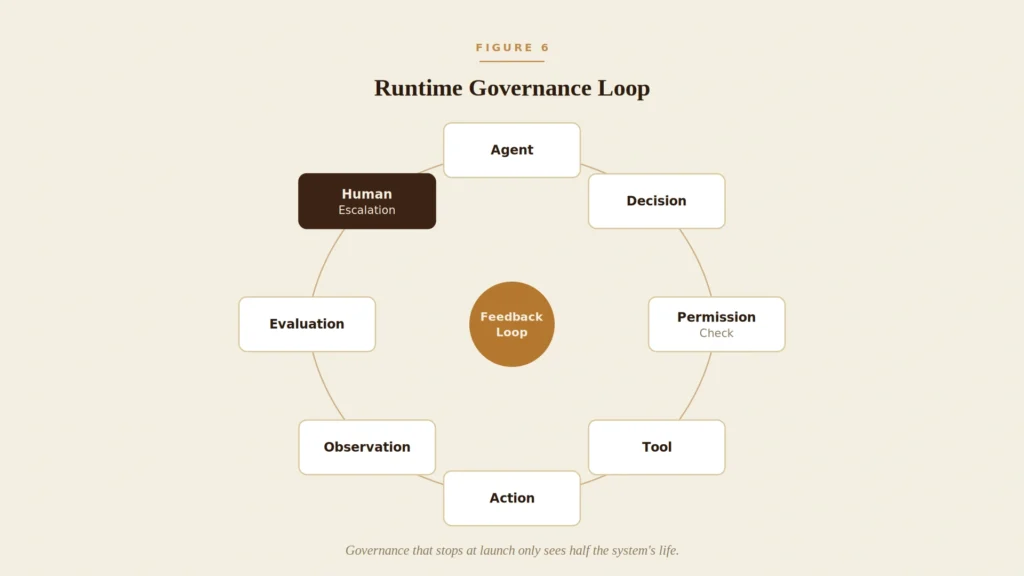
Governance Has to Move to Runtime
Pre-deployment governance asks whether a system should be approved to launch. Runtime governance asks whether it’s still behaving as approved once it’s live, handling real inputs, and encountering situations nobody explicitly tested for in advance.
The distinction matters because an agent’s behavior isn’t fixed at deployment; it depends on the specific inputs, tool responses, and context it encounters, which is precisely what a pre-launch review can’t fully anticipate. Runtime governance is the set of mechanisms that catch what pre-launch approval structurally cannot: continuous monitoring of what an agent is doing, logging of individual actions (not just final outputs), permission checks enforced at the moment of each tool call rather than assumed from configuration, policy enforcement that can block an out-of-bounds action before it executes, alerts when behavior falls outside expected patterns, human approval gates on specific high-stakes actions, anomaly detection across a fleet of agents rather than one at a time, ongoing evaluation of outcomes, and rollback capability where an action can realistically be reversed.
None of this replaces pre-deployment review. It’s the layer that has to exist because pre-deployment review, by definition, evaluates a system before it has encountered the situations it will actually face.
The AI Agent Governance Stack
Bringing the eight governance areas together into a working architecture, rather than a checklist, gives a clearer picture of how the pieces relate. This is a conceptual model, not a specific product architecture every enterprise needs to buy or build identically.
Layer 1 Identity: who is the agent.
Layer 2 Access: what can it see?
Layer 3 Tools: what systems can it interact with.
Layer 4 Actions: what is it actually allowed to do.
Layer 5 Guardrails: what rules constrain its behavior in real time.
Layer 6 Observability: what did it actually do?
Layer 7 Evaluation: was that behavior acceptable.
Layer 8 Human escalation: when does a person have to take over.
Each layer answers a question the one below it can’t. Identity without access controls tells you who acted but not what they could touch. Observability without evaluation tells you what happened but not whether it was actually correct. The stack is only as strong as its weakest layer an organization with excellent logging and no permission boundaries can see problems clearly after they’ve already happened, which is better than nothing but far short of prevention.
Shadow Agents: The Next Version of Shadow IT
Shadow IT employees adopting unapproved software because it solved an immediate problem faster than going through official channels was manageable partly because the tools involved were, for the most part, passive: a spreadsheet, a file-sharing app, a project board. The risk was largely about where data lived.
Agentic tools raise a related but sharper version of the same problem. An employee who connects a personal AI tool to a work email account, or builds a simple automation that chains a few SaaS integrations together, has created something with the ability to act, send messages, move data, trigger downstream systems, not just store information. The credentials, data flows, and scope of what that automation can touch are frequently invisible to any central team, in the same way shadow IT tools historically were, except now the tool doesn’t just hold data. It can use it.
This shouldn’t be read as a claim about how widespread the practice already is; that’s not something this article can responsibly quantify without a credible survey to cite. It’s a structural observation: the conditions that produced shadow IT low switching costs, no centralized visibility requirement, genuine short-term usefulness apply at least as strongly to agentic tools, with a higher ceiling on what an ungoverned instance can actually do.
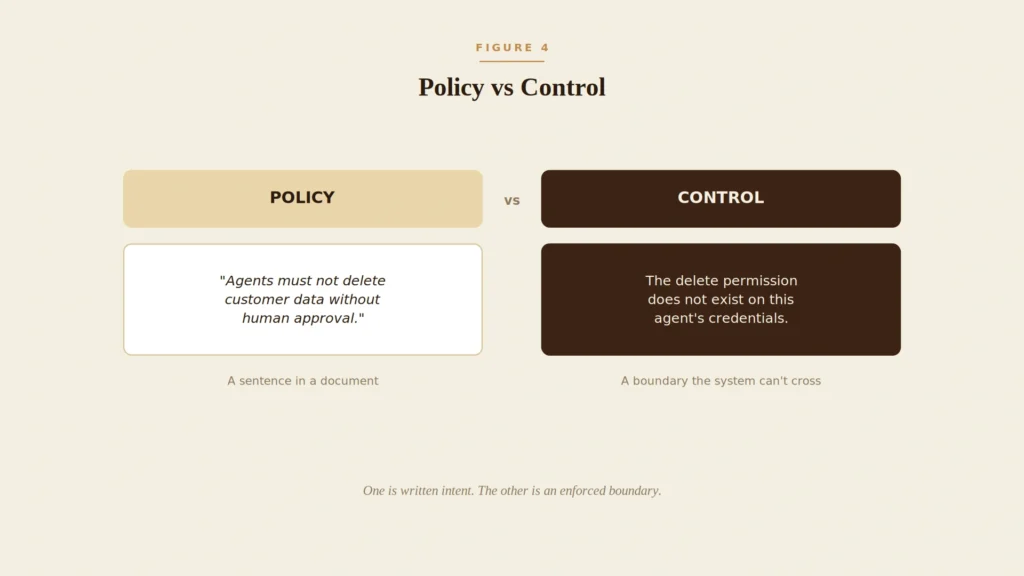
Why an AI Policy Document Isn’t Enough
A policy says what an agent should do. A control determines what it’s actually capable of doing. The gap between those two is where most governance failures live, and it’s a distinction worth making concrete.
A policy stating that “agents must not delete customer data without human approval” is a sentence in a document. A control is the technical permission boundary that makes an unauthorized delete call fail, regardless of what the agent decides to attempt. IBM and the Ponemon Institute’s 2025 Cost of a Data Breach Report found that 97% of organizations that experienced an AI-related security incident lacked proper AI access controls at the time not necessarily a documented AI policy, which many organizations do have, but the enforced technical boundary that would have actually prevented the specific action involved. The same report found 63% of breached organizations had no AI governance policy in place at all, and that a high level of “shadow AI” AI tools adopted without organizational approval or oversight added an average of $670,000 to the cost of a breach.
Those numbers describe two separate failure modes, and it’s worth being precise about which is which: some organizations lack the policy entirely; a larger share of those specifically breached through AI lacked the enforced control, even where a policy may have existed on paper. Both matter. Only one of them actually stops an unauthorized action from executing.
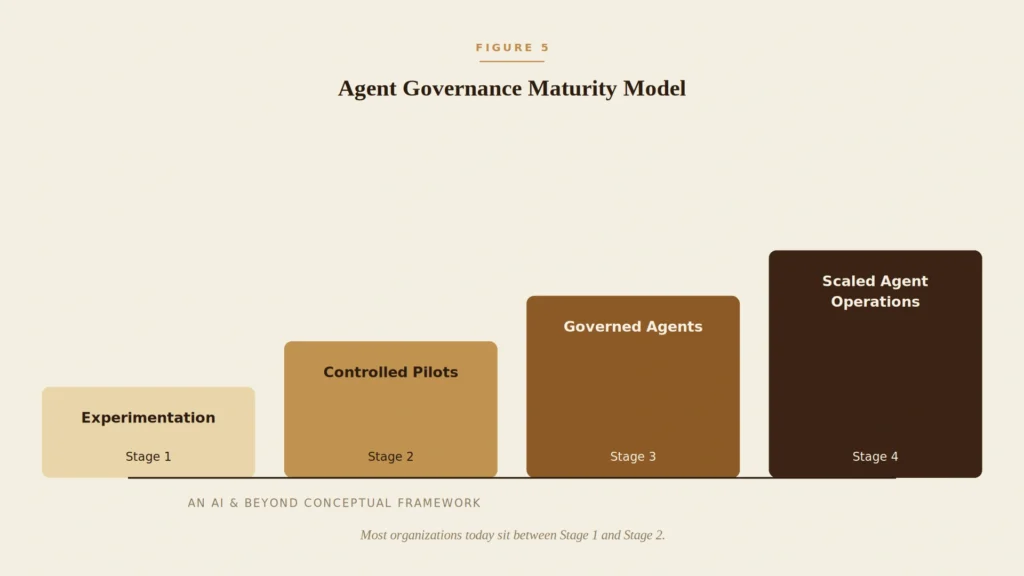
A Practical AI Agent Governance Maturity Model
This is offered as an AI & BEYOND conceptual framework, not an industry-standard benchmark as a way to locate where an organization currently sits and what tends to break at each stage.
Stage 1 Experimentation. Individual teams or employees are testing agentic tools on narrow, low-stakes tasks, often without centralized visibility. Capabilities are limited by design or by accident, and governance is essentially informal conversation, not a control. The main risk here is invisibility: nobody has a complete list of what’s running.
Stage 2 Controlled Pilots. A specific agent is deployed for a defined workflow, usually with a named owner and some manual oversight. Permissions tend to be broader than necessary because scoping them precisely takes deliberate effort teams haven’t yet invested. The main risk is permission creep when the pilot works, so its access quietly expands without a corresponding review.
Stage 3 Governed Agents. Identity, permissions, and logging exist for agents in production use, typically because a pilot’s success (or a near-miss) forced the organization to formalize what had been ad hoc. The main risk is coverage governance applied thoroughly to a handful of well-known agents while newer or smaller deployments slip in underneath it.
Stage 4 Scaled Agent Operations. Governance operates as infrastructure: consistent identity and permission models across many agents, runtime monitoring, defined escalation paths, and periodic re-evaluation built into the operating rhythm rather than treated as a one-time project. The main risk shifts from individual agent behavior to systemic ones for instance, several well-governed agents interacting in ways no single team fully anticipated.
Most organizations deploying agents today sit somewhere between Stage 1 and Stage 2. Gartner’s projection that 40% of enterprise applications will incorporate task-specific AI agents by the end of 2026, up from under 5% in 2025, describes an adoption curve considerably steeper than the governance maturity curve tracking alongside it.
What Companies Should Do Now
Inventory existing agents. Before governing anything, establish what’s actually running including tools adopted outside a formal procurement process. An inventory that only lists officially sanctioned deployments isn’t a complete inventory.
Map their permissions. For each agent, document what it can access and what it can do not what its instructions say it should do, but what its actual technical access allows.
Identify connected tools. List every system an agent can call, and note which of those calls are read-only versus capable of changing something.
Define high-risk actions. Name the specific actions, deletions, payments, external communications, irreversible changes that warrant a mandatory checkpoint regardless of how the agent arrived at the decision.
Establish approval thresholds. Decide, in advance, which categories of action require human sign-off before execution, rather than leaving that judgment to be improvised in the moment.
Log important actions. Ensure agent actions not just final outputs are captured somewhere reviewable. A log of what an agent said is not the same as a log of what it did.
Create escalation paths. Define, concretely, who gets notified and what happens when an agent encounters a situation outside its defined boundaries.
Evaluate agents continuously. Treat evaluation as an ongoing operational practice tied to real outcomes, not a one-time check performed before launch.
Review permissions periodically. Access that was appropriate at deployment can become excessive as a workflow evolves; schedule reviews rather than relying on someone noticing.
Start with governance proportional to risk. A low-stakes, read-only agent doesn’t need the same control intensity as one with payment or data-deletion capability matching governance effort to actual risk keeps the approach sustainable as agent count grows.
Conclusion
The question enterprise AI faced in its first wave was whether a model was accurate and safe enough to trust with an answer. The question this next wave raises is different: whether an organization has built enough control around a system to trust it with an action.
That’s not a smaller version of the same problem. Capability and trustworthiness are separate properties, and a system can be highly capable while remaining operationally ungoverned able to do a great deal, with no reliable way to know what it actually did, on whose authority, or with what consequence. Closing that gap isn’t a matter of writing a better policy. It’s a matter of building the identity, permission, and observability infrastructure that makes an agent’s actions visible and constrained in the first place before autonomy outpaces the organization’s ability to answer, with confidence, what its systems are actually doing.
