
Why AI “Copilots” Are Quietly Being Replaced by Autonomous Agents in 2026


Copilots wait for a prompt. Agents don’t. Here’s why enterprises are quietly shifting from AI that suggests to AI that executes and what that shift actually requires.
Open a copilot, type a request, wait for a draft, read it, fix what’s wrong, copy it somewhere else, and start the next task from zero. Do that fifty times a day and it stops feeling like assistance. It starts feeling like a second job supervising the first one.
That fatigue isn’t a copilot working badly. It’s a copilot working exactly as designed. A copilot’s entire architecture assumes a human sits in front of it, holds the context, decides what happens next, and carries every output to wherever it needs to go. The tool never forgets this arrangement, because it was never built to operate outside it.
For a couple of years, that arrangement was the whole story of enterprise AI. A chat window bolted onto a workflow, waiting for someone to type. It was a genuine improvement over nothing, and for a lot of tasks, it still is.
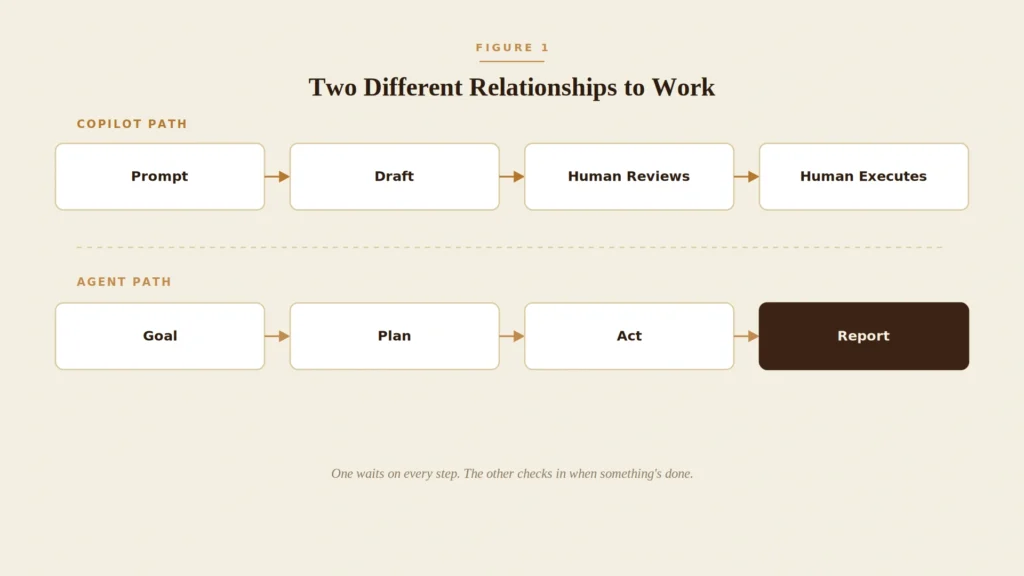
But a quieter shift has been happening underneath the copilot conversation. Systems are increasingly being built not to answer a prompt, but to take a goal, plan a sequence of steps, call the tools needed to execute them, and report back only when something is actually done or when something needs a human’s attention. Nobody sat down and typed each of those steps individually. The system worked out the sequence itself.
That’s not a faster copilot. It’s a different relationship to the work.
The distinction matters because most organizations are still evaluating “AI adoption” as a single category, as if a chatbot that drafts an email and a system that reconciles a thousand invoices overnight belong on the same maturity curve. They don’t. One waits. The other doesn’t. And the gap between those two postures is where most of 2026’s real enterprise AI shift is actually happening.
In this guide, we’ll cover:
- What a copilot actually is, architecturally, not just conversationally
- The ceiling every copilot eventually hits, regardless of how good the model gets
- What specifically makes an agent different not smarter, differently built
- The architecture shift from suggestion to action
- Where agents are already doing real, unsupervised work
- What copilots still do better, because the answer isn’t “nothing”
- The trust question nobody has fully answered yet
- A practical framework for choosing between the two
- Common mistakes companies are making in this transition
What a Copilot Actually Is
Strip away the branding, and a copilot is a request-response tool with a memory of the current conversation and, at best, some connected context. A person provides intent, in the form of a prompt. The system produces an output a draft, a summary, a suggestion, a block of code. The person evaluates that output, decides whether to use it, and does whatever comes next themselves.
That loop is the entire architecture. It’s why copilots are genuinely good at what they’re good at: drafting, summarizing, explaining, and suggesting inside a single, bounded exchange. It’s also why a copilot cannot, on its own, complete a multi-step task that spans systems, waits on external events, or requires deciding what to do next based on what just happened. Each of those steps requires the human to come back, re-establish context, and issue the next prompt.
This isn’t a limitation someone forgot to fix. It’s the shape of the tool. A copilot is built around a single unit of work: prompt in, output out. Everything about scaling that unit chaining it, sequencing it, letting it act on its own output sits outside what the architecture was designed to do.
The Ceiling Every Copilot Eventually Hits
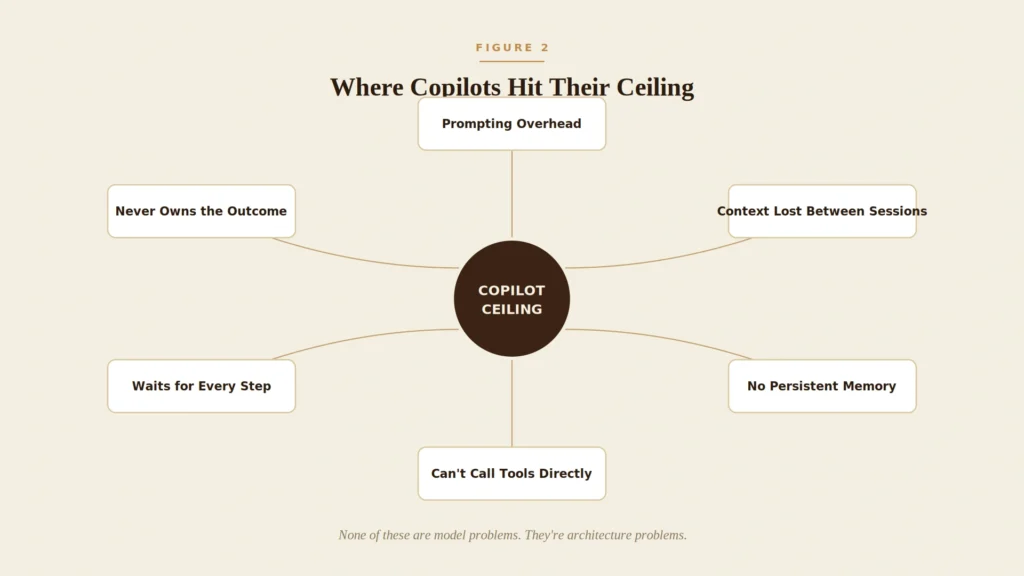
The ceiling shows up the same way in almost every organization that adopts a copilot seriously: usage grows fast, then plateaus, and the plateau isn’t about model quality.
It’s about the fact that a copilot has no memory of the work between sessions, so context gets rebuilt from scratch every time. It can’t call tools or update systems directly, so a human remains the connective tissue between “the AI suggested this” and “this actually happened somewhere.” It waits for every single step, which means the pace of the work is capped at the pace of the person prompting it and that pace doesn’t scale the way headcount or infrastructure does. And because a copilot never owns an outcome, only a suggestion, accountability for whether the task actually got done correctly stays entirely with the human, no matter how good the draft was.
None of this is really about the underlying model getting smarter. A more capable model produces a better draft. It doesn’t remove the human from the loop of prompting, checking, and carrying the output forward. That loop is architectural, not a capability gap which is exactly why simply upgrading the model behind a copilot doesn’t dissolve the ceiling.
What Makes an Agent Different
An agent is given a goal instead of a prompt, and the difference in what happens next is the entire story. Instead of producing one output and stopping, an agent plans a sequence of steps toward that goal, calls the tools it needs querying a database, updating a record, sending a message, triggering another system and continues through that sequence largely on its own, checking back in with a human only at defined points, or when something falls outside what it’s confident handling.
The model underneath an agent isn’t necessarily more advanced than the one underneath a copilot. What’s different is what surrounds it: persistent memory across steps and sessions, direct access to tools and systems rather than a human acting as the go-between, and a planning layer that decides what to do next based on what just happened, instead of waiting to be told.
That’s the shift industry researchers have been describing throughout 2026 not agents replacing copilots because they’re smarter, but because they’re wired into the places where work, permissions, and systems already live, in a way copilots structurally aren’t.
From Suggestion to Action: The Architecture Shift
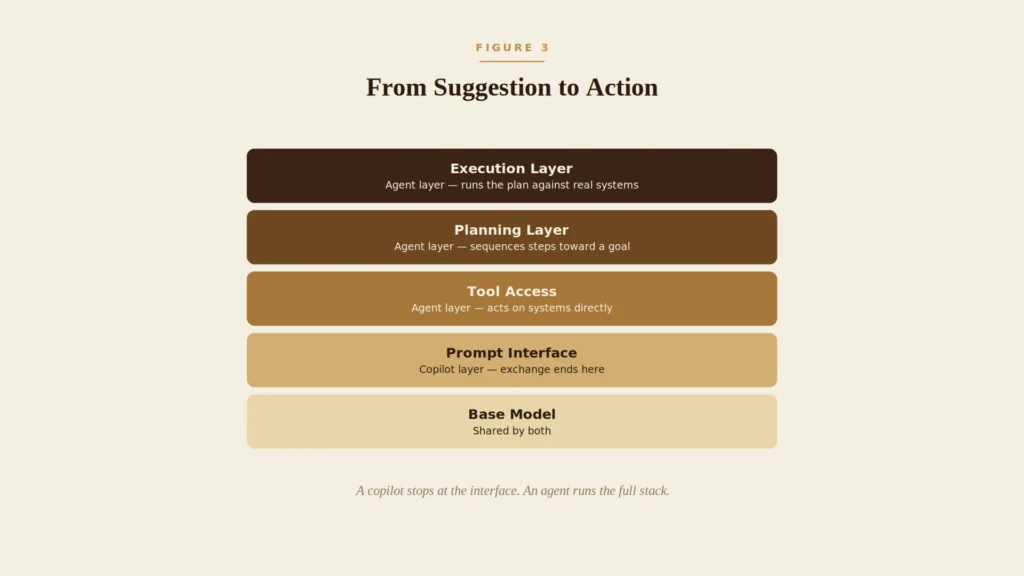
It helps to think of this as a stack, because the difference between a copilot and an agent isn’t one feature it’s which layers exist at all.
At the base sits the model, doing the reasoning either way. Above that, a copilot adds a prompt interface: a person types, the model responds, and the exchange ends there. An agent adds several more layers on top of the same model tool access, so the system can act on systems rather than just describe what someone else should do; a planning layer, so it can sequence multiple steps toward a goal rather than answering one prompt at a time; and an execution layer, where the plan actually runs against real systems, producing an outcome rather than a suggestion.
A copilot stops at the interface layer. An agent runs the full stack. That’s the entire technical distinction underneath a lot of vendor language about “autonomy” not a smarter model, but more of the stack actually built and connected.
Where Agents Are Already Doing the Work
The shift isn’t theoretical. It shows up in specific, bounded workflows where the pattern is consistent: a goal is defined, the agent plans and executes the steps, and a human is involved only at checkpoints that actually warrant it.
Finance operations. Reconciling invoices against purchase orders used to mean a person opening both documents, comparing line items, and flagging discrepancies. An agent can pull both records, match them automatically, and surface only the exceptions that don’t reconcile cleanly the person’s attention goes to the 5% that need judgment, not the 95% that don’t.
IT and DevOps. Instead of a copilot suggesting a fix that an engineer then has to apply, test, and deploy by hand, an agent can diagnose an issue, apply a fix in a staging environment, run tests, and only escalate to a human if the fix doesn’t hold or the change touches something sensitive.
Customer operations. A copilot drafts a reply for an agent to review and send. An agent can resolve the routine share of tickets end to end checking account status, applying a standard policy, closing the ticket and route only the ones that fall outside defined thresholds to a person.
Research and reporting. A copilot summarizes one document when asked. An agent can be given a broader goal compile a competitive summary, monitor a metric, flag anomalies and check multiple sources on a schedule, producing a report only when there’s something worth reporting.
In each case, the underlying task didn’t get easier. What changed is who’s driving each individual step.
What Copilots Still Do Better
None of this makes copilots obsolete, and treating them that way is its own mistake. A copilot remains the better tool for genuinely single-shot, judgment-heavy work drafting a sensitive email, thinking through a strategy problem out loud, getting a second opinion on a piece of writing. These are tasks where a human wants to stay in the loop on every sentence, not hand off a sequence of steps.
Copilots are also the safer default in early adoption and in regulated or high-ambiguity contexts, where the cost of an unsupervised misstep is high and the workflow itself hasn’t been mapped and tested enough to trust an agent with it yet. Handing a fragile or poorly understood process to an autonomous system tends to produce failures faster, not fewer the process was broken either way, and agents just execute a broken process at higher speed.
The honest framing isn’t copilot versus agent as a maturity ladder. It’s that copilots suit single-turn, judgment-dense work, and agents suit multi-step, well-bounded work with a clear goal and defined checkpoints. Most organizations need both, applied to different tasks, not a single organization-wide choice.
The Trust Question Nobody’s Fully Answered
The honest obstacle to wider agent adoption isn’t capability. Current systems can already plan and execute multi-step work across connected tools. The obstacle is trust specifically, the question of what happens when an agent gets several steps into a plan before anyone notices it went wrong.
A copilot’s mistake is contained by design: it produces one bad draft, and a human catches it before anything happens. An agent’s mistake can compound, because several actions may already have executed a record updated, a message sent, a downstream system triggered before a human sees any of it. That’s a structurally different failure mode, and it’s why the organizations moving fastest into agent deployment are also the ones investing hardest in observability: logging every step an agent takes, defining exactly which actions require approval before they execute, and building the ability to catch a plan going sideways early rather than after the fact.
This is also why the shift toward agents and the discipline of human-in-the-loop design are the same conversation, not two separate ones. An agent doesn’t remove human oversight it relocates it, from reviewing every output to approving specific, higher-stakes actions before they execute. Getting that relocation right is most of the actual engineering work involved in a serious agent deployment.
A Framework for Choosing Between Them
A workable rule doesn’t require a committee. It requires answering three questions about the task in front of you.
Does the task require a single judgment call, or a sequence of steps? A single judgment call draft this, evaluate this, explain this is copilot territory. A sequence that spans systems and waits on intermediate results is agent territory.
Is the workflow well-understood and tested? An agent executing a broken or poorly mapped process will find its failure modes faster and at greater scale than a human doing it manually. Map and stabilize the workflow before handing it to an agent, not after.
What’s the cost of an unsupervised mistake? High-stakes, hard-to-reverse actions need a human checkpoint before execution, regardless of how capable the agent is. Low-stakes, easily reversible actions are exactly where autonomy earns back the most time.
Tasks that are single-shot, judgment-heavy, low-volume, or still being figured out stay with a copilot. Tasks that are repeatable, well-bounded, and clearly define what “done correctly” looks like are strong candidates to hand to an agent, with checkpoints placed at whatever step actually carries the risk.

Common Mistakes Companies Are Making
Treating agent adoption as a copilot upgrade. It happens because the marketing language makes them sound like points on the same spectrum. It fails because the architecture, not just the capability, is different swapping in a “smarter” copilot doesn’t produce agent-like behavior. Better approach: evaluate agents as a different system with a different oversight model, not a copilot with extra features.
Handing a broken process to an agent to fix it. It happens because automation feels like a solution to a process nobody wants to redesign. It fails because an agent executes the existing process faster, including its flaws. Better approach: stabilize and map the workflow before introducing autonomy.
Setting no clear approval checkpoints. It happens because defining exactly which actions need human sign-off is genuinely harder than just switching autonomy on. It fails because the first sign of trouble is often several completed actions in. Better approach: name specific, high-stakes actions that require approval before the agent goes live, not after an incident.
Removing humans entirely instead of relocating them. It happens because “autonomous” gets read as “unsupervised.” It fails because it is, in fact, the least safe version of an agent deployment. Better approach: treat agent oversight as human-in-the-loop design applied to a different layer approving actions, not reviewing every output.
Measuring adoption by usage instead of outcomes. It happens because usage is easy to track and outcomes take longer to show up. It fails because a heavily used agent that doesn’t reduce the work or improve the result isn’t accomplishing anything. Better approach: tie agent deployment to a specific, measurable outcome before rollout, not after.
Where This Is Headed
The near-term trajectory isn’t a single autonomous agent quietly taking over more of the enterprise. It’s multiple specialized agents, each handling a narrower slice of work, increasingly coordinated with each other rather than operating in isolation a pattern already visible in how vendors are building multi-agent orchestration rather than single do-everything agents. Governance is maturing alongside that shift, not behind it: logging, permissioning, and approval workflows built specifically for agentic systems are becoming a standard part of the deployment, not an afterthought bolted on later.
Copilots aren’t disappearing from this picture. They remain the right interface for genuinely single-turn, judgment-heavy work, and that category of work isn’t shrinking to zero. What’s changing is that copilots are increasingly one tool in a broader system rather than the whole system the interface a person reaches for when a task needs their judgment on every step, sitting alongside agents handling the steps that don’t.
FAQ
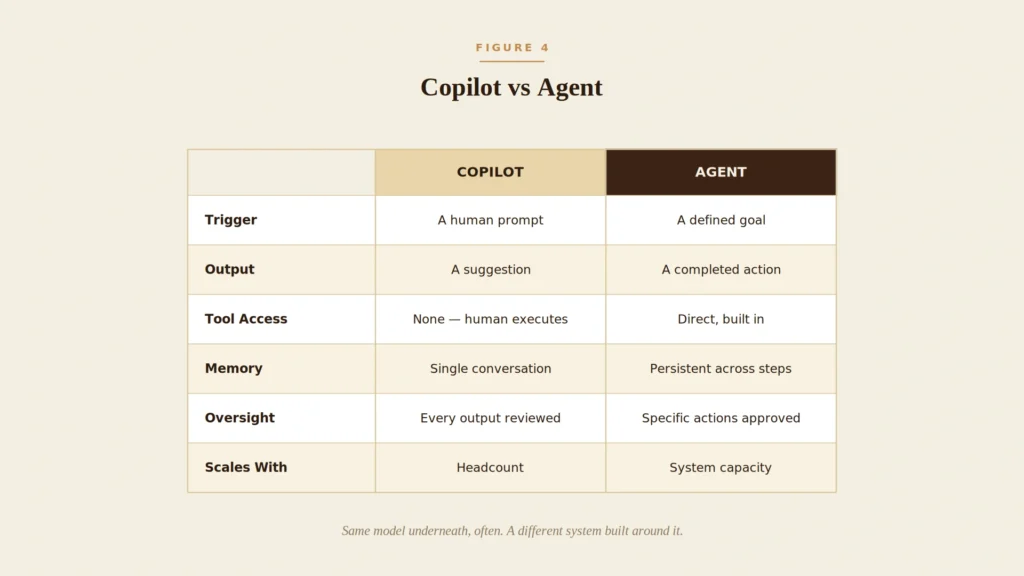
What’s the actual difference between an AI copilot and an AI agent? A copilot responds to a prompt and stops the human carries the output forward. An agent is given a goal, plans a sequence of steps, calls tools directly, and executes largely on its own, checking in only at defined points.
Are agents replacing copilots entirely? No. Copilots remain the better fit for single-turn, judgment-heavy tasks. Agents are being adopted for repeatable, well-bounded, multi-step work the two are increasingly used together, for different categories of task.
Is an agent just a copilot with a better model? No. The underlying model can be identical. What differs is the surrounding architecture persistent memory, direct tool access, and a planning layer none of which a better model alone adds.
Why do copilots plateau in enterprise adoption? Because their architecture caps the pace of work at the pace of the person prompting them, and requires context to be rebuilt every session. That’s a structural limit, not a model-quality limit.
What’s the biggest risk with autonomous agents? Compounding errors several actions can execute before anyone notices something went wrong, unlike a copilot’s single-draft mistake, which a human catches before it goes anywhere.
Should a company start with copilots or agents? Start with copilots for judgment-heavy, low-volume, or poorly understood workflows. Move to agents once a workflow is well-mapped, repeatable, and has clearly defined checkpoints for higher-stakes actions.
Does adopting agents mean removing human oversight? No it relocates it. Instead of reviewing every output, a human approves specific, higher-stakes actions before they execute. That relocation, done well, is most of the actual work in a serious agent deployment.
Bottom Line
The copilot era taught organizations to work with AI one exchange at a time a prompt, a draft, a human carrying it the rest of the way. That pattern isn’t wrong. It’s just bounded, in a way that was easy to miss until agents made the boundary visible by working outside it.
The shift isn’t that AI got smarter in 2026. It’s that more of the surrounding architecture memory, tool access, planning, execution finally got built and connected. What that buys an organization isn’t less human judgment. It’s human judgment spent on fewer, higher-stakes decisions, while the rest of the sequence runs on its own. That’s a narrower, more deliberate use of the same scarce resource copilots were always quietly asking too much of.
