
Attribution in an AI-First World: What’s Actually Trackable Now

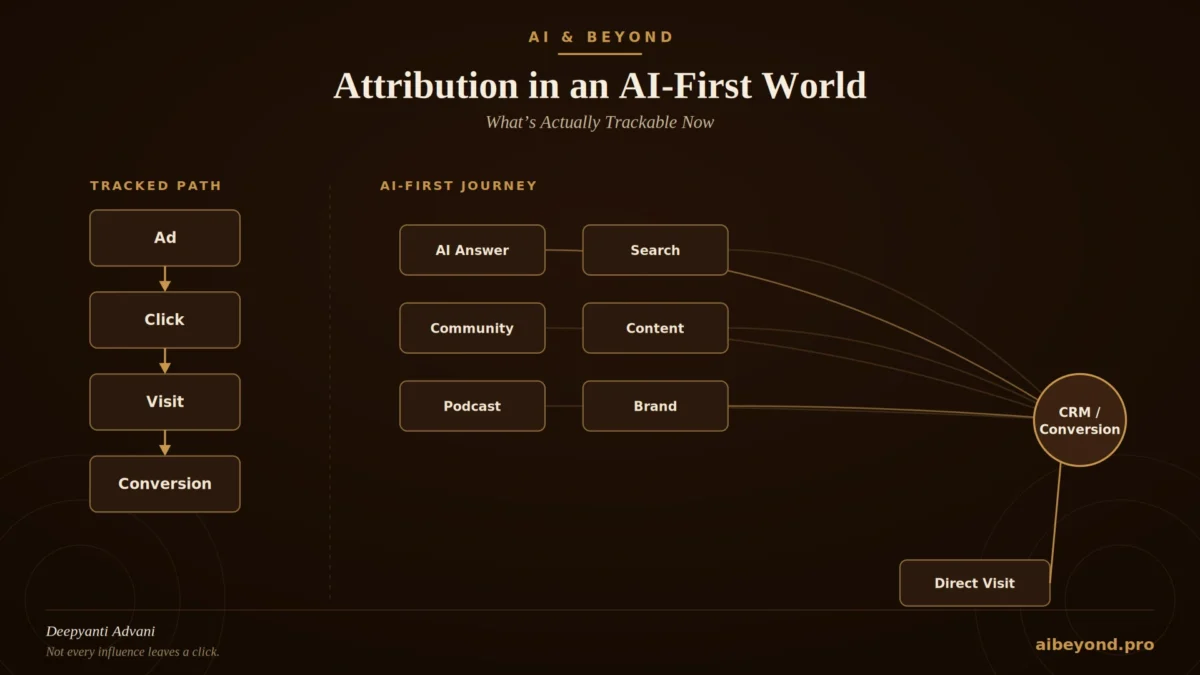
Why the traditional marketing attribution model is breaking and how businesses can measure the influence of AI, search, content, and invisible journeys.
A prospect books a demo. The sales rep asks the usual question how did you hear about us? The answer is vague: “I’ve just sort of known about you for a while.” The analytics dashboard is no more helpful. Session source: direct. No campaign, no referrer, no history in the CRM beyond today.
Nobody did anything wrong. The tracking is implemented correctly. The UTM parameters are clean. And still, the honest answer to “where did this customer come from” is: nobody knows.
This is happening more often, and it isn’t a tooling failure. It’s a symptom of something larger. A person can now read a company’s name inside an AI-generated answer, see it mentioned in a Reddit thread while researching something else entirely, hear it referenced on a podcast, and search for it by name three weeks later all without a single one of those moments generating a trackable event.
The old assumption was that influence and measurement moved together. If something shaped a decision, it probably left a trace: a click, a visit, a session. That assumption held up reasonably well for a long time, not because journeys were simple, but because most of the surfaces where discovery happened were surfaces marketers could instrument.
That’s no longer a safe assumption. A growing share of the journey now happens on surfaces marketing was never built to see into inside a private chat with an AI assistant, inside a closed community, inside somebody’s memory of a conversation they can’t quite place.
AI didn’t create this problem. It made it impossible to ignore.
In this guide, we’ll cover:
- Why traditional attribution models were built around visible interactions
- Why the customer journey is becoming structurally harder to observe
- How AI search specifically breaks the impression-to-conversion chain
- What’s directly measurable, partially measurable, and currently out of reach
- Why asking customers directly is becoming a serious measurement method again
- A framework for shifting from click attribution to influence measurement
- A practical, layered attribution stack for AI-first teams
- Common attribution mistakes worth retiring
- What attribution is likely to look like as this matures
The Attribution Model Was Built for a More Visible Internet
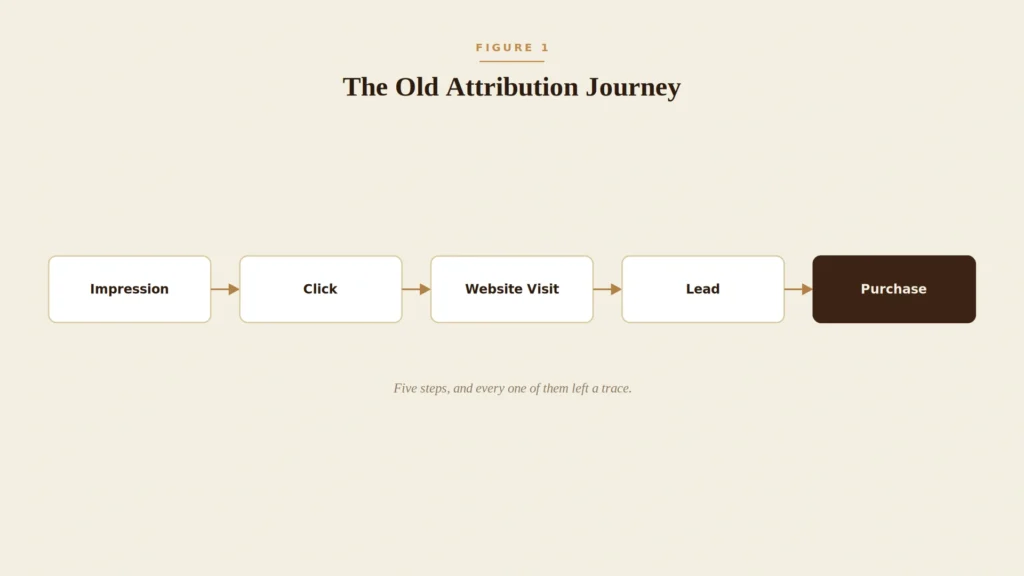
Attribution models were never perfect. First-touch attribution credits whatever interaction started the journey often overvaluing early-funnel content that merely happened to appear first. Last-touch attribution swings the other way, crediting whatever happened immediately before conversion, which tends to overvalue bottom-funnel activity like branded search or direct visits. Multi-touch models attempt a compromise, distributing credit across several touchpoints using rules that are reasonable but ultimately somewhat arbitrary.
None of these models claimed to capture the full truth of human decision-making. What they captured, reasonably well, was a sequence of observable digital events: a paid search click, an organic listing click, a referral from another site, a direct type-in, each timestamped and tied to a session.
That was the real strength of the old system. Not accuracy in some absolute sense, but coverage. The paths people actually used to discover and evaluate companies search engines, ads, referring websites, email were, for the most part, paths that generated a referrer header or a click ID. CRM systems could stitch those events to a contact record. Marketing could build a defensible, if imperfect, story about what drove a conversion.
The model wasn’t designed around certainty. It was designed around visibility. And for a long stretch, visibility and reality were close enough.
The Customer Journey Is Becoming Harder to See
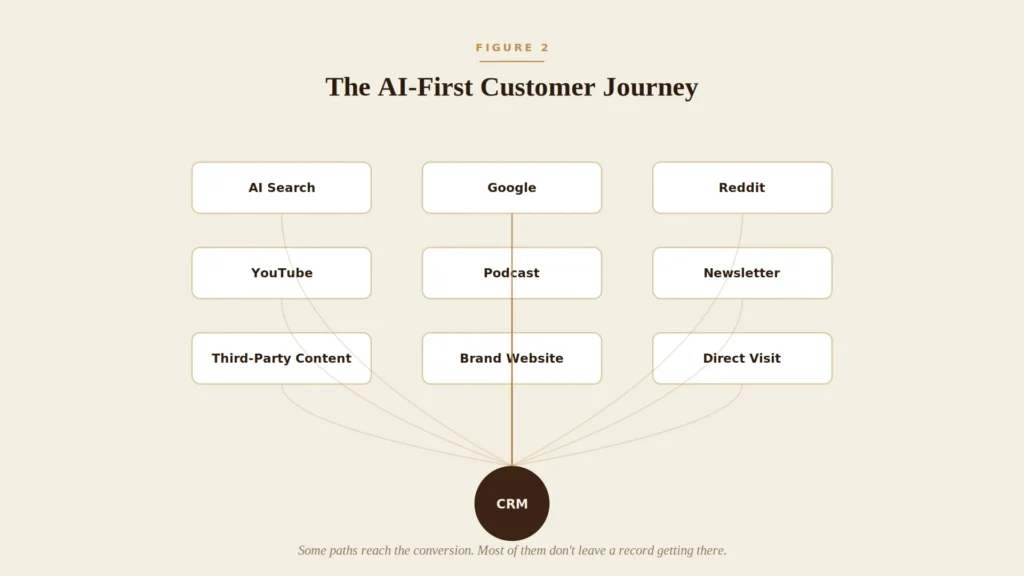
The paths people take before converting haven’t gotten more complicated in principle multi-channel research has always existed. What’s changed is how much of that research now happens on surfaces that don’t pass along evidence of themselves.
Someone might ask an AI assistant to compare options in a category, read the synthesized answer, and never click a citation link, because the answer already contained what they needed. Someone might see a brand mentioned favorably in a Reddit thread while searching for something unrelated, form a quiet impression, and act on it weeks later. Someone might hear a company name on a podcast, absorb it passively, and later type that name directly into a search bar or browser an action that analytics will record as “direct,” with no memory of the podcast attached to it anywhere in the data.
None of these are edge cases anymore. They’re becoming the default texture of how people learn about companies, particularly in categories where research happens before intent is fully formed.
Call this invisible influence: exposure that shapes a decision without generating a conventional trackable event. It isn’t new in kind word of mouth has always been invisible influence but it’s new in scale, because so much discovery has migrated onto AI interfaces and semi-private social spaces that structurally don’t emit the same signals a webpage click does.
The uncomfortable implication is that “direct traffic” was never a clean category. It was always partly a bucket for journeys the analytics stack failed to observe. AI hasn’t introduced that failure. It’s made it large enough that ignoring it is no longer a reasonable option.
AI Search Creates a New Attribution Problem
The traditional model assumed a fairly tight chain: an impression leads to a click, a click leads to a visit, a visit leads to a conversion. Each link in that chain generates data, and the data more or less lines up with what actually happened.
AI-mediated discovery breaks that chain in a specific way. The sequence now often looks like: a person asks a question, an AI system generates an answer that mentions or describes a company, that exposure shapes the person’s mental shortlist, the person does independent research elsewhere, and then visits the company’s site directly sometimes days later, using the brand name rather than a category term.
The final, trackable event in that sequence a direct visit, or a branded search looks identical in the analytics platform to a visit from someone who’d never heard of the company before that moment. The AI exposure that actually created the awareness is invisible by the time a session gets logged.
It matters to be specific about what current AI platforms do and don’t expose here, because the landscape is inconsistent and changing quickly. Google Analytics 4 introduced a native “AI Assistant” traffic channel, which rolled out to most properties by early June 2026 and captures referral traffic from major AI platforms without additional configuration. But Google has confirmed the native channel’s coverage includes ChatGPT, Gemini, DeepSeek, Copilot, and Grok notably excluding Perplexity, which still lands in generic referral traffic unless a team builds a custom channel group to catch it.
Even where a platform does pass referral data, that data is unreliable in a specific, quantifiable way: industry analyses estimate that across AI platforms, somewhere between 35 and 70 percent of AI referral sessions arrive without referrer headers and land in “direct” traffic instead, meaning the true volume of AI-influenced sessions is very likely undercounted in most reporting setups, sometimes substantially.
And that’s only the traffic that eventually clicks through. A large and fundamentally unmeasurable category consists of people who get their answer from the AI system itself and never visit anything brand exposure that shaped consideration but generated zero data of any kind.
What You Can Actually Track
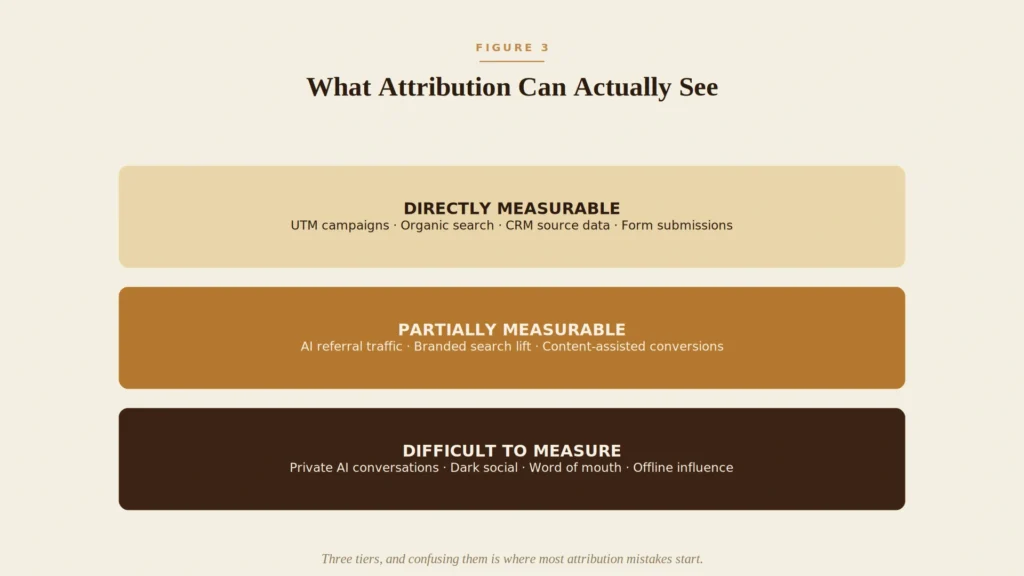
The most useful thing a marketing team can do right now is stop treating “measurable” as a single category. It isn’t. It breaks into three meaningfully different tiers, and confusing them is where most attribution mistakes start.
Directly measurable. This is the traditional core: UTM-tagged campaign traffic, standard organic and paid search, referral traffic from known domains, branded search volume, landing-page conversion events, CRM-recorded lead sources, form submissions, demo requests, and assisted-conversion paths inside a multi-touch model. This layer is imperfect but genuinely reliable the data reflects real, timestamped user behavior.
Partially measurable. This tier requires effort and comes with acknowledged gaps. AI referral traffic, where platforms pass referrer data, falls here real, but very likely an undercount given how much of it arrives unlabeled. Increases in branded search volume are a useful proxy for growing awareness, but they can’t be cleanly attributed to a single cause. Content-assisted conversions, AI citation monitoring where a platform’s outputs are publicly observable, and shifts in returning-direct-traffic behavior all belong in this tier: directionally informative, not individually precise.
Difficult or currently unmeasurable. This is the honest boundary. Private conversations inside AI assistants that never generate a click are invisible by design no platform currently exposes that data to third parties, and there’s no credible reason to expect that changes soon given the privacy expectations involved. Recommendations made inside closed communities, word of mouth triggered by something someone read in an AI answer, and most forms of dark social the private sharing of links through DMs, forwarded emails, or messaging apps, a category of traffic attribution error that strips out the referrer information analytics tools depend on all sit in this category. So does most offline influence.
Treating these three tiers as one undifferentiated “attribution” problem is what leads teams to either give up on measurement entirely or fake a precision they don’t actually have. Naming the tiers explicitly is a small discipline with an outsized effect on decision quality.
The Rise of Self-Reported Attribution
If a meaningful share of the journey is structurally invisible to tracking software, the most direct way to recover some of that information is also the oldest: ask.
A single, well-placed question “what were you researching before you found us?” or “where did you first come across us?” captures information no pixel ever will, because it doesn’t depend on a referrer header existing in the first place. It can surface an AI conversation, a podcast mention, or a colleague’s recommendation that left no digital trace whatsoever.
Self-reported attribution has real limitations, and it’s worth naming them rather than glossing over them. Memory is imperfect people often reconstruct a simplified version of their journey rather than an accurate one, collapsing multiple touchpoints into whichever one feels most salient in hindsight. Response rates are typically partial, which introduces sample bias toward more engaged customers. And open-text answers require some manual categorization before they become usable data, which adds friction most teams underinvest in.
None of that makes the method useless. It makes it a complement to behavioral data, not a replacement for it. The two data types fail in different, non-overlapping ways: behavioral tracking is precise but structurally blind to certain journeys; self-reported data is imprecise but can see into exactly the places tracking can’t reach. Used together, each compensates somewhat for the other’s blind spot. Used alone, either one gives a distorted picture.
From Click Attribution to Influence Measurement
The deeper shift this article has been circling is a change in the question itself. The old question was: where did this conversion come from? That question assumes a single identifiable source exists and that the job of attribution is to find it.
The more honest question is: what influenced this decision? That framing doesn’t assume a single source. It assumes correctly, based on everything above that most real decisions are shaped by an accumulation of exposures, some trackable and some not, and that the goal of measurement is to build a reasonable picture of that accumulation rather than to locate one clean cause.
A useful way to structure that picture is as a sequence of states, each with a different measurement posture:
Discovery the first exposure to a company, often untrackable if it happens through AI, word of mouth, or a private share. Exposure repeated or reinforcing encounters, partially trackable through branded search trends and AI citation monitoring. Engagement active interaction with owned content or channels, directly trackable through standard web and campaign analytics. Consideration comparison against alternatives, partially visible through comparison-page traffic, review-site referrals, and self-reported research behavior. Conversion the final measurable action: a purchase, a signup, a demo request. Directly trackable, but only ever the last visible step in a much longer process. Retention what happens after, directly trackable through product and CRM data, and often the strongest long-term signal of whether the original influence was genuine.
Mapping a journey against these six states, rather than trying to compress it into a single attributed source, makes the measurement gaps explicit instead of hiding them behind a misleadingly clean number.
A Practical Attribution Stack for an AI-First Marketing Team
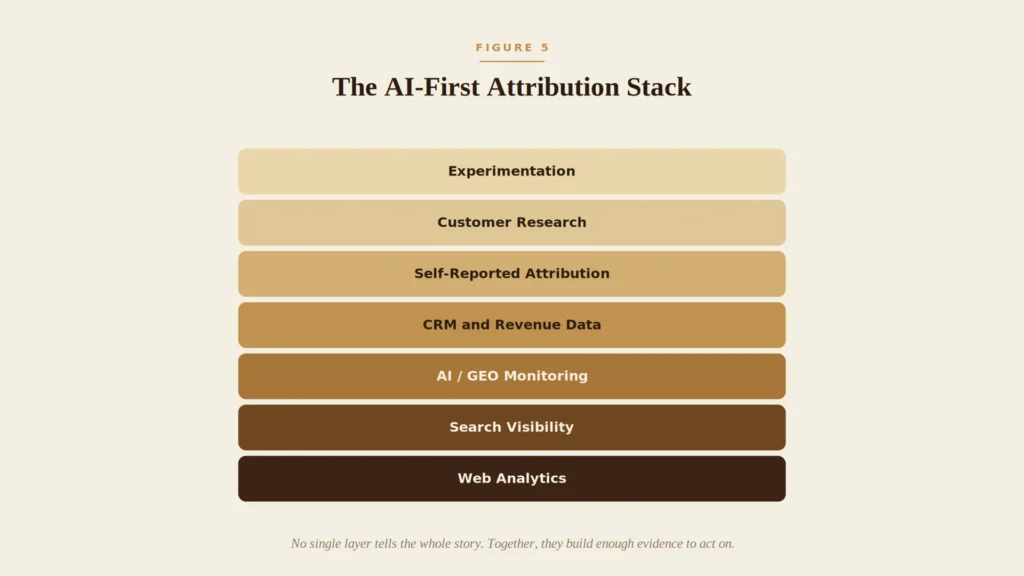
No single tool covers every state in that sequence, which means the practical answer isn’t picking a better platform it’s assembling layers that each cover a different part of the picture, then reading them together rather than in isolation.
Web analytics is the foundation: sessions, behavior, conversion events, the layer every other layer eventually connects back to.
Search visibility sits above it traditional rank tracking, but also branded search volume as a proxy for growing top-of-funnel awareness that hasn’t yet converted.
AI and GEO monitoring is the newest layer: tracking whether and how a brand gets cited inside AI-generated answers, where that visibility is technically observable at all.
CRM and revenue data connects marketing activity to what actually closed, which is the layer most attribution reporting skips or bolts on as an afterthought rather than a foundation.
Self-reported attribution fills in the discovery-stage gaps that behavioral data structurally can’t reach.
Customer research structured interviews, win-loss analysis goes deeper than a single survey question can, surfacing the why behind a decision, not just the where.
Experimentation is the layer that substitutes for certainty where certainty isn’t available: controlled tests, geo-holdouts, and incrementality studies that estimate causal effect without requiring a clean attribution trail.
No layer alone tells the full story. Together, they build converging evidence which is a meaningfully different, and more honest, standard than a single dashboard number claiming to show “the” source of a conversion.
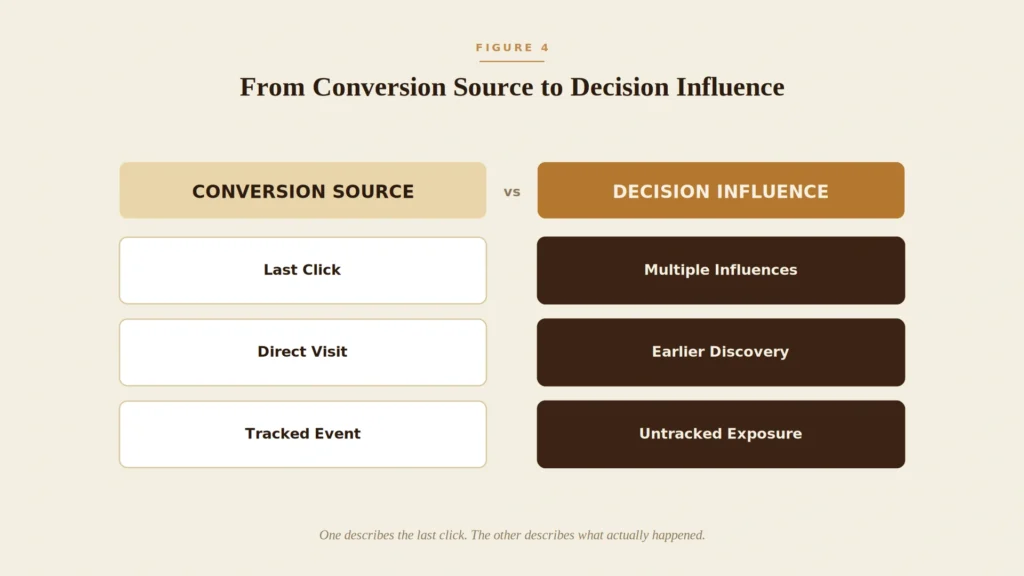
Why Last-Touch Attribution Is Becoming Less Useful
Consider a realistic path. A buyer asks an AI assistant to compare vendors in a category and gets your company mentioned as one of three options. Over the following days, they read two independent comparison articles that also mention you. They see your company referenced in a Reddit thread about the same category. A week later, they search your brand name directly, land on your site, and book a demo.
A standard analytics setup will credit that conversion to “Direct” or possibly “Organic Search,” depending on how the branded search resolves. Both labels are technically accurate descriptions of the final click. Neither one describes what actually happened.
This is the distinction worth holding onto: conversion source describes the last visible action before a conversion event. Decision influence describes everything that built the conviction to take that action. Last-touch attribution was always measuring the former while implicitly being read as if it explained the latter. That gap was tolerable when the two were closer together. It’s less tolerable now that AI-mediated research has stretched the distance between them.
This doesn’t make last-touch data worthless it’s still an accurate record of the final action, and final actions matter operationally. It means that final action should stop being treated as a proxy for the whole story.
The New Attribution Model: Observe, Connect, Ask, Test
Bringing the previous sections together into something usable day to day, a simpler operating model has four moves, each answering a different question.
Observe what behavioral data actually shows, without inflating it. This is the directly- and partially-measurable data described earlier: sessions, campaigns, AI referral traffic where it’s visible, branded search trends. Treat it as real but incomplete.
Connect that behavioral data to revenue, by linking analytics platforms to CRM outcomes rather than stopping at session-level metrics. A conversion that never gets tied to closed revenue is a vanity number, however well-tracked it is upstream.
Ask customers directly what analytics can’t see the self-reported layer that recovers discovery-stage information tracking structurally misses.
Test what can’t be observed or asked with confidence, using controlled experiments and incrementality studies to estimate causal effect where a clean attribution path doesn’t exist and isn’t going to.
The order matters. Teams that skip straight to “ask” without first getting the observable layer right end up with survey data they can’t cross-check. Teams that skip “test” entirely tend to over-trust whatever number their dashboard produces, simply because it’s the only number they have.
Common Attribution Mistakes in the AI Era
Treating direct traffic as a clean source. It happens because “Direct” reads as a definitive category in most dashboards. It fails because a large share of direct traffic is actually unlabeled AI referral, dark social, or delayed brand recall. Better approach: treat elevated direct traffic as a prompt to investigate, not a settled answer.
Assuming the last click caused the decision. It happens because last-touch data is the easiest to report and defend in a meeting. It fails for the reasons described above the last click is frequently just the final, most convenient step in a much longer process. Better approach: pair last-touch data with self-reported discovery data before drawing conclusions.
Ignoring self-reported attribution as “too soft.” It happens because behavioral data feels more scientific. It fails because behavioral data is structurally blind to entire categories of influence. Better approach: treat self-reported data as a distinct, complementary evidence source, not a downgrade from “real” analytics.
Treating AI referral traffic as the entire AI effect. It happens because it’s the only piece of AI influence that shows up as a clean number. It fails because, as covered above, a large share of AI-influenced sessions never pass referrer data at all, and an unknown further share never click through to a site. Better approach: read AI referral traffic as a floor, not a ceiling.
Measuring search rankings instead of actual influence. It happens because rank position is simple to track and report. It fails because a high ranking that generates no clicks and no brand recall isn’t accomplishing anything commercially. Better approach: pair visibility metrics with downstream branded search and conversion trends.
Running dashboards that never connect to CRM revenue. It happens because marketing and revenue systems are often owned by different teams with different tools. It fails because a conversion event that never reconciles against actual closed revenue can’t be trusted for budget decisions. Better approach: prioritize the analytics-to-CRM connection before adding new measurement tools.
Assuming every customer journey is fully measurable. It happens because admitting a measurement gap feels like an admission of failure. It fails because it leads to false confidence in numbers that are quietly incomplete. Better approach: explicitly document what a given report can and can’t see.
Giving false precision to attribution percentages. It happens because stakeholders often ask for a single clean number, and a model will always produce one whether or not it’s justified. It fails because a confidently wrong number is more damaging to decision-making than an honestly uncertain range. Better approach: report attribution as a range or a set of converging signals, not a single decimal-point figure.
What AI-First Attribution Will Look Like
The near-term trajectory isn’t toward some future tool that finally makes every AI-influenced journey fully trackable. Private conversations inside AI assistants are unlikely to become transparent to third-party marketing tools, for the same privacy reasons email and direct messages never became transparent. Betting a measurement strategy on that changing would be a mistake.
What’s more realistic is that the tools available for observing the edges of AI influence keep improving. AI discovery measurement and citation monitoring tracking whether and how a brand appears inside AI-generated answers is likely to mature as a category, following a similar arc to how rank tracking matured for traditional search. Entity visibility, meaning how clearly and accurately AI systems can describe a company and its offerings, will likely become a measurable input in its own right rather than an afterthought.
First-party data and structured customer research will carry more of the measurement burden than they have in the past decade, precisely because tracking-based data has become less complete. Probabilistic and experimental methods incrementality testing, geo-holdouts, mix modeling will likely be treated less as a specialty for the largest advertisers and more as a standard part of any serious measurement program, because they’re built specifically to work in conditions where a clean deterministic trail doesn’t exist.
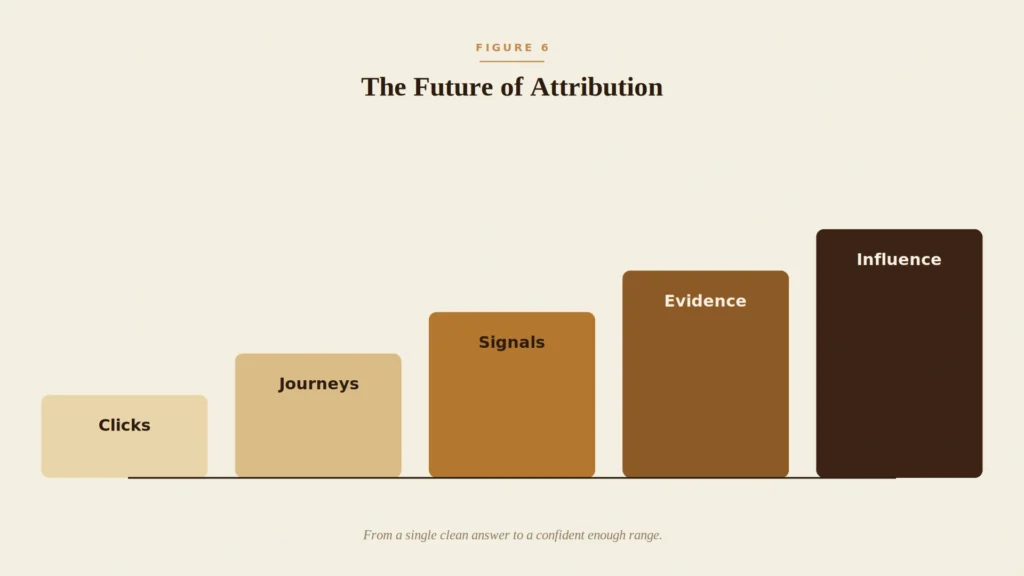
The honest summary: attribution is moving from something that tries to be exactly right about a single number toward something that tries to be reasonably confident about a range, built from multiple imperfect but complementary sources. That’s not a downgrade from where attribution used to be. It’s closer to what attribution always actually was, with the pretense of precision removed.
AI-First Attribution Checklist
- Set up GA4’s native AI referral channel, and supplement it with a custom regex channel group to catch platforms it misses
- Connect web analytics to CRM revenue data, not just conversion events
- Add at least one self-reported attribution question to your lead or signup flow
- Monitor branded search volume as a proxy for AI- and word-of-mouth-driven awareness
- Track AI citations and mentions where a platform’s outputs are publicly observable
- Explicitly separate “discovery” data from “conversion” data in reporting
- Run at least one controlled experiment or incrementality test per quarter
- Compare assisted-conversion paths against last-touch numbers before presenting either alone
- Document, in writing, what your current measurement stack cannot see
- Resist reporting attribution percentages with more precision than the underlying data supports
FAQ
Can ChatGPT traffic actually be tracked? Partially. When ChatGPT passes referrer data, GA4’s native AI Assistant channel or a custom regex filter will catch it. A meaningful share of sessions arrive without referrer data at all and land in “Direct,” so any number you see is very likely an undercount, not a false positive.
How can marketers measure AI search visibility? Primarily through citation monitoring tracking whether and how a brand is mentioned in AI-generated answers for relevant queries combined with branded search volume as an indirect signal of growing awareness.
Is last-click attribution still useful? Yes, for what it actually measures: the final action before conversion. It becomes misleading only when treated as a proxy for everything that influenced the decision, rather than one data point among several.
What is self-reported attribution? Directly asking customers where they first heard about a company or what they were researching beforehand. It recovers information behavioral tracking structurally can’t see, at the cost of relying on imperfect human memory.
How does AI change marketing attribution? It doesn’t change the underlying logic of attribution so much as it expands the share of the customer journey that happens on surfaces marketing tools were never built to observe private AI conversations, closed communities, and zero-click search results chief among them.
Can AI citations be measured? Where a platform’s outputs are publicly accessible, yes, to a reasonable degree tools and manual monitoring can track whether and how a brand appears in response to relevant prompts. Private, non-public conversations remain outside what any third-party tool can observe.
What should marketers track if customers discover brands through AI? All three tiers described in this article: the directly measurable core (search, campaigns, CRM), the partially measurable layer (AI referral traffic, branded search trends, citation monitoring), and through self-reported data and experimentation some structured evidence about the difficult-to-measure remainder.
Is attribution ever completely accurate? No, and it never was, even before AI. What’s changed is the size of the gap between what a dashboard reports and what actually happened. The responsible response is to be explicit about that gap, not to pretend it doesn’t exist.
Bottom Line
Attribution isn’t broken so much as it’s being asked to measure a world it was never built to see. The customer journey didn’t get more chaotic when AI assistants entered it it became more honest about how much of it was always happening off the record, in conversations and private moments no pixel was ever going to catch.
The future of attribution isn’t a better dashboard that finally finds the one true source for every conversion. It’s a discipline built from multiple imperfect, complementary sources behavioral data, self-reported data, experimentation layered until they produce enough evidence to act on, and honest enough to say clearly where that evidence runs out.
