
Human-in-the-Loop: The Middle Path Between Automation and Control

How organizations can automate aggressively without removing the human judgment that matters most.
Ask an executive team whether they want to automate a workflow, and you’ll get a version of the same argument every time. One side wants speed: let the AI system run, remove the friction, stop paying people to do what software can now do faster. The other side wants safety: keep a human in the loop, don’t let the machine decide anything that matters, review everything before it goes out the door.
Both sides are usually right about something and wrong about the same thing. They’re arguing about how much automation is acceptable, as if that were a single dial you turn up or down. It isn’t. A workflow isn’t one decision it’s dozens of small decisions stacked together, and each one has its own risk, its own reversibility, and its own need for judgment. Treating them as a single automation setting is where most of the debate goes wrong.
Full automation advocates tend to point at the parts of the workflow that are genuinely repetitive data entry, formatting, routing, first-draft generation and use them to justify removing humans from parts that aren’t repetitive at all. Manual-control advocates tend to point at the one case that went wrong the fraud that slipped through, the message that shouldn’t have gone out and use it to justify reviewing everything, including the ninety-five percent of cases where a human adds no real signal.
Neither side is wrong about the example they’re citing. They’re wrong about generalizing from it.
The organizations that actually get value from AI automation have stopped asking “should we automate this workflow.” They’re asking a narrower, more useful question: for each decision inside this workflow, does a human add value here, or does a human just add latency?
That reframing matters because human attention is not free, and it is not infinite. Every case a person reviews is a case they aren’t spending time on somewhere else. A review queue that includes both a genuinely ambiguous fraud case and a routine password reset is not being careful it’s diluting the attention that the fraud case actually needed.
This is the real design problem behind every AI rollout that works well over time: not whether humans stay involved, but where.
Good AI workflow design does not remove humans everywhere, and it does not keep humans everywhere either. It removes people from the decisions where their involvement adds little beyond delay, and it deliberately preserves them at the points where judgment, accountability, or ambiguity make a human decision worth the cost.
In this guide, we’ll cover:
- Why the automation debate is framed as a false binary, and what to ask instead
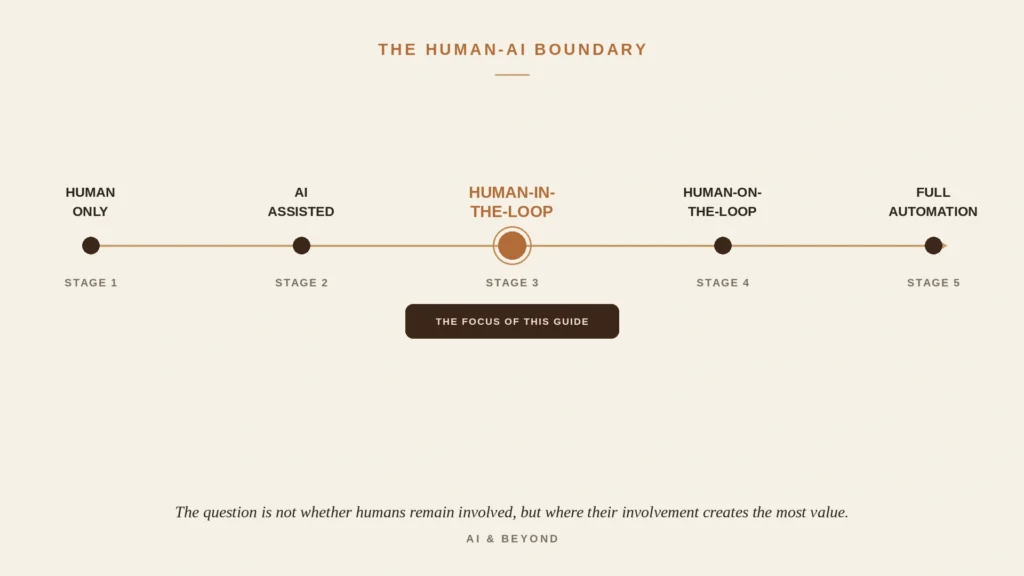
- What human-in-the-loop actually means, and how it differs from human-on-the-loop and full automation
- A framework for deciding which decisions deserve human attention
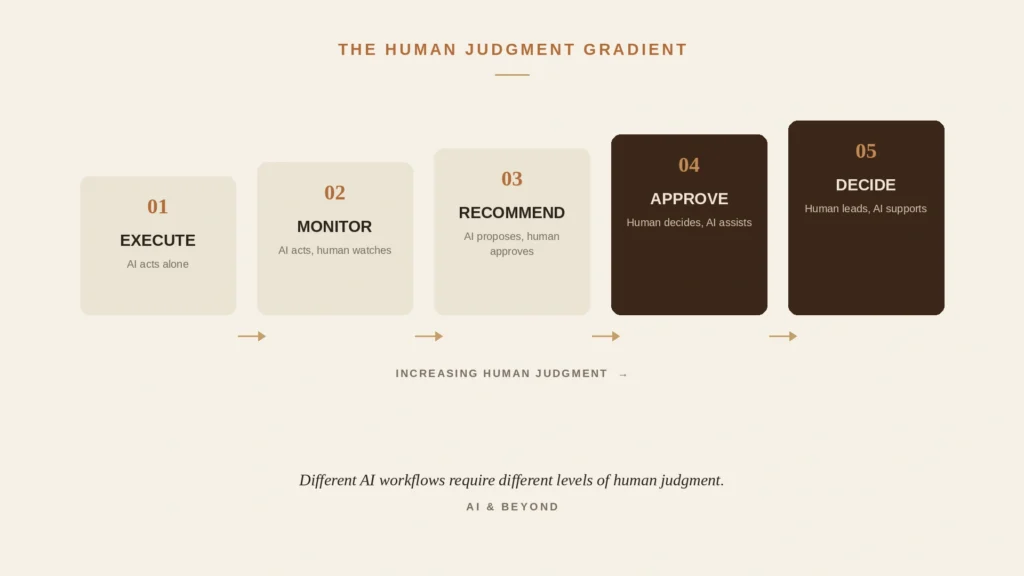
- An original five-level model of human involvement the Human Judgment Gradient
- Where human-in-the-loop creates the most value, with realistic scenarios
- Why human attention behaves like a budget, and how to spend it well
- A practical framework for designing the human-AI boundary in an existing workflow
- What goes wrong when that boundary is designed badly, and how to fix it
- A step-by-step process for building a human-in-the-loop system
- Why this design skill becomes more important, not less, as AI agents get more capable
The Automation Debate Is Asking the Wrong Question
Most organizations approach automation as a binary choice between two extremes, with a vague, unexamined middle labeled “augmentation” that nobody has actually designed.
Full automation means the AI system executes without a human checkpoint. It’s fast and it scales, but every error propagates without a chance to catch it before it reaches a customer, a regulator, or a balance sheet.
Manual workflows mean a person makes every decision, start to finish. They’re slow and expensive, but every decision benefits from human judgment, context, and accountability even the decisions that didn’t need it.
Human augmentation, in practice, usually means someone bolted a human review step onto an AI-generated output without thinking hard about which outputs actually needed one. It looks like oversight. It often behaves like theater a rubber stamp that slows the workflow down without meaningfully reducing risk.
Exception-based automation is the pattern that actually works: the AI system handles the workflow end to end, and humans are pulled in only when something meets a defined threshold low confidence, high risk, a policy conflict, a customer explicitly asking for a person.
The mistake in the debate is treating “how much to automate” as one decision applied uniformly across a workflow. A loan-servicing workflow, for instance, contains address updates, payment scheduling, hardship requests, and fraud flags four decisions with wildly different risk profiles bundled under one label. Automating all four the same way, in either direction, guarantees you get at least two of them wrong.
The better system doesn’t sit at a point on the spectrum between “full automation” and “manual.” It’s not a point at all. It’s a set of rules for which decisions land where and that’s a design problem, not a philosophical one.
What Human-in-the-Loop Actually Means
Stripped of jargon, human-in-the-loop describes a specific architecture: the AI system does the work, and a human supervises, validates, intervenes, or makes the final call at defined points in the process. It is not “a person checks the AI’s homework.” It’s a designed handoff, with clear rules about when control passes from machine to human and back.
That definition only becomes useful once you separate it from two adjacent models it’s often confused with.
Human-in-the-loop (HITL). The human is inside the execution path. The AI proposes, and a defined action approval, correction, escalation cannot happen without a human decision. This is appropriate when errors are costly, irreversible, or legally consequential: a fraud case that will freeze a customer’s account, a clinical documentation change, a contract clause that alters liability.
Human-on-the-loop (HOTL). The human is outside the execution path but monitoring it, with the authority to intervene. The AI acts on its own; a person watches dashboards, reviews samples, and can pause or override the system but the default is the AI proceeding without waiting. This suits high-volume, lower-stakes, and largely reversible decisions: content ranking, routine transaction processing, standard customer replies.
Human-out-of-the-loop. The AI acts with no real-time human checkpoint at all. Oversight, if it exists, is retrospective audits, logs, periodic review. This is appropriate only for low-risk, high-reversibility, well-understood tasks: spell-checking a draft, categorizing incoming support tickets, generating an internal summary nobody will act on directly.
The three models aren’t a maturity ladder where “less human involvement” equals “more advanced.” They’re different tools for different risk profiles, and a single mature AI system typically runs all three simultaneously across its different workflows sometimes across different steps of the same workflow.
The EU AI Act formalizes a version of this logic for systems it classifies as high-risk: Article 14 requires that such systems be built so a qualified person can effectively oversee their operation, correctly interpret their output, and decide not to use the system or to override its output when appropriate. The regulation doesn’t require a human in every workflow it requires proportional oversight matched to risk, which is precisely the logic that makes HITL a design discipline rather than a blanket safety switch.
Not Every Decision Deserves a Human
Here’s the assumption worth challenging directly: that adding a human reviewer always makes a system safer.
It doesn’t. It makes a system safer only when the human is positioned at a point where they can meaningfully improve the outcome and it makes a system worse when a bored, overloaded reviewer is asked to approve hundreds of near-identical, low-risk cases a day. That reviewer doesn’t add judgment. They add a delay and, eventually, a rubber stamp. Researchers studying human oversight requirements describe this as automation bias: the tendency to automatically rely on, or over-rely on, the output produced by an AI system a risk that grows, not shrinks, when a human is asked to review too much, too often, with too little at stake in any individual case.
Human attention is a scarce resource, and organizations that treat it as free tend to spend it badly. The fix isn’t fewer humans in the workflow. It’s a deliberate rule for where they belong.
A workable framework allocates human review based on seven factors, evaluated together rather than in isolation:
| Factor | Question to ask | Pushes toward human review when… |
|---|---|---|
| Risk | What’s the worst plausible outcome if the AI is wrong? | The downside is severe or hard to contain |
| Ambiguity | Does this case require interpreting intent, context, or nuance? | The “correct” answer depends on judgment, not just data |
| Reversibility | Can the action be undone cheaply if it’s wrong? | Undoing it is slow, costly, or impossible |
| Financial impact | What’s the dollar exposure of a mistake? | The exposure is large relative to the transaction’s normal size |
| Customer impact | Does this touch someone’s money, health, legal status, or relationship with the company? | The person affected has limited ability to contest a wrong outcome |
| Regulatory requirement | Does a law, contract, or policy require human sign-off? | Yes this one isn’t optional |
| Model confidence | How confident is the system in this specific case? | Confidence is low, or the case is unlike the training distribution |
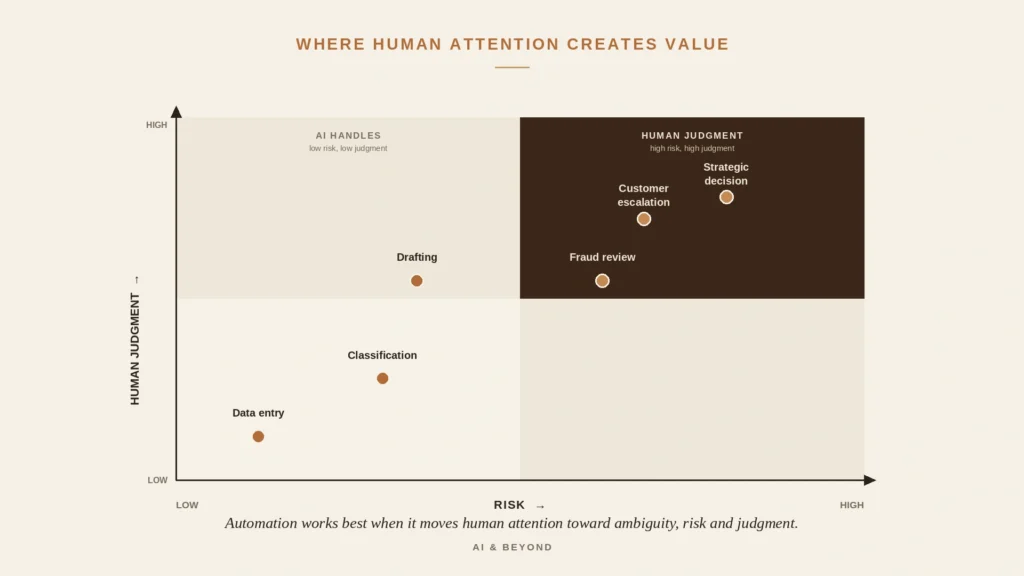
No single factor should trigger review on its own except the regulatory one. A low-risk, low-ambiguity, easily-reversible decision doesn’t need a human even if the dollar amount looks large a routine, well-understood transaction at $50,000 is often safer to automate than an ambiguous one at $500. The combination is what matters, and the practical move is to convert this table into a scoring rule: any case that crosses a defined risk-and-ambiguity threshold routes to a person; everything below it doesn’t, regardless of how it looks superficially.
The Human Judgment Gradient
Not every AI-assisted decision requires the same intensity of human involvement, and treating them uniformly is how organizations end up either over-reviewing routine work or under-reviewing risky work. It’s useful to think of human involvement as a gradient with five levels, moving from full machine execution to full human authority.
Level 1 Execute. The AI acts with no per-case human step. Example: an AI system auto-formats incoming invoices into a standard schema before they enter the accounting system. Errors are cheap to catch and cheap to fix downstream.
Level 2 Monitor. The AI acts autonomously, but a human watches aggregate performance and can intervene if patterns look wrong. Example: an AI system auto-responds to routine support tickets, while a team lead reviews a daily sample and tracks resolution and reopen rates.
Level 3 Recommend. The AI proposes a specific action; a human approves or rejects it before it takes effect. Example: an AI system flags a transaction as likely fraudulent and recommends a hold; a fraud analyst confirms or dismisses the flag before the account is affected.
Level 4 Assist. The AI provides analysis, options, or drafts, but the human makes the actual decision and can deviate from the AI’s suggestion entirely. Example: an AI system summarizes a loan applicant’s file and highlights risk factors; a loan officer makes the credit decision using that summary as one input among several.
Level 5 Decide. The human makes the decision largely independently; the AI’s role is limited to information retrieval or light support. Example: a physician makes a treatment decision for a complex case, using an AI system only to surface relevant literature.
The gradient isn’t a ranking of workflow maturity a Level 1 workflow isn’t “behind” a Level 5 one. It’s a match between the level of involvement and what the decision actually requires. The design failure isn’t landing at the wrong number in the abstract; it’s applying the wrong level to a specific decision running fraud holds at Level 1, or running invoice formatting at Level 4.
Where Human-in-the-Loop Creates the Most Value
The abstractions above become concrete once you look at how the boundary should sit in specific functions. The following are illustrative scenarios, not case studies of named organizations.
Customer support escalation. What AI does: resolves routine tickets end to end password resets, order status, standard policy questions. What the human does: takes over when a customer expresses frustration, requests a refund above a set threshold, or describes a problem the AI’s confidence score flags as unfamiliar. Why the boundary exists: a routine ticket handled well doesn’t need a person; a frustrated customer handled badly by a bot becomes a churn risk. If designed badly: every ticket routes to a human “to be safe,” support costs stay flat, and the AI investment produces no efficiency gain or the opposite failure, where escalation triggers are too narrow and angry customers get looped through bot responses until they leave.
Fraud detection. What AI does: scores every transaction in real time and auto-clears the overwhelming majority that fall well within normal patterns. What the human does: reviews the transactions that score in an ambiguous middle range not the obvious fraud (which the system can often block outright) and not the obviously clean transactions (which don’t need attention), but the genuinely uncertain cases. Why the boundary exists: analysts reviewing 100% of transactions can’t sustain the attention needed to catch the 2% that matter; analysts reviewing only the ambiguous middle can. If designed badly: the threshold for “ambiguous” is set too wide, and analysts drown in low-value alerts until they start clearing everything quickly without real scrutiny the automation-bias failure described earlier, produced by a human review step that exists in name only.
Healthcare administration. What AI does: drafts clinical documentation, codes visits, and flags likely billing errors before claims submission. What the human does: a clinician confirms that documentation accurately reflects what happened in the visit; a coder confirms edge cases the AI flags as uncertain. Why the boundary exists: documentation errors can affect patient care records and reimbursement, and only the clinician who was in the room can confirm accuracy. If designed badly: clinicians rubber-stamp AI drafts without reading them closely, because the review step was added for compliance optics rather than genuine oversight a well-documented risk in any workflow where review volume outpaces review time.
Enterprise content approval. What AI does: generates first drafts of marketing copy, internal communications, or knowledge-base articles against brand and compliance guidelines. What the human does: reviews content that touches regulated claims, pricing, legal language, or anything customer-facing above a defined visibility threshold; lower-stakes internal drafts publish automatically. Why the boundary exists: a factual error in a regulated claim carries legal exposure; a typo in an internal Slack summary doesn’t. If designed badly: every piece of AI-generated content internal and external routes through legal, and the review queue becomes the new bottleneck the AI was supposed to remove.
Sales qualification. What AI does: scores and routes inbound leads, drafts outreach, and schedules qualified prospects directly onto a rep’s calendar. What the human does: the rep takes over the moment a prospect asks a pricing or contractual question the AI isn’t authorized to answer definitively. Why the boundary exists: qualification is largely pattern-matching against known signals well suited to automation while negotiation requires reading a specific person’s priorities, which the AI has limited ability to do. If designed badly: the AI is allowed to make informal commitments about pricing or terms that the sales org later has to honor or awkwardly walk back.
AI agents. What AI does: plans and executes multi-step tasks autonomously querying systems, drafting outputs, chaining tool calls. What the human does: approves the agent’s action before anything irreversible happens sending an external communication, executing a financial transaction, modifying a production system and reviews the agent’s plan when it deviates from expected patterns. Why the boundary exists: agentic systems compound errors across steps in ways single-turn AI systems don’t; an early misstep can cascade before anyone notices. If designed badly: the agent operates with standing permissions broad enough to take irreversible actions with no checkpoint, and the first anyone learns of a problem is after it has already happened.
Across every example, the pattern repeats: automation handles volume and pattern-recognition; humans handle exceptions, ambiguity, and anything the organization would need to defend later.
The Economics of Human Attention
It’s worth stating the goal precisely, because it’s easy to get backwards. The goal of AI automation is not to eliminate human involvement. It’s to spend human attention where it produces the most value and to stop spending it where it doesn’t.
That distinction changes how you’d evaluate three approaches to the same workflow.
A 100% manual workflow puts a person on every case. Decision quality per case can be high, because a human is genuinely engaged with each one but only up to a point. Beyond a certain volume, fatigue, repetition, and time pressure degrade that same judgment. A person reviewing their four-hundredth near-identical case of the day is not bringing the same attention as their fourth.
An AI-assisted workflow has a human review every AI output before it takes effect. This looks safer than full automation, and for genuinely mixed-risk workflows it often is but it inherits the same fatigue problem as the manual workflow if the review volume is high and undifferentiated. A human reviewing a thousand AI drafts a day, most of which are fine, tends toward the same rubber-stamping behavior as a human reviewing a thousand cases with no AI involved.
An exception-based workflow routes the predictable majority straight through automation and reserves human attention for the cases that actually need it flagged by risk, ambiguity, or low model confidence. This is where the economics change: the same number of human-hours now cover a much smaller, much higher-signal set of cases, so the attention per case goes up rather than down. A team that used to review 1,000 cases a day at low intensity can review 80 cases a day at genuinely high intensity, using the same headcount.
The organizations that get the most value from automation aren’t the ones with the fewest humans in the workflow. They’re the ones whose humans spend the least time on decisions a machine could have made just as well, and the most time on the decisions that actually needed them.
Designing the Right Human-AI Boundary
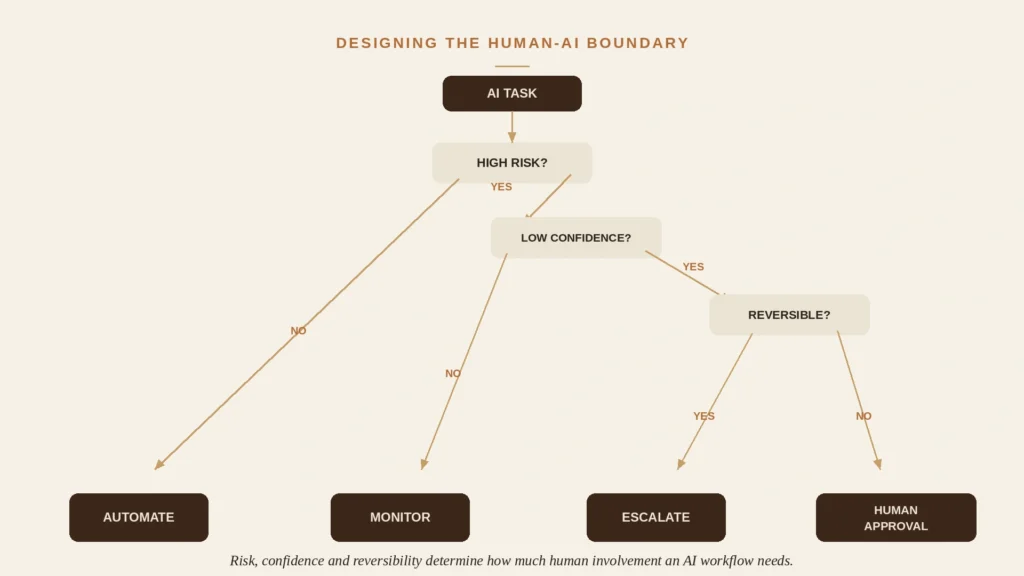
Turning the ideas above into something a business leader can apply to an existing workflow requires a repeatable framework, not a one-off judgment call. Six factors determine where a specific decision should sit:
- Risk the severity of a plausible worst-case outcome
- Confidence how certain the AI system is about this specific case, not its average accuracy
- Complexity how many variables and how much context the decision genuinely requires
- Reversibility how easily the action can be undone if it’s wrong
- Cost of error the financial, legal, or reputational cost of a mistake
- Human expertise whether the domain has established human expertise that meaningfully outperforms the model, or whether the model has actually caught up
These six factors map onto four possible dispositions for any given decision:
Automate. Low risk, high confidence, low complexity, reversible, low cost of error. The AI executes without a per-case checkpoint. Formatting, routing, and well-bounded classification tasks typically land here.
Monitor. Moderate risk but high confidence and strong reversibility. The AI executes, and a human reviews aggregate patterns rather than individual cases. Most high-volume, low-variance operational workflows land here.
Escalate. Low confidence on this specific case, regardless of the task’s average risk profile. The AI recognizes it’s operating outside its reliable range and routes to a human rather than guessing. This is arguably the most underused disposition many systems are built to always act or always ask, with no path for “I’m not sure about this particular one.”
Require human approval. High risk, low reversibility, high cost of error, or a regulatory requirement. The AI prepares the action; a human must authorize it before it takes effect. Financial commitments, irreversible external actions, and anything with a hard compliance requirement belong here by default.
A practical way to apply this: take an existing workflow, list its individual decision points rather than treating it as one block, and score each against the six factors. Decisions that cluster in the “automate” corner are candidates for immediate automation. Decisions that cluster in “require approval” should stay there regardless of how much the AI improves reversibility and regulatory status don’t change with model accuracy. The interesting work happens in the middle, where confidence and complexity determine whether a decision belongs in “monitor” or “escalate,” and that’s where most organizations should focus their design time.
What Goes Wrong When the Boundary Is Poorly Designed
1. Humans become approval bottlenecks. Why it happens: every AI output routes through a human “to be safe,” without regard to whether that specific output carries real risk. Better approach: apply the automate/monitor/escalate/approve framework above so approval is reserved for decisions that actually warrant it.
2. Humans stop reviewing AI outputs. Why it happens: review volume is high and the AI is usually right, so reviewers default to approving without close reading automation bias in practice. Better approach: reduce review volume to genuinely ambiguous cases, and track approval rates; a reviewer approving 99.8% of cases without variance is a signal the review step has stopped functioning.
3. AI escalates too many cases. Why it happens: confidence thresholds are set conservatively, often after an early mistake prompts an overcorrection. Better approach: recalibrate thresholds against actual outcome data rather than anecdote, and treat an escalation rate that keeps climbing as a signal the model or the workflow needs attention, not just the threshold.
4. AI escalates too few cases. Why it happens: confidence thresholds are set to minimize human workload rather than to genuinely reflect where the model is reliable. Better approach: audit a sample of auto-approved decisions the model didn’t escalate, specifically looking for cases that should have been flagged.
5. Nobody knows who is accountable. Why it happens: the workflow was designed around what the AI does, without explicitly assigning a human owner for outcomes at each disposition. Better approach: name an accountable owner for every escalation path before launch, not after an incident forces the question.
6. Employees become overly dependent on AI. Why it happens: the human role narrows to approving AI suggestions so consistently that the underlying skill atrophies, leaving no one able to catch a wrong suggestion when it appears. Better approach: deliberately preserve some fully human-decided cases in Level 4 and 5 work, even when the AI could plausibly handle more, to keep judgment sharp.
7. Automation increases volume instead of reducing work. Why it happens: automation lowers the cost of generating outputs drafts, leads, tickets faster than the organization’s capacity to review or act on them, so total human workload doesn’t fall; it shifts and often grows. Better approach: set automation goals around outcomes (resolved tickets, closed deals) rather than outputs (drafts produced, leads generated), and monitor downstream review queues as a first-class metric, not an afterthought.
Human-in-the-Loop vs Human-on-the-Loop
| Human-in-the-Loop | Human-on-the-Loop | |
|---|---|---|
| Decision authority | Human approval required before the action takes effect | AI acts independently; human can override after the fact |
| Speed | Slower every case waits on a human step | Fast no per-case delay |
| Risk profile | Suited to high-risk, low-reversibility decisions | Suited to lower-risk, reversible, high-volume decisions |
| Scalability | Limited by human review capacity | Scales with system capacity, not headcount |
| Human workload | Concentrated on individual case review | Concentrated on pattern monitoring and sampling |
| Best use cases | Fraud holds, clinical documentation, regulated approvals, irreversible agent actions | Content ranking, routine transaction processing, high-volume classification |
Neither model is categorically safer. HOTL applied to a genuinely high-risk, irreversible decision is negligent. HITL applied to a low-risk, high-volume, reversible decision is expensive theater. The right question for any decision is which of these two columns actually matches its risk and reversibility profile not which one sounds more cautious.
Building a Human-in-the-Loop AI Workflow
1. Map the current workflow. Break it into its individual decision points rather than treating it as a single process. A workflow that looks like one thing on a process diagram is usually five or six distinct decisions in practice.
2. Identify decisions, not just steps. Some steps in a workflow are pure execution no real decision is being made. Focus the rest of this process only on points where a choice with more than one reasonable outcome actually occurs.
3. Classify risk for each decision. Score each decision point against the risk, reversibility, and cost-of-error factors covered earlier. This produces a rough disposition automate, monitor, escalate, or approve before any AI system is even built.
4. Measure AI confidence, not just accuracy. Average model accuracy across a whole task category tells you little about any specific case. Build the system to expose a per-case confidence signal, and use that signal not the task’s average performance to trigger escalation.
5. Define escalation rules explicitly. Write down, in advance, exactly what confidence threshold, risk flag, or policy condition sends a case to a human. Undocumented, ad hoc escalation logic is the most common source of the “too many” or “too few” failures covered above.
6. Assign human ownership. Every escalation path needs a named accountable role, not a queue that anyone might pick up. Ambiguous ownership is how flagged cases sit unresolved.
7. Monitor outcomes, not just volume. Track not just how many cases were escalated or automated, but what happened after error rates, reversal rates, customer complaints, reviewer approval rates. Volume metrics alone hide the failures described earlier.
8. Continuously adjust the boundary. The right disposition for a decision today may not be right in six months, as model performance improves, as regulation shifts, or as the business’s risk tolerance changes. Treat the boundary as a setting to be revisited on a schedule, not a decision made once at launch.
The Future Isn’t Human vs AI
As AI agents take on longer, more autonomous multi-step tasks, the question of where humans belong doesn’t get smaller. It gets more consequential, because agentic systems can compound a bad early decision across many downstream steps before anyone notices. McKinsey’s research on enterprise AI adoption found that the organizations extracting the most measurable value from AI were also the ones most likely to have human-in-the-loop rules, centralized oversight, and executive accountability built into how they manage risk governance and performance moving together, not traded off against each other.
That’s the pattern worth taking seriously. The organizations winning with AI aren’t the ones automating the most. They’re the ones that have gotten specific about which decisions belong to machines, which belong to people, and which belong to both at the same time, at different points in the same process.
Mature AI adoption isn’t a race to remove humans from the loop. It’s a discipline of deciding, decision by decision, where the loop needs a human at all and building the system to make that boundary explicit, monitored, and adjustable rather than assumed.
Comparison Table: Five Workflow Models
| Human-Only | AI-Assisted | Human-in-the-Loop | Human-on-the-Loop | Fully Automated | |
|---|---|---|---|---|---|
| Speed | Slow | Moderate | Moderate | Fast | Fastest |
| Human involvement | Total | High, per case | Selective, per case | Low, aggregate | None, per case |
| Risk | Low per case, high fatigue risk at volume | Low, if review stays genuine | Low for the decisions it covers | Moderate depends on monitoring quality | Depends entirely on system reliability |
| Scalability | Poor | Limited by review capacity | Limited by escalation volume | High | Highest |
| Best use cases | Novel, high-stakes, precedent-setting decisions | Mixed-risk workflows with moderate volume | High-risk, low-reversibility decisions | High-volume, reversible, well-understood decisions | Low-risk, high-volume, well-bounded tasks |
| Typical failure mode | Burnout, inconsistency, doesn’t scale | Reviewer fatigue → rubber-stamping | Escalation thresholds miscalibrated | Under-monitoring → drift goes unnoticed | Errors compound with no checkpoint |
FAQ
What does human-in-the-loop mean in AI? It describes a workflow where a human must review, approve, or intervene at a defined point before an AI-driven action takes effect as distinct from a human simply monitoring the system after the fact.
Is human-in-the-loop the same as human oversight? Human-in-the-loop is one specific form of human oversight the form where a human sits inside the execution path. Human-on-the-loop and periodic auditing are also forms of oversight, but with the human positioned differently relative to the action.
When should humans approve AI decisions before they take effect? When the action is high-risk, hard to reverse, expensive to get wrong, or legally required to have a named human decision-maker. Low-risk, reversible, high-volume decisions generally don’t need per-case approval.
Does human-in-the-loop reduce automation? Not necessarily. A well-designed system automates the majority of a workflow’s decisions and reserves human-in-the-loop review for the minority that actually need it the goal is targeted oversight, not blanket slowdown.
What is the difference between human-in-the-loop and human-on-the-loop? Human-in-the-loop requires human approval before an action proceeds. Human-on-the-loop lets the AI act independently while a human monitors and retains the authority to intervene or override.
How do companies decide when AI should escalate to a human? Through explicit rules combining the system’s confidence in a specific case with the decision’s risk, reversibility, and cost of error not a single blanket threshold applied to an entire task category.
Can AI agents operate with human-in-the-loop systems? Yes, and it becomes more important as agents take on multi-step, autonomous tasks. The usual pattern is requiring human approval before irreversible actions external communications, financial transactions, production changes while letting the agent plan and execute lower-risk steps independently.
How should organizations measure human-in-the-loop performance? Beyond volume metrics like cases reviewed, track reviewer approval-rate variance (a flatlined near-100% rate suggests rubber-stamping), reversal rates on automated decisions, and outcomes for escalated versus automated cases over time.
Bottom Line
The debate over AI automation keeps asking whether humans should stay involved. That was never really the question. The organizations building AI systems that hold up over time have stopped treating human oversight as a safety switch to leave on or off, and started treating it as a design decision made one workflow, one decision point, at a time.
The goal was never to eliminate human judgment. It’s to make the judgment that remains more selective, better informed, and applied to the decisions that were actually worth a person’s attention in the first place. Everything else the formatting, the routing, the well-understood, reversible, low-stakes majority of the work was never where the judgment was needed. Freeing it up isn’t a reduction in human involvement. It’s a redirection of it, toward the parts of the job that were always the reason to have a person in the room.
