
RAG vs Fine-Tuning: What Marketers Need to Know

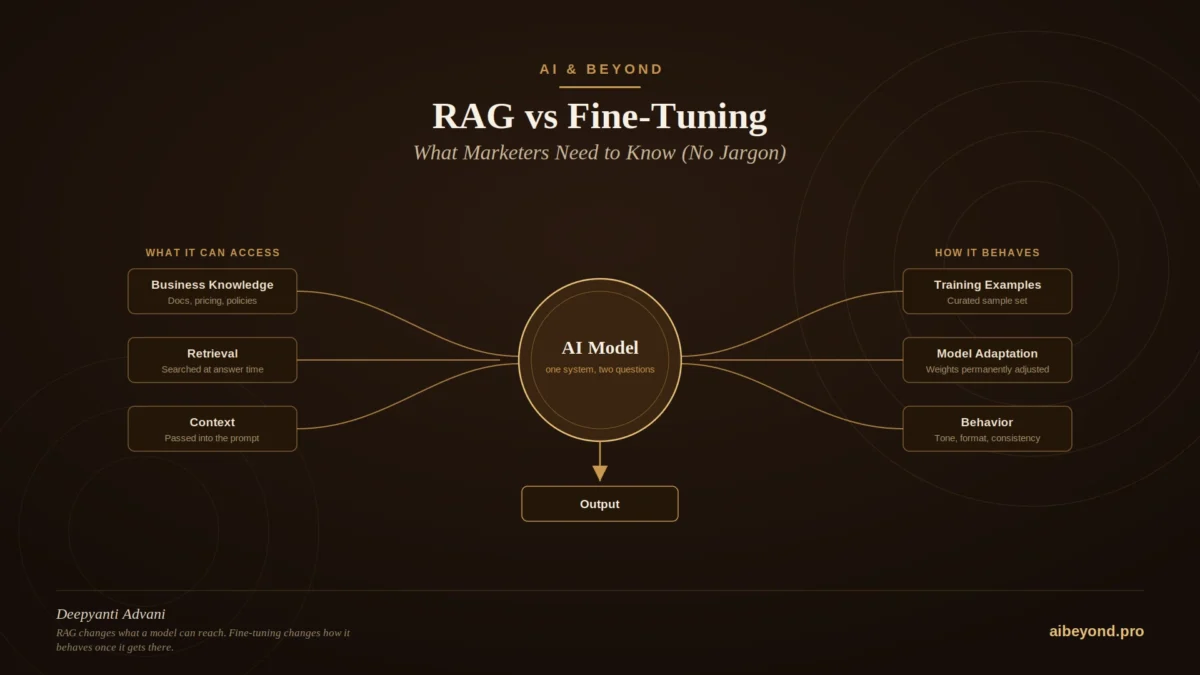
Marketers don’t need the math behind RAG or fine-tuning. They need to know how AI should use business knowledge. Here’s the plain-language guide.
Every company that adopts AI eventually asks the same question: how do we get it to actually know our business? The instinct is almost always the same feed it more. More documents. More product sheets. More brand guidelines, transcripts, spreadsheets, and PDFs, uploaded in the hope that volume will translate into understanding.
It rarely does. A model handed a thousand pages of internal material doesn’t become a thousand pages smarter. It becomes, more often, slower, less consistent, and occasionally confident about something that was true eighteen months ago and isn’t anymore.
The instinct isn’t wrong, exactly. Businesses do have knowledge an AI system needs. The mistake is assuming there’s one way to give it that knowledge, and that “more information” is a strategy rather than a starting point.
There are, in practice, a small number of distinct answers to that question and they behave very differently. One lets a model look something up right before it answers. Another changes how the model behaves, permanently, based on examples it was shown once. A third simply tells the model what it needs to know for this one conversation, and nothing more.
Marketers rarely need to understand the engineering underneath any of this. What they need is a working sense of a much narrower question: does the AI need to know something, or does it need to do something differently? Those are not the same problem, and they don’t have the same solution.
That distinction is the actual subject of this guide not the mathematics of retrieval or the mechanics of model training, but the decision underneath them.
In this guide, we’ll cover:
- What RAG actually does
- What fine-tuning actually does
- Prompting vs RAG vs fine-tuning, compared directly
- When each approach makes sense and when it doesn’t
- Cost and maintenance realities
- Common mistakes companies make
- A practical decision framework
- What this means for marketing teams specifically
What Problem Are You Actually Trying to Solve?
Most companies skip a step. They hear “AI” and jump straight to a technology decision should we fine-tune, should we build a retrieval system before establishing what’s actually broken.
It helps to separate four different problems that get bundled together under “the AI doesn’t know our business.”
A knowledge problem means the model lacks specific facts: current pricing, this quarter’s campaign calendar, a customer’s account history. A behavior problem means the model has the facts but produces the wrong kind of output off-brand tone, the wrong format, inconsistent structure. A context problem means the model needs information relevant to this one task, not permanently a single brief, a single customer conversation. A workflow problem isn’t a model problem at all; it’s a process that hasn’t been designed, and no amount of retrieval or training fixes a workflow that doesn’t exist.
Most “AI doesn’t understand us” complaints are actually one of these four, misdiagnosed as a single, vaguer thing. The technology choice becomes obvious once the problem is named correctly which is precisely why so many companies get it backwards.
RAG, Without the Jargon
Retrieval-augmented generation is easier to understand as a habit than as an architecture. Imagine a sharp new hire who hasn’t memorized the company handbook, but who’s been given the ability to search it before answering any question. They don’t know your refund policy off the top of their head but they know where to look, and they read the current version every time, not whatever they remember from onboarding.
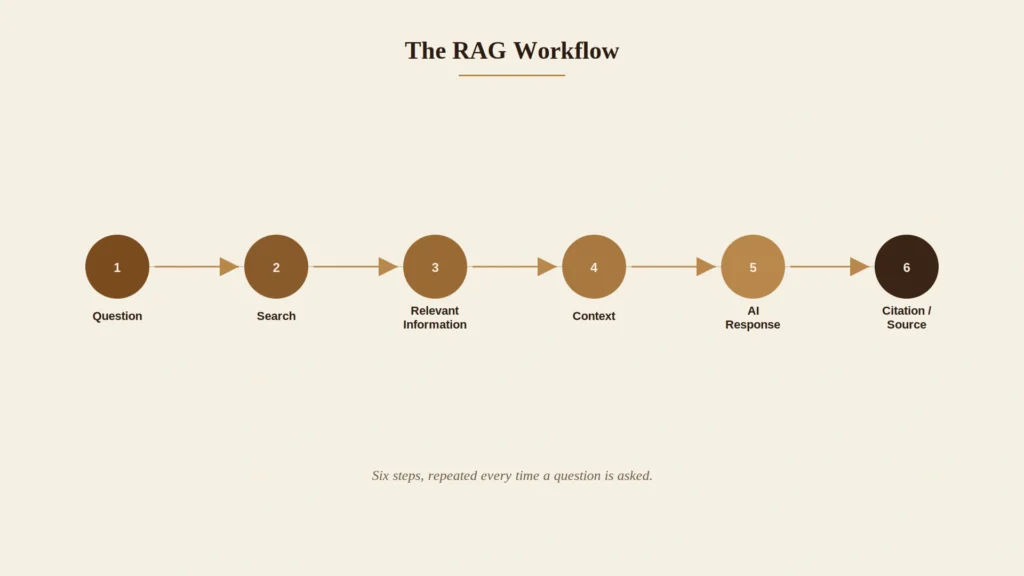
That’s RAG. The sequence is simple: a question comes in, the system searches a knowledge source for the most relevant material, that material gets handed to the model as context, and the model generates an answer grounded in what it just read.
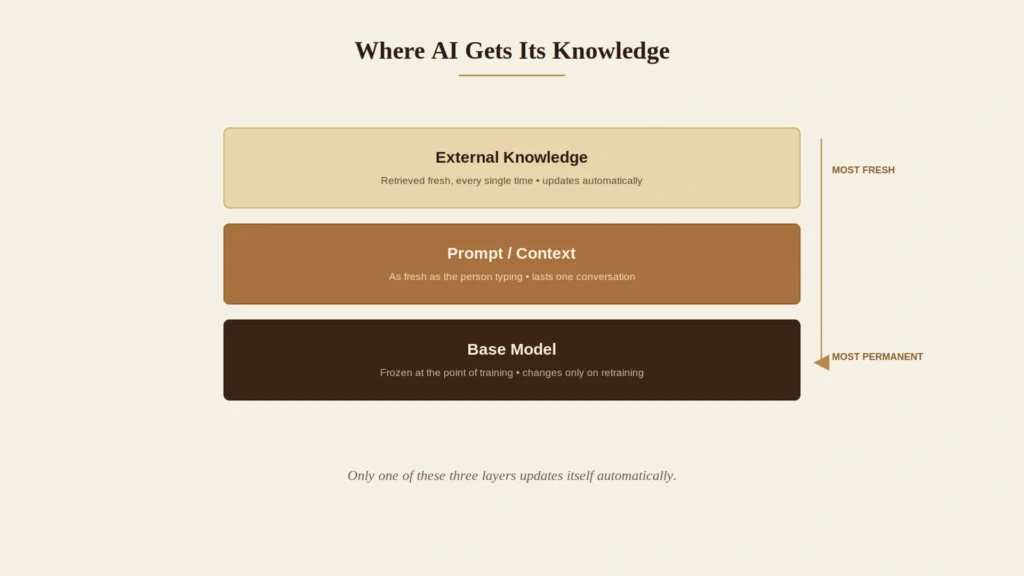
Two things make this valuable. First, freshness because the model is reading current material rather than relying on what it memorized during training, an update to a pricing page or a policy document is reflected the moment someone asks, not the next time a model is retrained. Second, traceability because the answer is built from retrieved material, it’s usually possible to show what that material was, which matters when accuracy and sourcing are non-negotiable.
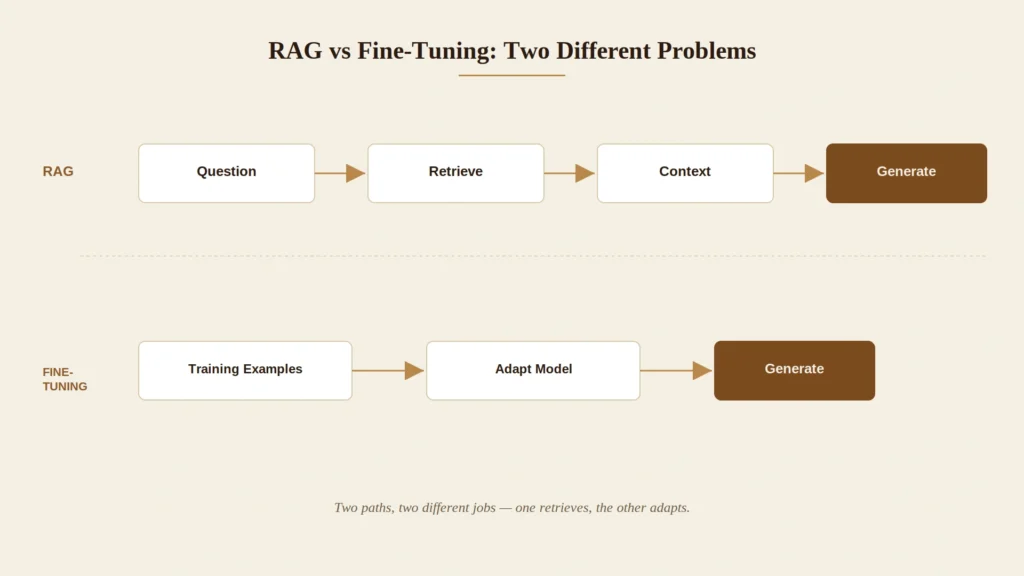
What RAG does not do is teach the model anything permanently. Nothing about the model’s underlying behavior, tone, or reasoning changes. It’s an information supply chain, not an education. Turn off the retrieval system and the model reverts to knowing exactly what it knew before which is either RAG’s biggest strength or its most misunderstood limitation, depending on what a company expected from it.
Fine-Tuning, Without the Jargon
Fine-tuning solves a different kind of problem. Rather than feeding a model more to read at the moment of answering, it customizes a model’s output for a specific use case by giving it additional rounds of training on a smaller, targeted dataset and adjusting its underlying parameters based on that training.
Where RAG changes what a model can look up, fine-tuning changes how it behaves once it’s done looking. A fine-tuned model can be shaped to consistently write in a specific brand voice, output data in a rigid structural format, classify incoming requests using a company’s internal taxonomy, or handle a narrow, repetitive task with less prompting required each time.
Here’s the distinction that trips up most non-technical teams: fine-tuning does not automatically give a model current, factual knowledge about the business. A model fine-tuned on last year’s product catalog doesn’t know about this year’s product catalog the training examples taught it a pattern, not an updating fact base. It won’t reliably know new pricing, and it offers no built-in mechanism for citing where an answer came from.
A concrete example: a retail brand fine-tunes a model on a thousand examples of its product descriptions, teaching it the brand’s specific tone, structure, and vocabulary. The result is a model that reliably writes new product copy in the house style, with far less prompting. It’s still the wrong tool for keeping that copy factually current if pricing or inventory changes weekly, the model doesn’t know that unless something else tells it.
Prompting vs RAG vs Fine-Tuning
The three approaches solve different layers of the same problem, and the comparison is where the decision usually becomes clear.
| Prompting | RAG | Fine-Tuning | |
|---|---|---|---|
| What changes | Nothing in the model; instructions given per request | What the model can access at answer time | How the model behaves, permanently |
| Knowledge | Only what’s typed into the prompt | Whatever is in the retrieval source, kept current | Frozen at the point of training |
| Freshness | As fresh as the person typing | High reflects live source updates | Low requires retraining to update |
| Complexity to implement | Lowest | Moderate needs a search/retrieval pipeline | Higher needs curated training data |
| Ongoing maintenance | None | Keep the knowledge source current | Retrain periodically |
| Best for | One-off tasks, small context | Fact-heavy, frequently changing knowledge | Consistent behavior, tone, structure |
The pattern worth noticing: prompting and RAG both supply information at the moment of use. Fine-tuning changes what the model is. That single distinction resolves most “which one do we need” arguments before they start.
When RAG Is the Better Choice
Product documentation that updates often. Support and sales teams need answers that reflect this week’s specs, not last quarter’s. RAG pulls from the live source; the limitation is that answer quality depends entirely on how well that source is organized.
Pricing and inventory questions. Numbers that change daily are a poor fit for anything trained into a model’s weights. RAG’s limitation here is latency retrieval adds a small delay a fine-tuned model wouldn’t have.
Internal knowledge bases. Onboarding material, brand guidelines, campaign archives RAG makes these searchable in natural language. The limitation is retrieval quality: a poorly indexed knowledge base produces confidently wrong answers just as easily as a well-indexed one produces good ones.
Customer research and past campaign data. Marketers asking “what did we learn from last year’s holiday campaign” need retrieval over the archive, not a model that memorized fragments of it. The limitation is that stale or duplicate documents in the source degrade every answer pulled from them.
When Fine-Tuning Is the Better Choice
Consistent brand voice at scale. A content team producing hundreds of product descriptions a month benefits from a model that reliably writes in-house style without re-explaining it every time.
Structured, repetitive classification. Tagging inbound leads, categorizing support tickets, routing content by campaign type tasks with a fixed, specialized output format are a strong fit.
Domain-specific pattern recognition where the pattern itself, not the underlying facts, is what needs to be learned recognizing the shape of a well-written headline for a specific audience, for instance.
Fine-tuning is unnecessary when the real problem is knowledge freshness, when task volume is too low to justify curating training data, or when a well-written prompt already gets a good enough result. A surprising share of “we need to fine-tune” requests are solved by a better prompt and nothing else.
When You Should Use Both
RAG and fine-tuning aren’t competitors; they answer different questions. Fine-tuning shapes how the model behaves its tone, format, and reasoning patterns. RAG determines what information it can reach when it behaves that way.
A support system fine-tuned to respond in a specific, calm, on-brand style and connected via RAG to a constantly updating product and policy database gets both halves: consistent behavior, current facts. Neither approach alone gets there.
The Knowledge-Behavior Framework
A simpler way to make this decision: ask two questions, not five.
Does the information change? If yes, and the model needs to reflect that change without retraining, that’s a retrieval problem lean RAG.
Does the behavior need to change? If yes tone, format, consistency, a specialized task pattern that’s a training problem lean fine-tuning.
If the honest answer to both is yes, the answer is both. If the honest answer to both is no, the likely answer is that a well-constructed prompt already solves it, and neither RAG nor fine-tuning is needed yet.
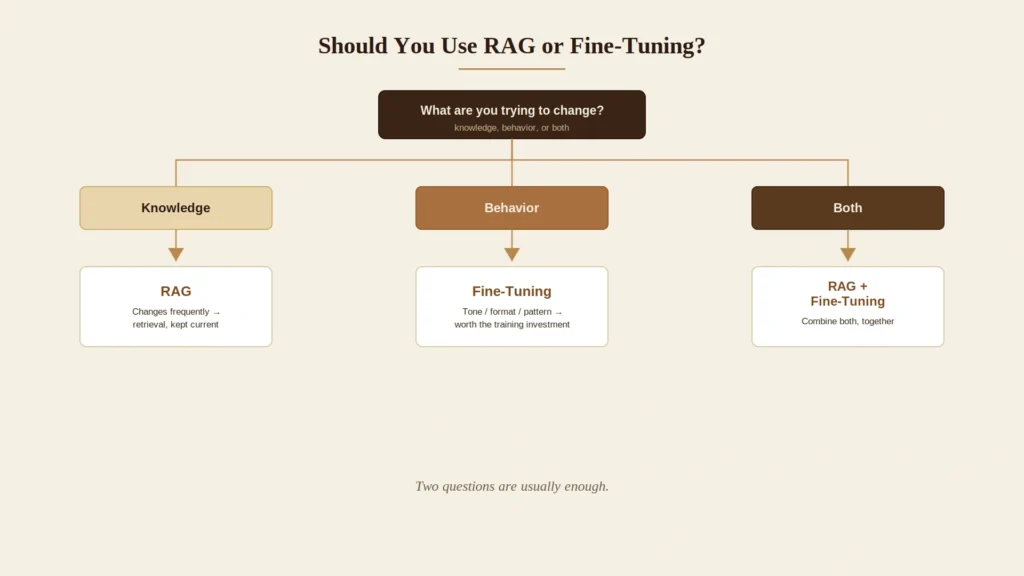
Decision path:
- What are you actually trying to change knowledge, behavior, or both?
- Knowledge → does it change frequently? If yes, RAG. If it’s stable and small, a good prompt may suffice.
- Behavior → is it a formatting/tone/classification pattern, worth the investment at your task volume? If yes, fine-tuning.
- Both → combine them, with fine-tuning handling behavior and RAG handling live facts.
Common Mistakes Companies Make
Fine-tuning when RAG would have worked. Teams reach for training because it sounds more sophisticated, then discover the model still doesn’t know this quarter’s numbers because that was never a training problem.
Treating RAG as an accuracy guarantee. RAG reduces certain kinds of error, but a retrieval system built on disorganized or duplicated source documents will confidently retrieve the wrong thing.
Measuring model performance instead of business outcomes. A model that scores well on internal benchmarks but doesn’t change how fast a campaign ships hasn’t solved the actual problem.
Ignoring ongoing maintenance. RAG needs its knowledge source kept current; fine-tuning needs periodic retraining. Both were treated, in more than one project, as one-time setup costs they aren’t.
Solving a workflow problem with a model change. No retrieval system or fine-tuned model fixes a process where nobody owns the approval step.
What This Means for Marketers
Translated into day-to-day terms: brand voice and formatting consistency are usually fine-tuning territory. Product data, pricing, campaign performance, and customer research are usually RAG territory. Personalization efforts frequently need both a consistent tone (fine-tuning) applied to current, individual customer context (retrieval).
For content teams specifically, the practical takeaway is that “training the AI on our content” and “giving the AI access to our content” are different investments with different payoffs, and conflating them is where most AI content projects lose months.
Where This Is Headed
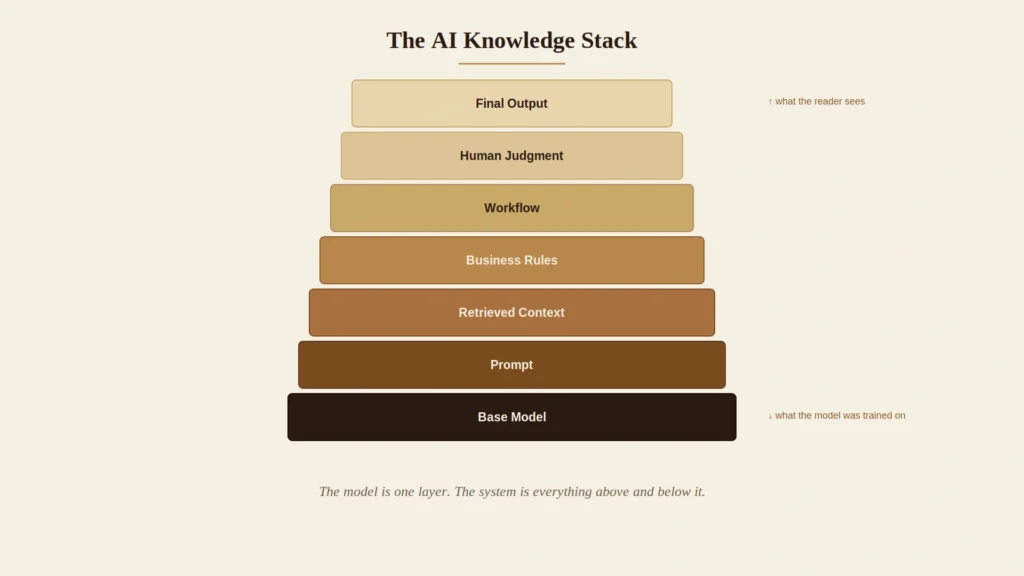
The near-term direction is less about choosing one approach and more about systems that combine both by default agents that retrieve current information as a matter of course while also being shaped, through targeted fine-tuning, to behave consistently within a specific domain. Smaller, more specialized models paired with strong retrieval are becoming a common pattern precisely because they avoid over-investing in training for problems retrieval solves more cheaply. None of this removes the need for the underlying diagnostic question knowledge or behavior it simply means more systems will eventually do both without a team having to choose upfront.
FAQ
Is RAG better than fine-tuning? Neither is categorically better they solve different problems. RAG is generally better for current, changing facts; fine-tuning is generally better for consistent behavior and format.
Is RAG cheaper than fine-tuning? Usually cheaper to start, since it doesn’t require curating a training dataset. But RAG has ongoing costs tied to maintaining the knowledge source, so “cheaper” depends on the time horizon.
Does RAG train the AI model? No. RAG supplies information at the moment of answering; it doesn’t change the model’s underlying weights or behavior.
When should marketers consider fine-tuning? When a task is high-volume, repetitive, and needs consistent tone, structure, or classification that prompting alone struggles to maintain reliably.
Can RAG use private company data? Yes that’s its primary use case, connecting a model to internal documents, databases, or knowledge bases that weren’t part of its original training.
Can RAG and fine-tuning be used together? Yes, and for many production systems, this combination sometimes called retrieval-augmented fine-tuning outperforms either approach alone.
What should a company try first? Prompting, almost always. It’s the fastest way to discover whether the real gap is knowledge, behavior, or something a better-designed workflow would fix without either technology.
The Bottom Line
The question companies keep asking “which technology is smarter” is the wrong one. RAG doesn’t make a model smarter; it makes more information reachable. Fine-tuning doesn’t make a model smarter either; it makes its behavior more consistent. Neither adds intelligence. Both add precision, in different places.
The question worth asking instead is simpler and more useful: what does this system need to know, and what does it need to do differently? Answer that first, and the technology choice tends to answer itself.
