
The AI Tool Sprawl Problem: How Marketing Teams Are Consolidating

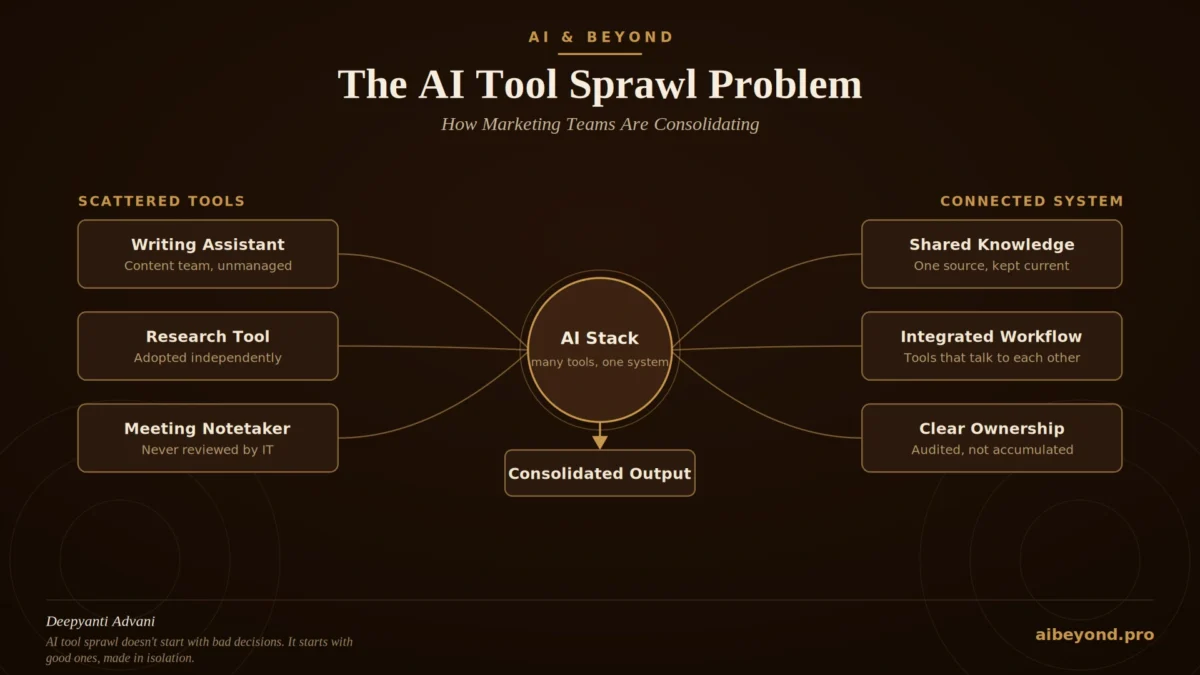
Marketing teams didn’t run out of AI tools they ran out of ways to connect them. Here’s how smarter teams are auditing, consolidating, and rebuilding their AI stack.
The average marketing team’s problem, in 2026, is rarely a shortage of AI. It’s the opposite. Somewhere between the writing assistant procured last spring, the research tool a strategist found on their own, the meeting notetaker IT never signed off on, and the analytics copilot bundled into a platform renewal, most teams have quietly accumulated more AI than anyone can account for.
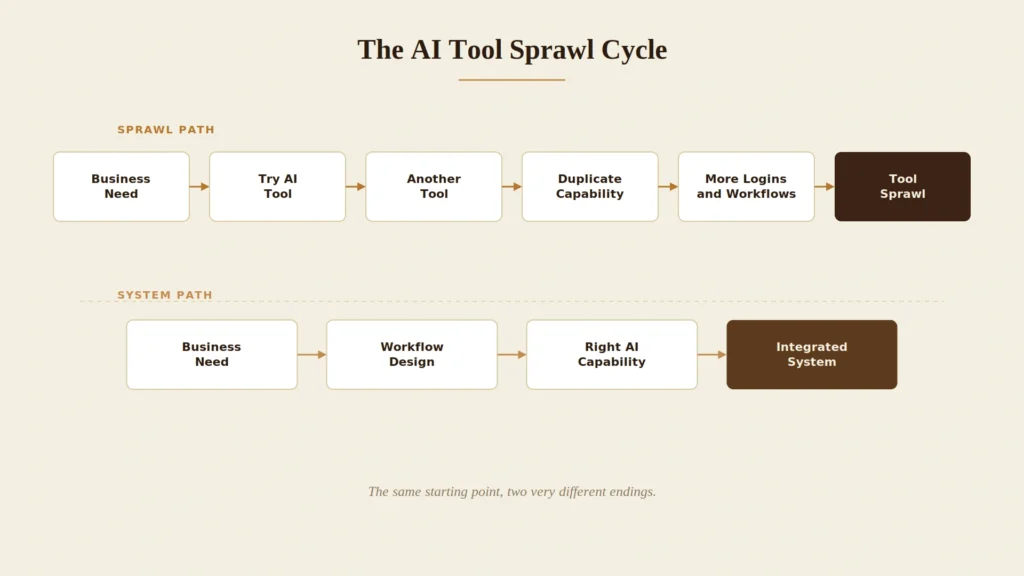
That accumulation didn’t happen through a single bad decision. It happened the way most infrastructure problems happen one reasonable choice at a time. A content lead trials a writing tool and it sticks. A researcher finds a summarization tool that saves an afternoon a week. A campaign manager adopts an image tool because the free trial solved a real, immediate problem. None of these decisions looks wrong in isolation.
The trouble shows up later, and it doesn’t look like failure it looks like friction. A campaign brief that has to be copied between three interfaces before it’s usable. A brand voice that shifts slightly depending on which tool wrote which section. A finance team that discovers a subscription during a budget review, not a planning meeting. None of it is dramatic. All of it adds up.
AI was supposed to remove steps from a marketer’s day. Instead, for a growing number of teams, each new AI tool quietly adds one back another login, another interface to learn, another output format that doesn’t match the last one, another approval nobody remembers assigning.
That’s the paradox worth sitting with before reaching for another product: more AI tools does not reliably mean more productive marketing. Past a certain point, it can mean the opposite a team spending more time managing its tools than doing the work the tools were bought to help with.
None of this is an argument for eliminating AI tools wholesale. It’s an argument for knowing the difference between healthy experimentation and uncontrolled accumulation and for having a real method to tell them apart.
In this guide, we’ll cover:
- What AI tool sprawl actually is, and what it isn’t
- Why marketing teams keep adding tools, even rationally
- The hidden costs sprawl creates
- A practical audit framework
- Consolidate, integrate, or eliminate three distinct paths
- What a leaner AI stack looks like structurally
- Common mistakes teams make when trying to fix this
- Where the AI stack is headed next
When Experimentation Becomes Sprawl
Not every new AI tool is a symptom of a problem. A team piloting three writing assistants for a month, comparing them against a real brief, and picking one is healthy experimentation a deliberate, time-boxed search for the right fit.
AI tool sprawl is what happens when that process never closes. Tools accumulate without a decision ever being made to keep them. Three writing assistants get used by three different people because nobody compared them directly. A research tool renews automatically because canceling it requires finding out who owns the account. The stack grows, but nobody could produce an accurate list of what’s actually running if asked this afternoon.
The distinction isn’t the number of tools. It’s whether each one is there by decision or by drift. A team of twelve running four well-integrated AI tools, each with a clear owner and a measurable job, is in a healthier position than a team running four tools total but unable to say why any of them are still active.
Why Marketing Teams Keep Adding Tools
The forces behind sprawl are rational individually, which is exactly why they’re hard to resist collectively. Switching costs for AI products are low most start with a free trial and a credit card, not a procurement process. Departmental buying means marketing, sales, and support each independently discover tools that solve a piece of their own workflow, with no shared visibility into what the others already adopted. Capability overlap is common but invisible at the point of purchase a new tool’s writing feature looks distinct until someone notices it duplicates a feature already sitting inside a platform the team pays for. And there’s a softer pressure behind all of it: the sense that not adopting a visible new AI tool means falling behind, even when the team’s actual bottleneck has nothing to do with capability.
None of this is a story about poor judgment. It’s a story about a category that grew explosively one industry analysis tracked the number of available marketing AI tools roughly tripling in about two years, faster than any single team’s evaluation process could reasonably keep pace with.
The Hidden Cost of Too Many AI Tools
The costs of sprawl rarely show up on a single invoice, which is part of why they’re easy to underestimate.
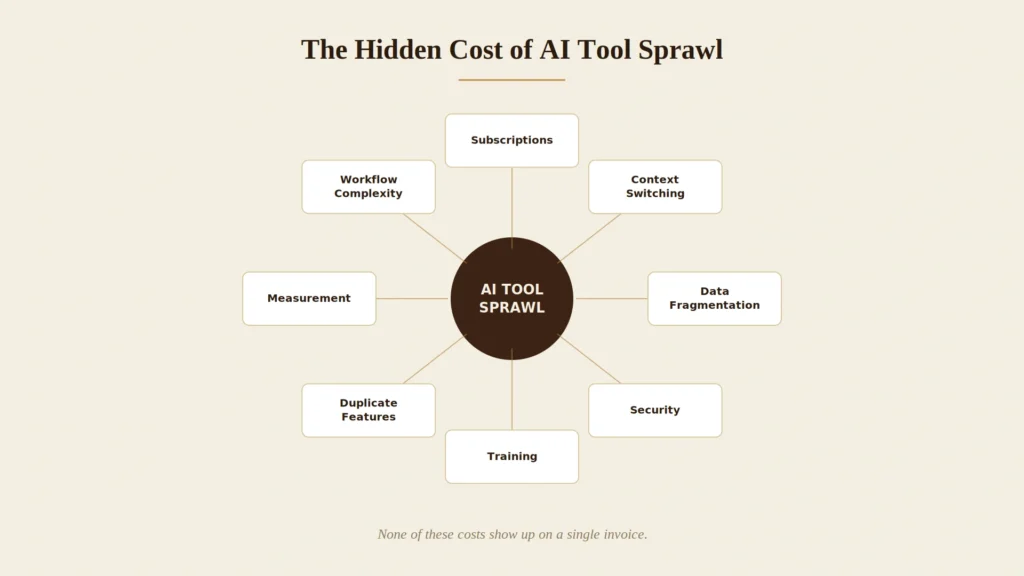
Subscription cost compounds quietly a handful of $30-a-month tools across a dozen people adds up to a real budget line that nobody planned deliberately. Context switching between four interfaces to complete one campaign task costs more attention than the time each switch appears to take. Data fragmentation means customer insight generated in one tool never reaches the workflow of another, so the same research gets redone instead of reused. Security and governance gaps open when tools are adopted outside IT review one recent industry analysis found that a large majority of AI tools in active enterprise use are unsanctioned by IT or security teams, which means most of a company’s actual AI footprint is often invisible to the people responsible for securing it. Training overhead rises with every additional interface a new hire has to learn. Inconsistent output voice, format, quality creeps in when different tools handle different parts of the same deliverable. And measurement becomes close to impossible when a result can’t be traced to a specific tool’s contribution.
One industry survey found tool sprawl and legacy-system integration now rank as a top adoption barrier for marketers, tied with data privacy concerns a signal that the fragmentation problem has become as significant as the trust problem it’s often discussed alongside.
The AI Stack Is a Workflow Problem, Not a Shopping List
The most useful reframe available to a marketing leader right now is this: the question is no longer “what AI tool should we buy?” It’s “where does this capability belong in the workflow, and does it need a new tool at all, or does an existing one already do this?”
Two disconnected tools performing adjacent steps of the same task can make a workflow longer than doing the whole thing in one system, even if each individual tool is fast. Speed at the tool level and speed at the workflow level are not the same measurement, and teams that only track the first one consistently overestimate how much AI has actually helped.
The AI Tool Audit
A workable audit doesn’t require sophisticated tooling it requires asking the same eight questions about every AI product a team currently pays for or actively uses:
Purpose what specific job is this solving? Users who actually uses it, not who was given a seat? Frequency daily, occasional, or dormant? Workflow role where does it sit in a larger process? Data access what does it see or store? Output what does it produce, and in what format? Integration does it connect to anything else the team uses? Overlap does another tool already do this?
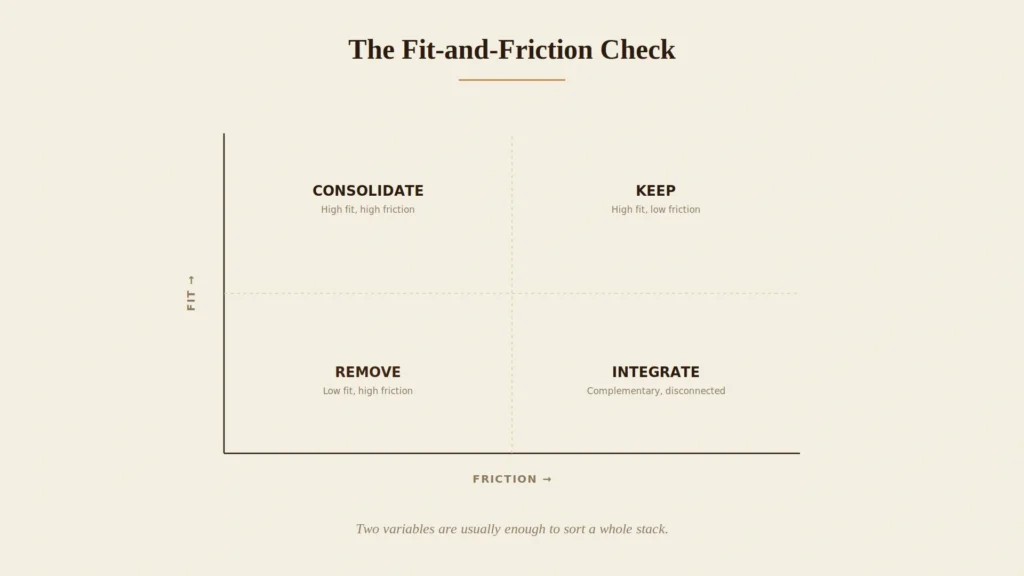
Call this the Fit-and-Friction Check for every tool, weigh what it genuinely contributes (fit) against what it costs the team in switching, duplication, and oversight (friction). A tool with strong fit and low friction stays without debate. A tool with weak fit and high friction is the clearest candidate for removal. Everything in between is where the real decisions happen and where the next section’s three paths come in.
Consolidate, Integrate, or Eliminate
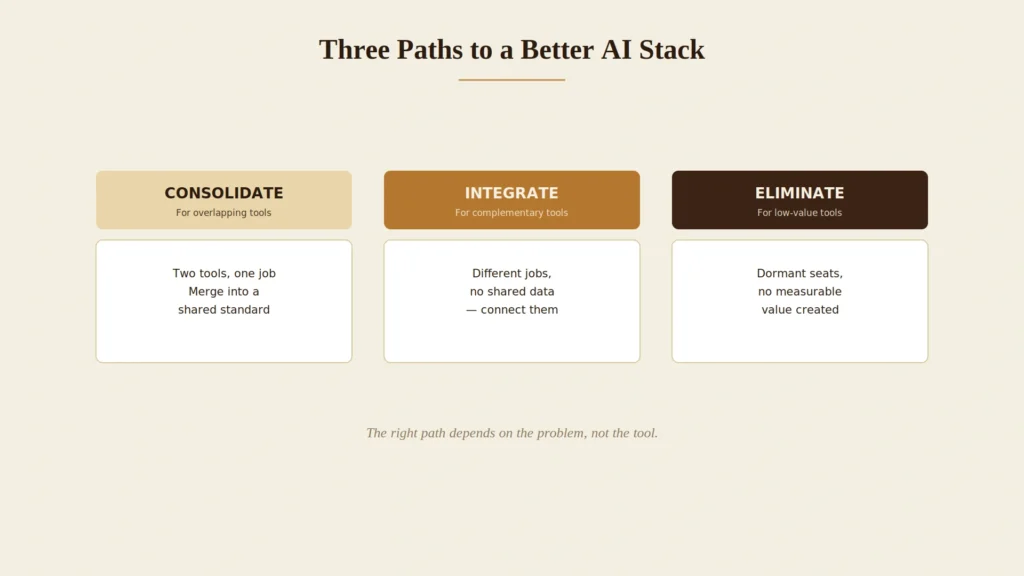
Consolidate applies when two or more tools solve the same problem for different people. A writing assistant used by content and a nearly identical one used by social should usually become one shared subscription with one shared standard, not two.
Integrate applies when tools are genuinely complementary but currently disconnected a research tool and a content tool that don’t share data, forcing someone to copy findings by hand between them. The fix isn’t removing either tool; it’s connecting them so information moves without a person acting as the pipe.
Eliminate applies when a tool’s usage doesn’t justify its presence a dormant seat, a capability duplicated elsewhere, or a tool kept “in case someone needs it” despite no one having opened it in months. This is usually the easiest decision and the one teams put off longest, because removing something feels riskier than adding it, even when the data says otherwise.
From Tool Collections to AI Systems
The deeper shift underway isn’t about picking better individual products. It’s about what a marketing AI setup fundamentally is. Isolated tools are the starting point each one useful, none of them aware of the others. Connected tools share data but still require a person to move between interfaces. Workflows string capabilities together around an actual task rather than around a product boundary. AI systems treat the workflow, not the tool, as the unit of design. And increasingly, agents operate within that system, executing steps across it rather than waiting for a person to hand off between stages.
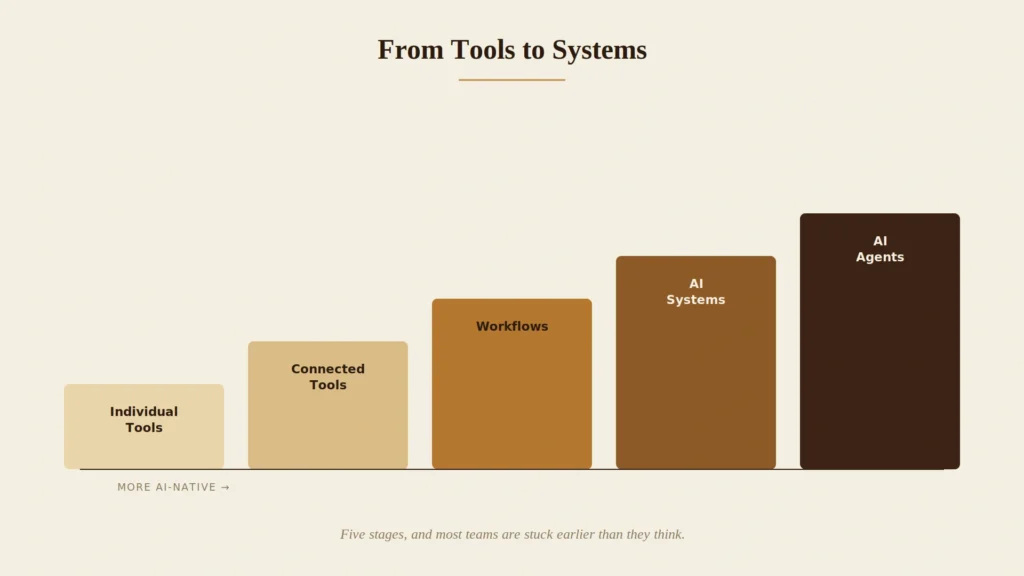
A team stuck at the first stage will keep buying tools indefinitely, because each new capability looks like the missing piece. A team that has moved to workflow-level thinking asks a different question before every purchase: does this fit inside a system we already have, or does it just add another disconnected piece to one we don’t?
What a Modern Marketing AI Stack Looks Like
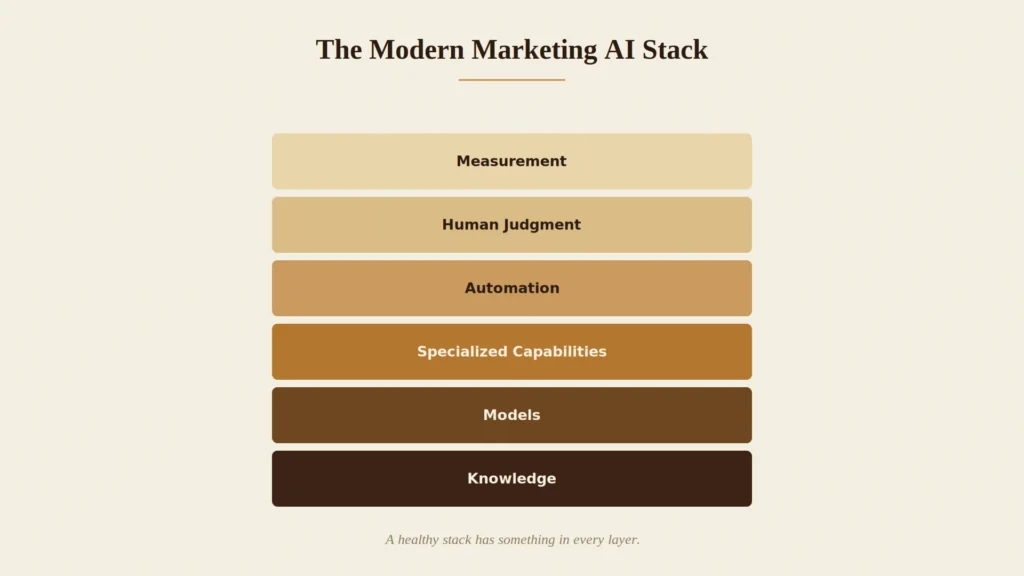
Rather than a list of specific products, it’s more durable to think in layers. Knowledge the business’s actual information, organized and current. Models the underlying AI capability doing the reasoning. Specialized capabilities the narrow, task-specific tools built on top of those models. Automation the connective layer that moves work between steps without manual handoffs. Human judgment the review and decision points that stay with people, deliberately. Measurement the layer that tells the team whether any of it is working.
A healthy stack has something in every layer and doesn’t over-invest in one at the expense of the others a team with excellent specialized tools but no measurement layer can’t tell if the tools are earning their keep, no matter how good each one is individually.
Common AI Stack Mistakes
Buying before mapping the workflow. Teams choose a tool because it looks capable, then discover it doesn’t fit anywhere in how work actually moves. Better approach: map the workflow first, then look for the gap a tool would actually fill.
Optimizing for features instead of fit. A tool with more capabilities isn’t better if the team only ever uses a third of them. Better approach: evaluate against the specific task, not the full feature list.
Ignoring duplicate functionality. Two tools quietly do the same thing because nobody compared them side by side. Better approach: run the audit before renewal, not after.
Measuring usage instead of outcomes. Login frequency isn’t the same as value created. Better approach: tie every tool to a business outcome it’s meant to move.
Letting every department build its own stack. Marketing, sales, and support each solve the same underlying problem separately, with no shared visibility. Better approach: a lightweight, shared inventory that every team can see.
Ignoring data flows between tools. Insight generated in one place dies there if nothing connects it to where it’s needed next. Better approach: prioritize integration alongside capability when evaluating a new tool.
Assuming integration alone means transformation. Connecting two tools doesn’t redesign the workflow around them it just moves the same friction one step over. Better approach: redesign the process, not just the plumbing.
Keeping tools “in case someone needs them.” Dormant seats persist because removing them feels riskier than it is. Better approach: treat unused access as a cost, not a safety net.
Where This Is Headed
The near-term trajectory points toward fewer interfaces doing more, not more interfaces doing narrower things. Orchestration layers that route a task to the right capability without a person choosing the tool by hand are becoming more common, as are AI agents that operate across a workflow rather than inside a single application. Centralized governance a shared inventory, a shared review process increasingly coexists with distributed experimentation at the team level, rather than one replacing the other. What’s less certain is exactly how fast this consolidation happens at any individual company; it depends less on the technology maturing and more on whether a team is willing to treat its AI stack as something to actively manage, rather than something that simply accumulates.
FAQ
What is AI tool sprawl? The uncontrolled accumulation of AI tools across a team, where subscriptions, workflows, and data become fragmented faster than anyone is tracking them.
Why is AI tool sprawl a problem? Because the costs subscription spend, context switching, data fragmentation, security gaps accumulate quietly and often outweigh the productivity gains of the tools causing them.
How do companies audit their AI tools? By evaluating every active tool against a consistent set of criteria purpose, usage, overlap, integration, data access, and business impact rather than relying on memory or informal lists.
How do you consolidate AI software? Group tools by the job they perform, identify genuine overlap, and merge duplicate capabilities into a single shared standard rather than maintaining parallel subscriptions.
How many AI tools does a marketing team actually need? There’s no fixed number the better question is whether every active tool has a clear owner, a measurable job, and no unaddressed overlap with something else the team already has.
Should companies standardize on one AI platform? Not necessarily. Standardizing reduces fragmentation but can limit fit for specialized tasks; the more durable goal is a connected system, not a single vendor.
What’s the difference between AI tools and AI workflows? A tool performs one capability. A workflow is the sequence of steps potentially spanning several tools that gets an actual piece of work done from start to finish.
How do AI agents reduce tool fragmentation? By operating across a workflow and calling on capabilities as needed, an agent can reduce the number of interfaces a person has to manually move between.
The Bottom Line
The measure of AI adoption that matters was never how many tools a team could list. It’s how much better the team’s actual work gets when those tools however many there are work together instead of past each other. A marketing team with three well-connected AI capabilities will consistently outperform one with fifteen disconnected ones, not because fewer is inherently better, but because coherence is what turns individual capability into compounding output. The next phase of AI adoption won’t be won by whoever adopts the most. It’ll be won by whoever builds the system the tools actually belong to.
