
The AI Evaluation Gap: Why Most Companies Still Can’t Prove Their AI Works

A great AI demo isn’t proof it works. Learn why AI evaluation matters, how to test LLM apps and agents, and a practical 10-step AI evaluation framework.
A well-built AI demo is one of the most persuasive objects in enterprise technology. A support assistant resolves a tricky billing question in seconds. An agent reconciles an invoice while the room watches. Someone says the word every project team hopes to hear: ready.
Sometimes it is. More often, the demo has established something narrower: that the system can produce a good result under conditions someone chose in advance. It hasn’t shown that the system works on the thousandth request, on the messy request, or after the model provider quietly updates what sits underneath it.
That gap is the subject of this article, and it comes down to three claims that are easy to blur together:
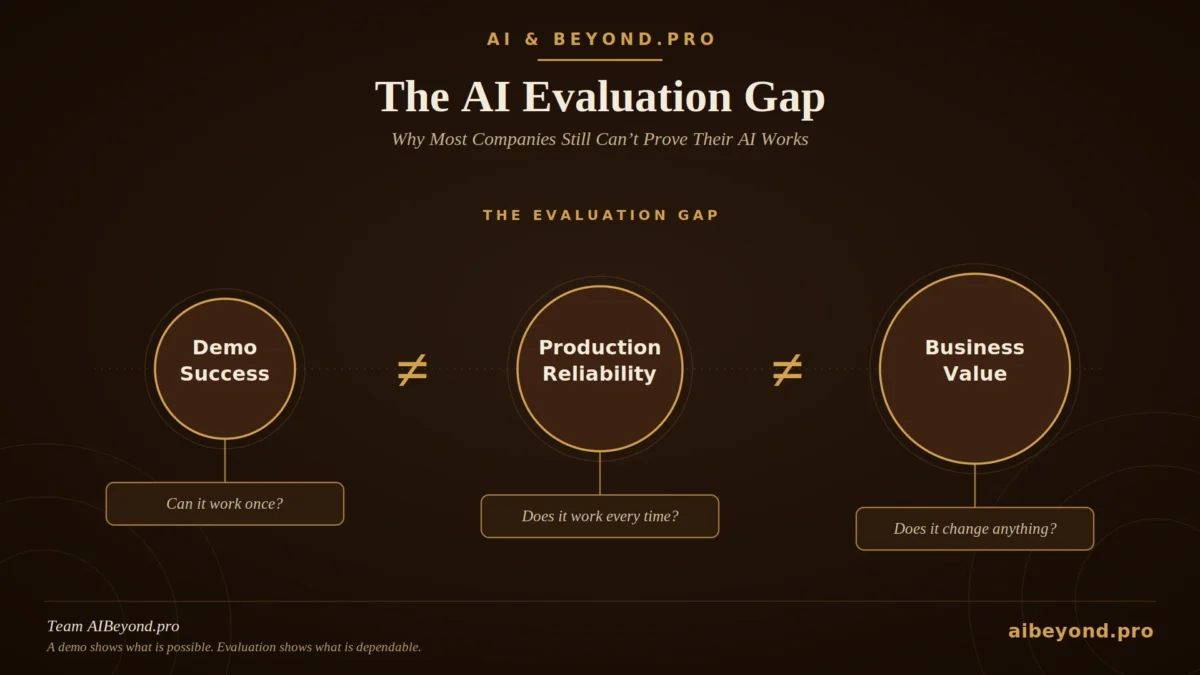
Demo success ≠ production reliability ≠ business value
A demo shows that something can work. Production reliability shows that it keeps working across the real range of inputs. Business value shows that working reliably changes something the organization cares about tickets resolved, hours saved, errors avoided. Each step needs its own evidence, and the discipline that produces it is evaluation.
What is AI evaluation? AI evaluation is the practice of systematically measuring whether an AI system does its intended job well enough, consistently enough, and safely enough to be trusted in a specific context. For systems built on large language models, it is often called LLM evaluation.
No reliable census exists of how many companies can demonstrate this, and this article won’t invent one. In mid-2025, Gartner predicted that more than 40% of agentic AI projects will be canceled by the end of 2027, citing escalating costs, unclear business value, or inadequate risk controls. It is a forecast, not a measurement but none of those reasons is “the model wasn’t capable enough.” They describe an inability to show and control what a system is doing.
Why Traditional Software Testing Doesn’t Fully Work for AI
Conventional software testing rests on a simple contract: given this input, expect exactly this output. A function that adds two numbers either returns the right sum or it doesn’t, and it fails the same way every time. That predictability makes automated test suites and release gates possible.
Generative AI breaks the contract in several ways at once.
- Probabilistic, not deterministic. The same prompt can produce different outputs, several of them equally valid. There is often no single expected output to compare against.
- An open-ended input space. Users phrase requests in endless ways, so edge cases can’t be enumerated.
- Subjective quality. Whether a summary is good depends on tone, completeness, and audience judgments a string comparison can’t make.
- Shifting behavior. A 2023 Stanford and UC Berkeley study found that the behavior of the “same” LLM service can change substantially within months, including more formatting mistakes in generated code. For an application whose downstream systems expect a particular format, that is a failure whatever happened to underlying capability.
- Context-dependent outputs. Results depend on the prompt, retrieved documents, conversation history, and available tools not the model alone.
None of this makes traditional testing obsolete. The code around a model APIs, permission checks, data schemas still deserves conventional tests, and deterministic checks such as “does the output parse as valid JSON?” remain useful. They are simply no longer sufficient. AI testing has to measure quality across a distribution of outputs, not confirm a single correct one.
The Benchmark Trap
Public benchmarks are useful, and dismissing them would be a mistake. They give the field a shared yardstick, make models comparable, and help a team build a shortlist. Stanford’s HELM project shows the form done well, scoring 30 models on shared scenarios across seven metrics including calibration, robustness, and efficiency not accuracy alone.
The trap is treating a benchmark score as a verdict on your application. Three limitations matter most:
- Generality. Benchmarks measure general capability on public tasks, not your documents, policies, or customers. Princeton researchers argued that the needs of model developers and downstream developers have been conflated, showing how benchmarks built for model evaluation can mislead when choosing a system for a specific application.
- Contamination and overfitting. When benchmark-like data leaks into training, scores can overstate ability. Scale AI researchers wrote fresh problems matching a popular math benchmark’s style; some model families lost up to 8% accuracy, while frontier models showed little sign of overfitting.
- Saturation. Once models near a benchmark’s ceiling, it stops separating good from better. Anthropic’s engineers note that scores on SWE-bench Verified rose from roughly 40% to above 80% in about a year.
It helps to separate three layers. Model benchmarks ask which model is generally capable. Application-specific evaluation asks whether this system does this job on these inputs. Real-world business performance asks whether doing that job changes an outcome that matters. Benchmarks belong at the first layer: shortlisting, sanity checks, tracking progress. As our piece on Small Language Models: Why Bigger Isn’t Always Better for Business argued, only testing against production-representative data shows how a model performs on your task.
Model Evaluation vs. Application Evaluation
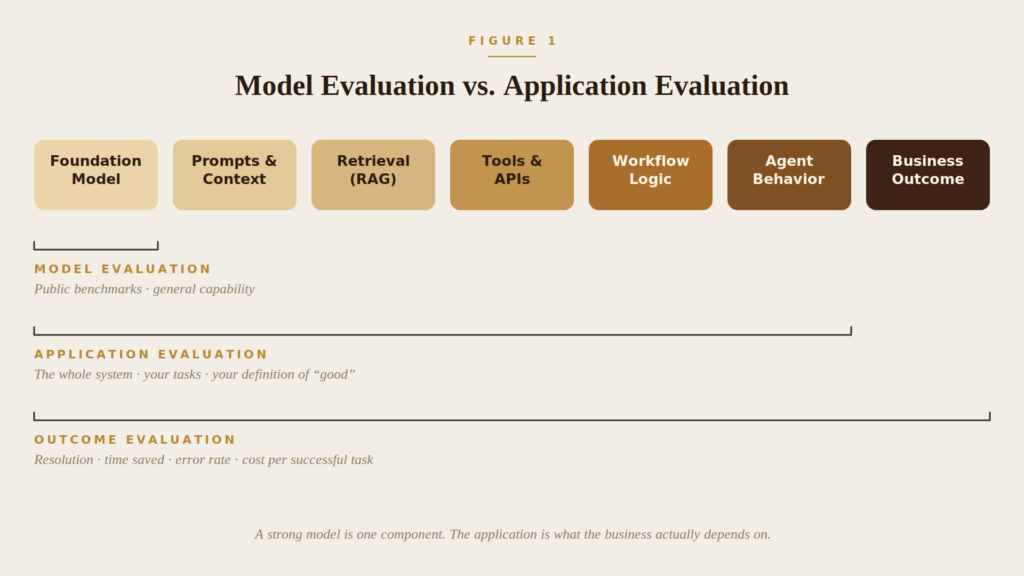
Model evaluation measures a foundation model’s capabilities in isolation. Application evaluation measures whether a specific system built on that model with its prompts, data, tools, and workflows does its job. The first is a property of the model; the second, of the product.
A working AI application is a stack, and each layer can fail independently:
- The foundation model reasoning, cost, and latency, ideally tested side by side on a sample of your own tasks.
- Prompts and context instruction following, format adherence, and sensitivity to small changes in wording. Our article on Context Engineering covers how much behavior lives here.
- Retrieval (RAG) whether the right documents are found and used. Researchers studying three real deployments catalogued failure points including missing content, poorly ranked documents, and answers present in context but not extracted. Frameworks such as Ragas score faithfulness, answer relevance, and context relevance separately, so a team can tell a retrieval failure from a generation failure. See RAG vs. Fine-Tuning for the architecture.
- Tools and workflows whether the system calls the right tool with the right parameters, and whether steps are sequenced, routed, and escalated correctly.
- Agents multi-step behavior across systems, covered below.
- The complete application end-to-end results on real tasks, including permissions, latency, and the interface.
This is why a strong model can still produce a poor business application. Imagine retrieval that surfaces a superseded policy document: the model summarizes it fluently and faithfully, and the answer is wrong. Or a tool with an ambiguous description, so a capable model passes the wrong argument. A model benchmark would look fine in both cases. The weakest component, not the strongest, sets the quality of the whole.
What Should Companies Actually Measure?
There is no universal scoreboard. Choosing what to measure is the first act of evaluation design, and the dimensions below are a menu, not a checklist.
| Dimension | The question it answers |
|---|---|
| Accuracy | Is the output correct against a reference or expert judgment? |
| Relevance | Does it address what the user actually asked? |
| Factuality | Are the stated facts true? |
| Hallucination rate | How often does it assert something unsupported? |
| Consistency | Does it give equivalent answers to equivalent inputs? |
| Instruction following | Does it respect the format, tone, and constraints it was given? |
| Safety | Does it avoid harmful or non-compliant output, even under adversarial input? |
| Latency | Is it fast enough for the way it is used? |
| Cost | What does each successful task cost, not just each request? |
| Task completion | Was the goal actually accomplished? |
| Tool-use accuracy | Did it choose the right tools and parameters? |
| Human satisfaction | Do users find it useful and trustworthy? |
What is a hallucination? Output that isn’t supported by the source material or by fact. Hallucination rate is only meaningful when a team specifies what counts, against which sources, and out of how many responses. In RAG systems, a common proxy is faithfulness: whether an answer’s claims can be inferred from the retrieved context.
Not every metric applies to every system. A document summarizer lives or dies on factuality and consistency; a refund-issuing agent, on tool-use accuracy, task completion, safety, and cost per task. Cost deserves special mention: Princeton researchers showed that on one coding benchmark, simple baseline agents beat many far more elaborate architectures at much lower cost, and argued for tracking accuracy and cost together.
Human Evaluation vs. Automated Evaluation
Mature evaluation programs use several methods, because each has a characteristic blind spot.
- Human review. Domain experts or trained raters grade outputs against a rubric. It is the highest-fidelity method and the reference for calibrating the others, but it is slow, expensive, and inconsistent without a precise rubric.
- Rule-based evaluation. Deterministic checks: is the output valid JSON, was the right tool called, does the database show the expected state. Fast, cheap, and reproducible and brittle, because they penalize valid variation and can’t judge nuance.
- Automated metrics. Similarity scores against reference answers, and retrieval metrics, scale cheaply but are proxies: a good answer phrased differently from the reference can score poorly.
- LLM-as-a-judge. A language model grades another model’s output against a rubric flexible enough to score open-ended output no rule can.
- Hybrid evaluation. Rules first, model judges for breadth, humans for calibration and high-stakes samples.
What is LLM-as-a-judge? It is an evaluation method in which a strong language model scores or ranks outputs against criteria the evaluator writes. The evidence is encouraging but qualified. In the research that popularized the approach, a strong judge agreed with human preferences more than 80% of the time about the rate at which humans agree with each other while the same paper documented position bias, verbosity bias, self-enhancement bias, and limited reasoning ability.
A second study, Who Validates the Validators?, makes the deeper point: LLM-based evaluators inherit the problems of the models they evaluate and need human validation. It also identified “criteria drift” people need criteria to grade outputs, but grading outputs changes what they think the criteria should be.
In practice, treat a judge like any measuring instrument: calibrate it against human labels, score one narrow dimension at a time, give it a way to answer “unknown,” present pairwise answers in both orders, and re-check it periodically. An LLM judge is a useful, scalable estimate not an objective one.
The Evaluation Dataset Problem
An evaluation is only as good as the examples it runs on. An evaluation dataset is a curated set of inputs with reference answers or grading criteria where possible used to measure a system repeatedly. Its composition determines what the numbers mean.
- Representative test cases drawn from real usage tickets, queries, documents not from what the team imagines users will ask.
- Edge cases: ambiguous, incomplete, multi-part, out-of-scope, and adversarial inputs.
- Failure cases: every real failure becomes a permanent test. Anthropic’s guidance suggests that 20 to 50 simple tasks drawn from real failures is a strong start, and that teams shouldn’t wait for a perfect suite.
- Production examples, used with care: sampling live traffic keeps the set honest but raises data-handling questions that need an owner.
- Continuous updates, with a held-out subset the team doesn’t tune against Princeton’s researchers warn that missing holdout sets invite shortcuts and overfitting.
Why does testing only easy examples create misleading confidence? Because a high score on a set without hard cases measures the set, not the product. A support assistant that handles every question its builders imagined can look excellent in testing and struggle when real customers ask three things at once. An evaluation that never fails is usually too easy.
Evaluating AI Agents Is Harder
AI agent evaluation measures whether an agent achieves its intended outcome and whether the path it took was acceptable, reliable, and within policy. (For agents versus simpler tools, see our article AI Tools vs. AI Agents.)
Agents are harder to evaluate because they do more than answer. They reason through multiple steps, call tools, access other systems, make decisions, take actions with real side effects, and recover or fail to recover when something goes wrong. Anthropic’s engineers note that in multi-turn runs, mistakes can propagate and compound. A wrong sentence can be caught by a reader; a wrong refund may not be.
Outcome versus process. Anthropic’s example is a flight-booking agent that ends with “Your flight has been booked.” The transcript says so; the outcome is whether a reservation actually exists in the database. Benchmarks such as τ-bench take the same approach, comparing final database state with an annotated goal state. Process matters too which tools were called, with what parameters, at what cost, within what permissions but grading a fixed sequence of steps is often too rigid, because agents find valid routes their designers didn’t anticipate.
Reliability, not just success. The τ-bench authors introduced pass^k, the probability that an agent succeeds on all k attempts at a task, and reported in 2024 that even state-of-the-art function-calling agents completed fewer than half of tasks, with pass^8 below 25% in the retail domain. Models have improved since, but the arithmetic remains: as Anthropic notes, an agent with a 75% per-trial success rate has only about a 42% chance of succeeding three times in a row.
Finally, evaluation must cover cost, latency, and safety boundaries whether irreversible actions required approval, how the agent behaved when a tool failed. That overlaps with our article The AI Governance Gap: an agent that can’t be evaluated can’t be governed.
From One-Time Testing to Continuous Evaluation
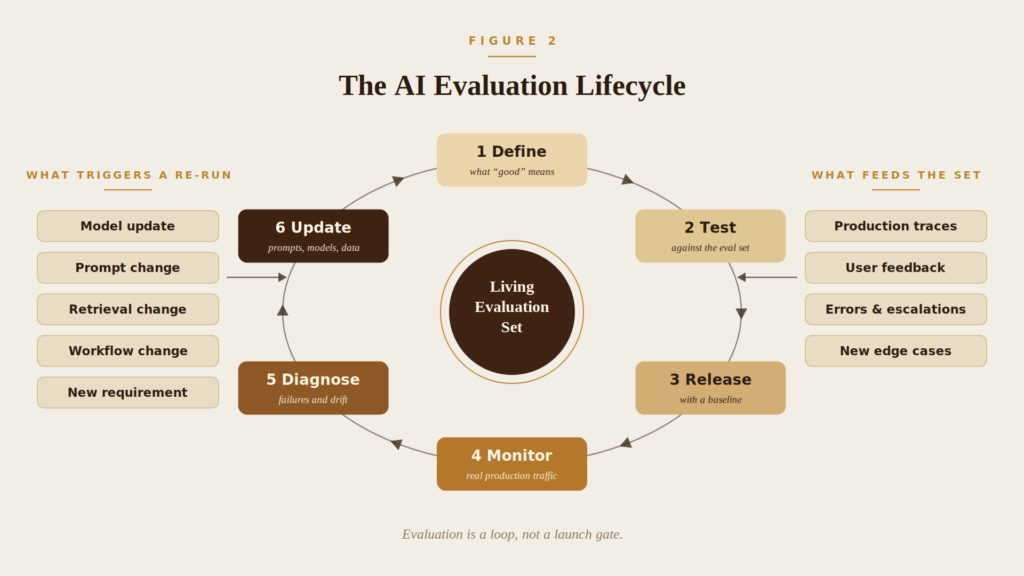
Continuous AI evaluation is the practice of repeatedly measuring a system’s performance across its lifetime on every meaningful change and against live traffic rather than once before launch. A pre-launch test is a photograph; the system keeps moving. Five things move it:
- Model updates. The Stanford–Berkeley study found that a nominally identical service can behave substantially differently within months.
- Prompt changes. A small edit that fixes one failure can quietly break another.
- Retrieval changes. New documents, chunking strategies, or embedding models change what the model sees.
- Workflow changes. Adding, reordering, or rerouting steps alters where errors originate.
- Changing business requirements. New products, policies, and regulations redefine what a correct answer is.
Two practices make this manageable. Regression testing reruns a stable suite on every change to confirm that what worked still does. Anthropic distinguishes capability evals, which start at low pass rates and give a team something to improve, from regression evals, which should pass nearly always and raise an alarm when they don’t. Production monitoring covers what any test set misses: sampled live traces, user feedback, escalations, and drift in real inputs.
No single layer is enough. Automated evals are fast but can create false confidence if they don’t match real usage; production monitoring reflects reality but is reactive; A/B tests measure outcomes but are slow. The payoff is speed as much as safety: Anthropic observes that teams with evals can assess a new model and upgrade in days, while teams without them may face weeks of testing. NIST’s AI Risk Management Framework reflects the same logic, with a dedicated Measure function for testing, evaluation, verification, and validation, extended to generative systems in its Generative AI Profile.
Connecting AI Evaluation to Business Outcomes
Technical metrics are proxies. Accuracy and pass rates matter only insofar as they predict something the business cares about and the right outcome metric depends on the job the AI performs.
- Customer support assistant: resolution rate, escalation rate, handling time, customer satisfaction.
- Document processing: error reduction, time saved per document, cost per document.
- Internal copilot: task completion time, employee productivity, sustained adoption.
- Marketing, sales, and recommendation tools: conversion, retention, editing time ideally measured through controlled tests.
Why not simply ask users whether they like it? Because perception can diverge from measurement. In a 2025 randomized controlled trial, METR found that experienced open-source developers using AI tools took 19% longer to finish their tasks yet they had predicted a 24% speedup and afterward still believed AI had sped them up by about 20%. The study was small (16 developers), reflects early-2025 tools, and its authors caution against overgeneralizing. Its lesson isn’t that AI slows people down; it’s that satisfaction and measured outcomes are different things.
Three habits keep the link honest: use cost per successful task rather than cost per request; compare against a baseline through A/B tests or holdouts so improvements can be attributed; and check periodically that technical scores and business outcomes move together. If evaluation scores rise while outcomes don’t, the evaluation is measuring the wrong thing.
A Practical AI Evaluation Framework: 10 Steps
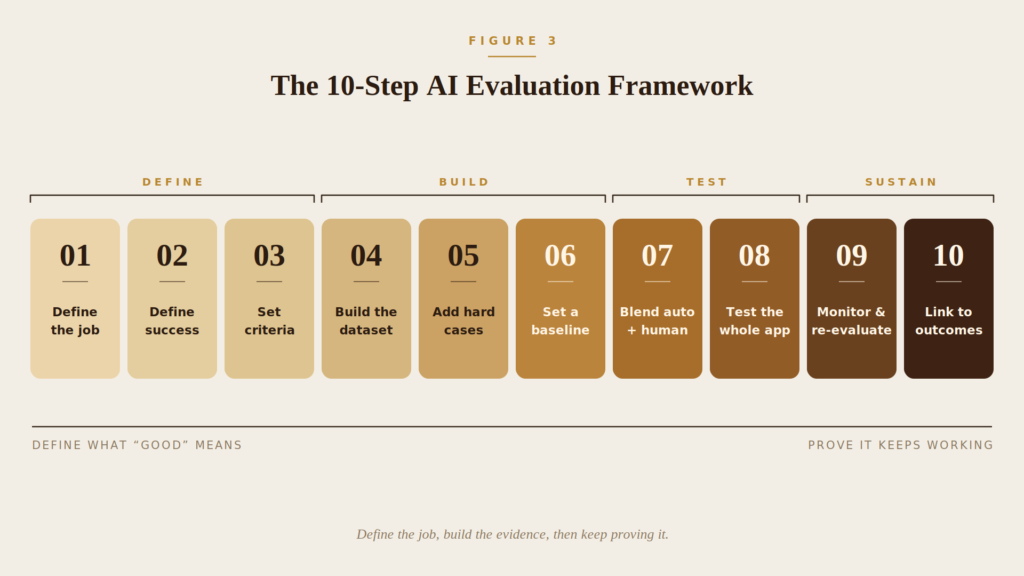
1. Define the AI system’s actual job
Write the job in a sentence a new employee could act on: who the users are, what comes in, what should go out, what is out of scope, and what happens when the system is unsure. If the job can’t be described plainly, it can’t be evaluated.
2. Define what a successful outcome means
Describe success at three levels: an acceptable output, a completed task, and a business result. Agree with domain experts, not only engineers, on which errors are tolerable. A missing answer and a confidently wrong one are rarely equal.
3. Identify measurable evaluation criteria
Translate success into four to six dimensions from the list above, not all twelve. For each, write a definition, choose how it is measured rule, model judge, or human and set a threshold. Rubrics with worked examples grade more consistently than adjectives.
4. Build a representative evaluation dataset
Start with 20 to 50 real cases from support queues, bug trackers, and manual checks your team already runs. Attach reference answers or grading criteria, confirm two experts would reach the same verdict, and hold some cases back from tuning.
5. Include difficult and failure cases
Add ambiguous, multi-part, out-of-scope, outdated-information, and adversarial cases, plus cases where the system should decline or do nothing. Turn every production failure into a permanent test.
6. Establish a baseline
Measure what exists before improving it: the human process, the previous system, or a simple prompt on an off-the-shelf model. Record quality, cost, and latency. Without a baseline, “better” has no meaning.
7. Combine automated and human evaluation
Layer cheap rule-based checks, model judges for scale, and human review of samples and high-stakes cases. Calibrate judges against human labels, and re-check them when the rubric or model changes.
8. Test the complete application, not only the model
Run the full pipeline retrieval, tools, permissions, interface, handoffs in a production-like environment. Score components separately to locate failures and end to end to judge results. For agents, grade final outcomes, check tool use where the path matters, and run repeated trials.
9. Monitor and re-evaluate continuously
Rerun the suite on every change to model, prompt, retrieval, or workflow. Sample live traffic, feed new failures back into the dataset, and track scores by version over time.
10. Connect evaluation results to business outcomes
Choose one to three outcome metrics tied to the job resolution rate, time saved, error rate, cost per successful task. Measure them against the baseline with A/B tests or holdouts, and check that evaluation scores actually predict them.
None of this requires specialized tooling to begin: a spreadsheet of thirty real cases and a written rubric are enough to start.
Conclusion
For the past several years, the enterprise AI conversation has centered on capability: larger models, longer contexts, more autonomous agents. But capability is not proof, and a system that cannot be shown to work cannot be scaled, governed, or trusted with anything that matters.
A demo shows what is possible. A benchmark shows what a model can do in general. Neither shows whether this system, on this work, keeps doing its job a month from now or whether that changes anything for the business. That takes datasets built from real cases, methods honest about their limits, evaluation that runs continuously, and outcome metrics someone owns.
The next stage of enterprise AI is not simply building more capable systems. It is being able to demonstrate, measure, monitor, and continuously improve whether they actually work. The advantage won’t belong to whoever builds the most impressive demo. It will belong to whoever can show, on any given Tuesday, that the system still works and why.
