
Agent Memory: Why Your AI Assistant Forgets You

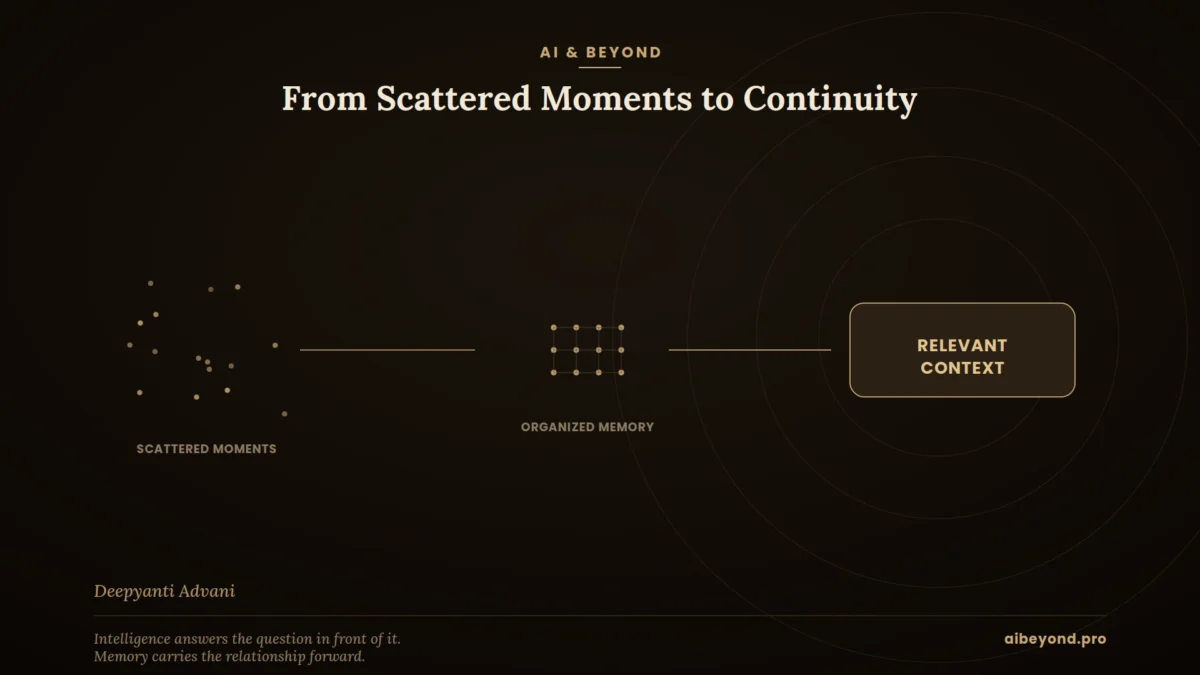
How Persistent Memory Is Turning AI Assistants From Stateless Tools Into Systems That Understand Context, Continuity, and the People Using Them
You tell an AI assistant something that matters. A deadline, a constraint, a decision you’ve already made and don’t want to re-litigate. It responds well. It seems to get it.
Then you open a new conversation next week, and it’s gone. Not corrupted, not misremembered simply absent, as if the exchange never happened. You explain it again. It responds well again. It still seems to get it. That’s almost the unsettling part: the assistant is never obviously wrong. It’s just never continuous.
This is not a bug in the ordinary sense. It’s a consequence of how most AI systems have handled information from the start: everything relevant to a response has to be present in that response’s context, and once the conversation ends, the context usually goes with it.
An AI system can be genuinely intelligent fluent, well-reasoned, technically capable without being continuous. It can answer the question directly in front of it while knowing almost nothing about the relationship that produced the question. Those turn out to be separate engineering problems, solved by different parts of a system, and conflating them is why so many people describe capable assistants as frustratingly forgetful.
That’s changing. Memory the ability to retain and selectively use information across sessions, not just within one is becoming a core architectural layer in AI systems, not a feature bolted on afterward. Anthropic and OpenAI have both shipped persistent memory to mainstream users over the past year, and the systems being built on top of language models increasingly treat what gets remembered, and what doesn’t, as a design decision on par with which model to use.
The more useful question is no longer just how intelligent a system is. It’s what the system remembers, what it forgets, when it retrieves that memory, and how much say you have over any of it.
In this guide, we’ll explore:
- Why intelligence and memory are genuinely different problems
- The difference between context and memory and why a bigger context window doesn’t close the gap
- The categories of memory an AI system might actually keep
- How agent memory works, end to end
- Why memory turns a one-off tool into a continuous system
- The risks of a system that remembers too much, or too confidently
- How memory relates to retrieval-augmented generation
- What responsible memory design looks like, for individuals and for enterprises
Intelligence Without Memory
Think about a specialist you’d call in for a single, high-stakes consultation sharp, well-read, capable of giving you excellent advice within the hour you have together. Now imagine that same specialist has no assistant, keeps no notes, and genuinely does not recall your previous conversations. Every session starts from zero. You’d still get good advice. You would never get continuity.
That’s a reasonable description of what a language model provides on its own. Its “intelligence” the knowledge encoded during training, plus its ability to reason over whatever is in front of it is largely fixed and doesn’t depend on you. What varies, session to session, is the context window: the finite space holding the current conversation, any documents you’ve shared, and system instructions. When the conversation ends, unless something was deliberately written elsewhere, the context goes with it.
Persistent memory is the thing that survives the end of the session. It’s a separate system, built on top of the model rather than inside it, whose job is to decide what’s worth keeping and to bring the right piece back at the right time. A model can be excellent and still have no memory. A system can have excellent memory built around a comparatively modest model. They’re different problems, and conflating them is where most of the confusion about “AI that remembers” comes from.
Context Is Not Memory
This is the distinction worth holding onto through the rest of the article, because nearly every other concept here builds on it.
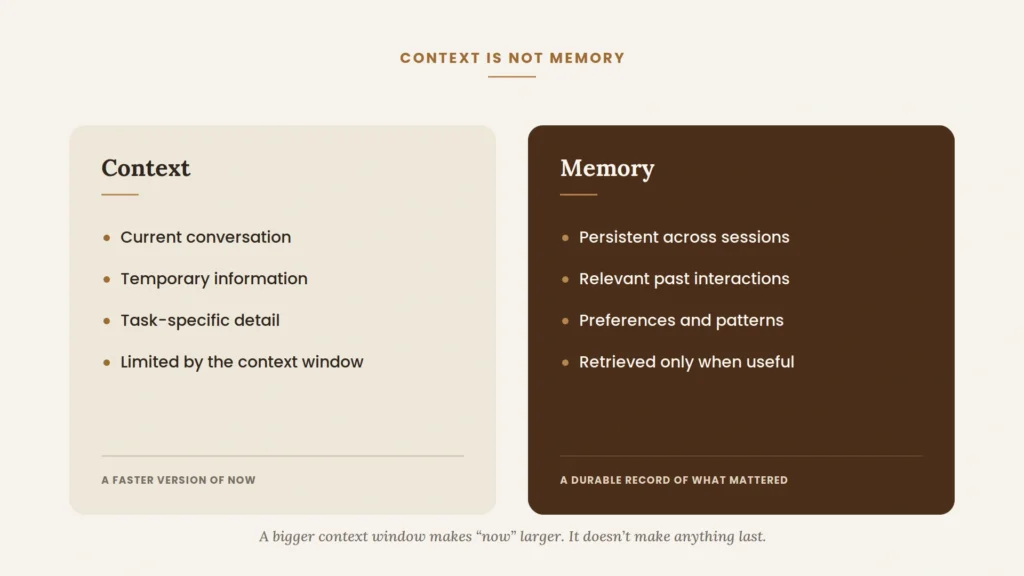
A bigger context window makes “now” larger. It doesn’t make anything last.
| Context | Memory | |
| Contains | The current conversation and any attached material | Selected facts, preferences, and patterns worth keeping |
| Lasts | For the session, or until it’s pushed out by newer content | Across sessions, until deliberately updated or removed |
| Comes from | What’s typed or attached right now | What was extracted and stored from earlier interactions |
| Retrieved by | Simply being present no retrieval step needed | A deliberate lookup, matched to relevance |
| Purpose | Let the model reason over the immediate task | Let the system stay consistent with what it already knows about you |
| Example | A document you just pasted in | “This user prefers concise answers and works in EST” |
Anthropic’s Claude and OpenAI’s ChatGPT have both made the context/memory distinction concrete over the past year. Anthropic’s memory tool for the API is explicitly separate from the context window: it lets an agent write information to persistent storage that the developer controls, then read it back in later turns in one long-running evaluation, pairing that memory tool with context editing let an agent complete a 100-turn task it would otherwise fail, while cutting token consumption by 84 percent. OpenAI’s approach to ChatGPT memory has moved a similar direction: explicit “saved memories” sit alongside a broader “chat history reference” layer that OpenAI calls “dreaming,” which periodically revises what’s stored as circumstances change updating “You’re going to Singapore in July” to “You went to Singapore in July” once the trip has passed.
The natural instinct, when an assistant forgets something, is to want a bigger context window. That helps with a different problem holding more of the current task at once but it doesn’t create persistence. A million-token context window still empties out when the session ends unless something was written to memory along the way. Context and memory solve different problems, and only one of them survives past the conversation.
What an AI System Actually Remembers
“Memory” isn’t one thing. Systems that do this well tend to work with several categories of information, each serving a different purpose.
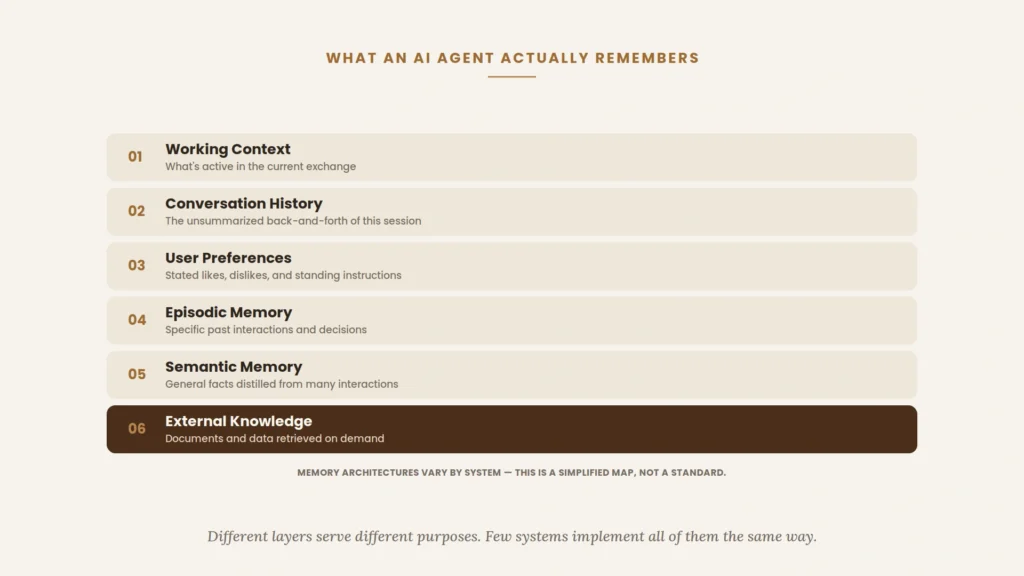
Different layers serve different purposes. Few systems implement all of them the same way.
Working context. What’s active in the exchange happening right now not memory in the persistent sense, but the foundation everything else builds on.
Conversation history. The unsummarized record of this session’s back-and-forth, useful while it’s active and often discarded or compressed once it ends.
User preferences. Explicit or inferred standing instructions tone, format, things to avoid that should apply consistently going forward.
Episodic memory. Specific past interactions and decisions: what was discussed on a particular date, what was agreed, what didn’t work last time.
Semantic memory. General facts distilled from many interactions not “what happened on March 3rd” but “this person consistently prefers X.”
External knowledge. Documents, databases, and other material retrieved on demand not really “memory” of the user at all, but relevant to the response.
No single taxonomy is universal. Different systems draw these lines differently, and some collapse several of these into one mechanism. What matters is recognizing that a system claiming to “remember you” might mean any of several quite different things and that the categories serving continuity (preferences, episodic and semantic memory) are distinct from the category serving accuracy (external knowledge).
How AI Agent Memory Works
Strip away implementation detail and the flow looks like this: an interaction happens; the system identifies what, if anything, is worth keeping; that information is extracted and stored; on a future request, the system retrieves whatever’s relevant; that retrieved material is assembled into context alongside the current task; and the agent responds with both in view.
Every stage in that chain hides a real design decision. Extraction has to decide what counts as worth keeping store everything and the system drowns in noise; store too little and it feels no different from having no memory at all. Storage has to decide on structure a flat list of facts, a set of summarized episodes, something more structured which shapes what’s easy to retrieve later. Retrieval has to rank candidate memories by relevance to the current moment, not just recency. Updating has to handle the case where new information contradicts something already stored do you overwrite, flag a conflict, or keep both and let a rule decide which wins? And forgetting has to remove what’s gone stale, without silently discarding something that still matters.
None of this needs to be visible to the person using the system. But it’s worth knowing that it’s happening, because each of those quiet decisions is also a quiet failure point.
The AI Memory Loop
It helps to think of memory less as a database and more as a cycle that keeps running: observe, extract, store, retrieve, use, update, forget then back to observe.
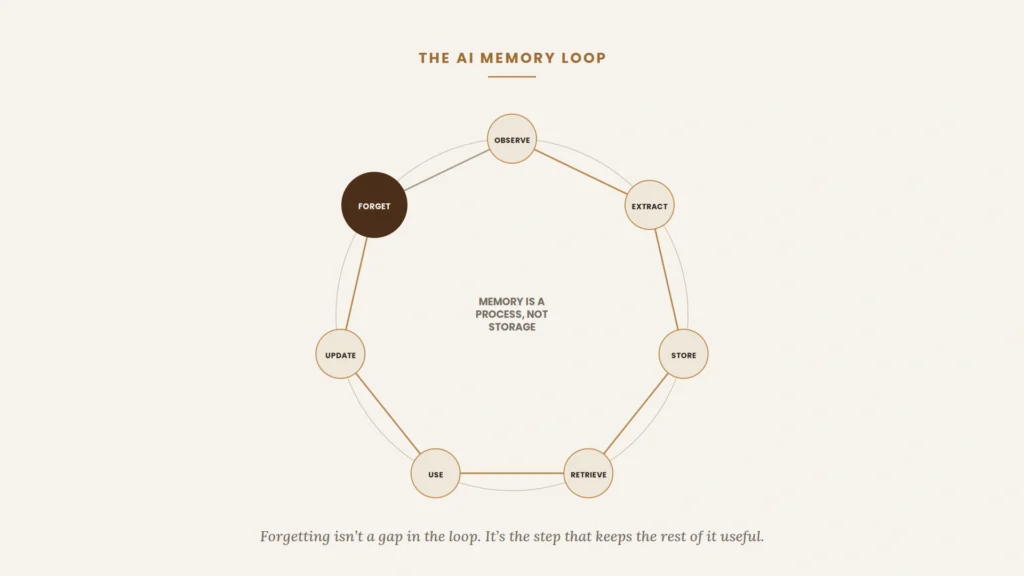
Forgetting isn’t a gap in the loop. It’s the step that keeps the rest of it useful.
The step people tend to skip when they picture “AI memory” is the last one. Forgetting isn’t a failure of the system it’s a required part of a working one. A memory system that never forgets accumulates outdated preferences, resolved problems treated as ongoing, and facts that were true once and aren’t anymore. Deliberate forgetting is what keeps retrieval fast, keeps stored information trustworthy, and keeps the system from confidently acting on something that stopped being true months ago.
Why Memory Changes AI Agents
Without memory, every interaction restarts from nothing: a customer explains their problem, the assistant responds well, and that’s the entire transaction. With memory, the pattern shifts: a customer’s history and stated preferences are already known, so the response can account for what’s already been tried, what already frustrated them, and what they’ve said matters most turning a competent one-off answer into something closer to what a good long-term account manager would do.
That shift shows up across functions. In customer support, a returning customer doesn’t have to re-explain a problem that was already escalated once. In sales, a rep’s AI assistant can recall the objections a prospect raised three calls ago instead of repeating a pitch that already didn’t land. In personal productivity, an assistant that remembers your recurring weekly structure can help you plan around it instead of asking you to redescribe it every Monday. In research, an assistant that remembers which sources you’ve already ruled out saves you from re-covering the same ground. In enterprise operations, an agent that remembers which systems a given team actually uses can route requests correctly on the first try instead of asking clarifying questions every time.
In each case, the underlying model didn’t get smarter. The system got more continuous and continuity is what turns a tool you operate into something closer to a working relationship.
Personalization at 1:1 Scale
Persistent memory is what makes real personalization possible at scale: not just addressing someone by name, but adapting communication style, recognizing recurring workflows, drawing on a genuine history with a customer, and making recommendations informed by what’s actually worked for that person before.
It’s also where memory turns risky fastest. Personalization built on memory the person doesn’t know exists, or didn’t expect to be retained, stops feeling helpful and starts feeling like surveillance even when the underlying data is accurate and the intent behind using it is good. A system that mentions a detail from a conversation the user has entirely forgotten having doesn’t read as attentive. It reads as unsettling. The line between the two isn’t the accuracy of the memory. It’s whether the person had any reasonable expectation that it would be kept, and whether they can see and correct it.
When AI Should Forget
Remembering everything is not the goal, and treating it as the goal is where a lot of memory design goes wrong. A good memory system needs relevance, expiration, correction, deletion, user control, and clear privacy boundaries not as afterthoughts, but as first-class parts of the design.
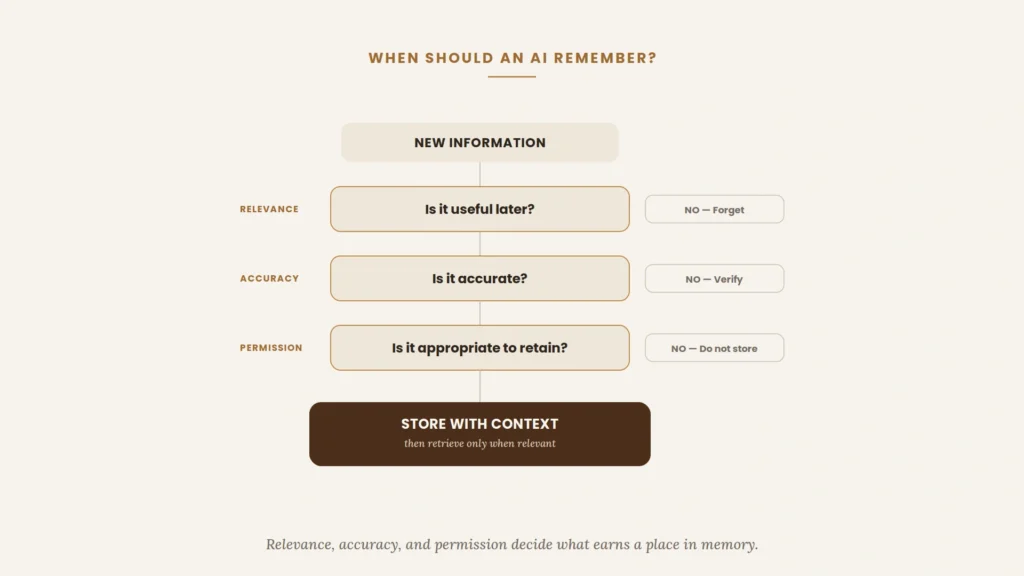
Relevance, accuracy, and permission decide what earns a place in memory.
Some information is only useful temporarily and should expire on its own: a travel itinerary once the trip is over, a project constraint once the project has shipped, an emotional state disclosed in a difficult moment that shouldn’t color every future interaction. Some information needs a correction path, because a memory extracted incorrectly the first time will otherwise keep being wrong indefinitely. And some information health details, financial specifics, anything sensitive shared in passing may need to never be stored at all, regardless of how useful it might theoretically be later.
Forgetting, treated this way, isn’t a limitation of the system. It’s a feature that keeps the system trustworthy, the same way a good colleague knows which conversations were confidential and which details were only relevant for a week.
The Risks of Persistent AI Memory
Incorrect memories. A wrong inference, stored once, can quietly shape every future interaction until someone notices and corrects it. This happens because extraction is itself a judgment call, not a certainty the fix is a visible, easy correction path, not just accurate extraction.
Outdated information. Circumstances change; stored facts don’t update themselves. This happens when a system stores facts without a mechanism for revisiting them the fix is expiration and periodic review, not indefinite retention.
Sensitive information. Details shared in passing can end up stored without anyone deciding they should be. This happens when extraction has no sense of what counts as sensitive the fix is explicit categories that are never retained by default.
Privacy concerns. People often don’t know what’s been retained about them. This happens when memory operates invisibly the fix is a visible, editable record of what the system believes it knows.
Context contamination. A memory relevant to one situation gets applied to an unrelated one. This happens when retrieval optimizes for topical similarity rather than genuine relevance the fix is scoping memories to the situations they actually apply to.
Memory poisoning. Someone deliberately feeds a system false information intended to be remembered and later acted on. This happens when extraction trusts input without verification the fix is treating high-stakes memories as claims to verify, not facts to accept.
Wrong personalization. The system optimizes for a pattern that no longer reflects the person. This happens when preference memory doesn’t decay or get re-confirmed the fix is periodically checking stored preferences against current behavior.
Lack of user control. People can’t see, edit, or delete what’s remembered about them. This happens when memory is designed as backend infrastructure rather than a user-facing feature the fix is making memory visible and editable by default, not as a hidden setting.
AI Memory vs RAG
The two get confused constantly, partly because they can look similar from the outside both involve pulling in information beyond the current prompt. They solve different problems.
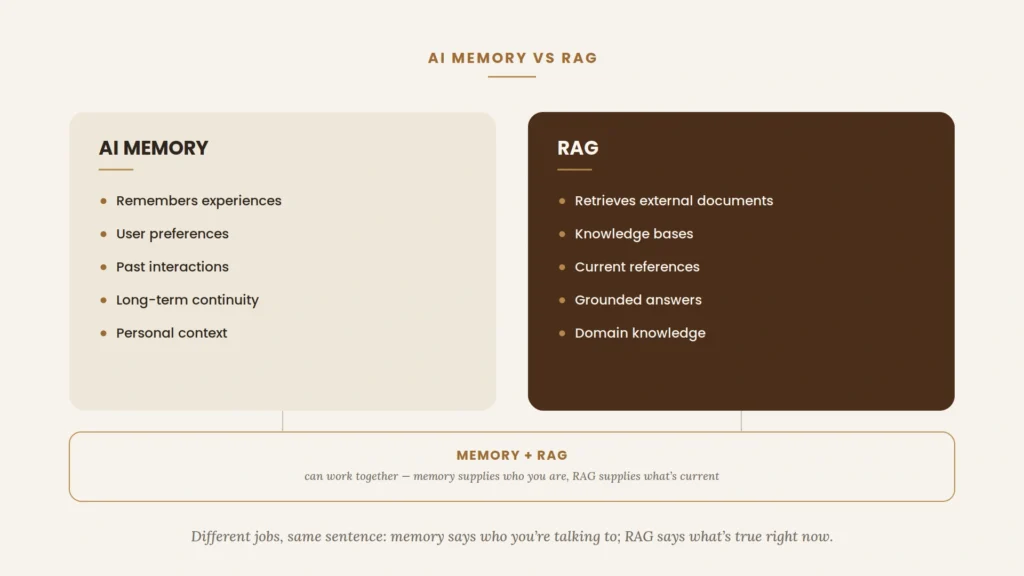
Different jobs, same sentence: memory says who you’re talking to; RAG says what’s true right now.
| AI Memory | RAG | |
| Purpose | Continuity with a specific person or account | Grounding answers in current, external information |
| Data source | Extracted from past interactions with this user | Documents, databases, and knowledge bases |
| Persistence | Deliberately retained across sessions | Not persistent by nature retrieved fresh each time |
| Retrieval | Matched to the user and the moment | Matched to the query’s subject matter |
| Typical use | “This user prefers short answers” | “What does our refund policy say?” |
| Primary challenge | Deciding what’s worth keeping, and for how long | Keeping the underlying source material current and well-indexed |
The two are complementary rather than competing, and mature systems tend to use both: memory supplies who the person is and what’s already been established with them; RAG supplies what’s currently true in the world. A support agent that remembers a customer’s plan tier (memory) while pulling the current refund policy from a knowledge base (RAG) is doing both jobs at once, and neither one substitutes for the other.
The Enterprise Memory Stack
Inside an organization, memory stops being a convenience and becomes something that needs governance because the information being remembered often belongs to customers, employees, or the business itself, not just to the person having the conversation.
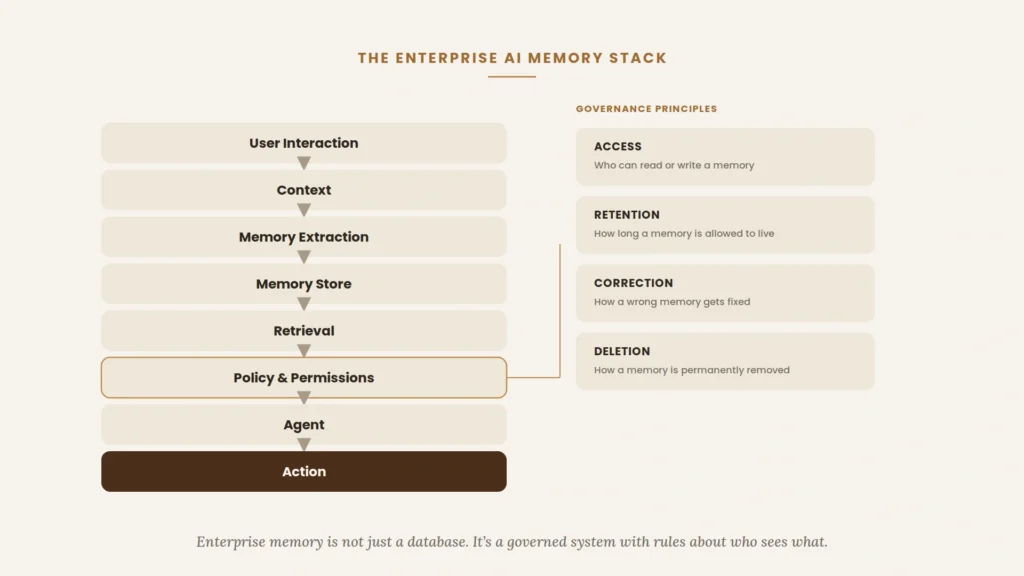
Enterprise memory is not just a database. It’s a governed system with rules about who sees what.
A reasonable enterprise stack runs from user interaction through context, memory extraction, a memory store, retrieval, and a policy and permissions layer, before reaching the agent that actually acts. That policy layer is what separates a personal memory feature from an enterprise-grade one: it decides who can access a given memory, how long it’s retained, how a wrong entry gets corrected, and how a memory is permanently deleted when it should be the same governance questions any other regulated data store has to answer, applied to a new kind of data.
Skipping that layer doesn’t just create a privacy risk. It creates an auditability problem: if no one can say why an agent knew something, no one can say whether it should have known it.
How to Design a Better AI Memory System
Remember selectively. Not everything said is worth keeping. Extraction should have a real bar for relevance, not a default toward storing more.
Store with provenance. Every stored memory should carry where it came from and when without that, correction and expiration are both guesswork.
Retrieve by relevance, not just recency. The most recent memory isn’t always the most useful one for the current moment; retrieval should rank accordingly.
Allow correction. Wrong memories are inevitable. The system needs an easy, visible way to fix them not just delete and hope it re-learns correctly.
Expire what becomes stale. Time-bound information should have a shelf life built in, not rely on someone remembering to clean it up.
Give users control. People should be able to see what’s remembered, edit it, and delete it as a standard part of the product, not a support ticket.
Common AI Memory Mistakes
Storing everything. Happens when extraction has no filter. Causes noisy, low-signal memory that degrades retrieval quality. Better: define what counts as worth keeping before building the extraction step.
Never expiring memories. Happens when a system is built to add but never to remove. Causes stale information to be treated as current. Better: attach a reasonable lifespan to time-bound categories from the start.
Confusing conversation history with memory. Happens when teams treat the transcript itself as the memory store. Causes bloated, unstructured context that’s expensive and hard to search. Better: extract and structure what matters; don’t just retain the raw log.
Retrieving irrelevant memories. Happens when retrieval ranks by keyword match instead of actual relevance to the moment. Causes contaminated, off-topic responses. Better: rank retrieval against the current task, not just topical overlap.
Failing to show users what’s remembered. Happens when memory is built as invisible infrastructure. Causes justified distrust the moment a user notices the system “knows” something they didn’t expect. Better: make the memory record visible by default.
Trusting incorrect memories. Happens when extraction is treated as ground truth rather than an inference. Causes compounding errors that get harder to trace over time. Better: version memories and make correction as easy as the original storage.
Ignoring privacy boundaries. Happens when convenience is prioritized over restraint in what gets stored. Causes real exposure for users and real liability for the business. Better: treat sensitive categories as never-store by default, not as edge cases to handle later.
Where AI Memory Is Going
Some of this is already shipping. Some of it is a reasonable near-term extrapolation. And some of it is still genuinely speculative worth naming as such rather than presenting with false confidence.
Already here: Persistent, user-controlled memory in mainstream consumer assistants; developer-facing memory tools that separate storage from the context window; background processes that revise stored facts as circumstances change rather than leaving them static.
Emerging: Organizational memory shared across a team rather than scoped to one person; memory-aware workflows where an agent’s next step depends on what it already knows about the situation; clearer governance tooling for enterprise deployments, following the same trajectory access control and audit logging took for other data stores.
Still speculative: Multi-agent memory that multiple autonomous agents read and write to in a coordinated way; genuinely cross-application memory that follows a person between unrelated products and vendors; user-owned memory that travels with the person rather than living inside any single company’s systems. All plausible directions. None of them solved yet, and each raises governance questions at least as hard as the technical ones.
FAQ
What is AI agent memory? The mechanism by which an AI system retains and later reuses information from past interactions, separate from whatever is currently in its context window.
What is the difference between AI memory and context? Context is what’s present in the current exchange, temporary by nature. Memory is what’s been deliberately extracted and stored so it can be retrieved in a future, separate session.
How does an AI assistant remember previous conversations? Typically by extracting notable facts, preferences, or events from a conversation, storing them separately from the transcript, and retrieving the relevant ones when a related situation comes up later.
What is long-term memory in AI? Information retained well beyond a single session stable preferences, recurring patterns, or significant past events as distinct from the short-term working context of one conversation.
Is AI memory the same as RAG? No. Memory is about continuity with a specific person or account. RAG is about grounding answers in external documents or knowledge bases. They solve different problems and often work together.
Why should AI systems forget information? Because unlimited retention degrades relevance, keeps stale information active, and increases privacy risk. Deliberate forgetting keeps a memory system accurate and trustworthy rather than just large.
Is persistent AI memory safe? It can be, if the system gives users visibility into what’s stored, an easy way to correct or delete it, and clear boundaries around sensitive categories. Without those, persistent memory is a real privacy risk regardless of how useful it is.
How will memory change AI agents? It shifts them from one-off tools that solve the task in front of them to continuous systems that account for history, preference, and context closer to a working relationship than a single transaction.
Bottom Line
A model’s intelligence is judged by the quality of the answer it gives right now. A system’s usefulness, over time, increasingly depends on something else: whether it retains what actually mattered, lets go of what didn’t, and gives the person in front of it real say over the difference.
Knowing what to remember is only half of that. Knowing what to forget and being honest with the user about both is the part most systems still get wrong.
Next Steps
- Identify where continuity actually matters in your product or workflow, rather than assuming memory helps everywhere equally.
- Separate context from memory explicitly in how you design or evaluate a system don’t let a larger context window stand in for persistence.
- Define, in writing, what should be remembered, for how long, and why before you build the extraction logic.
- Establish deletion and correction as first-class features, not settings buried three menus deep.
- Design human oversight into anything that stores sensitive information, with a clear owner accountable for what the system retains.
