
AEO and GEO: What Happens to Your Website When People Stop Clicking?

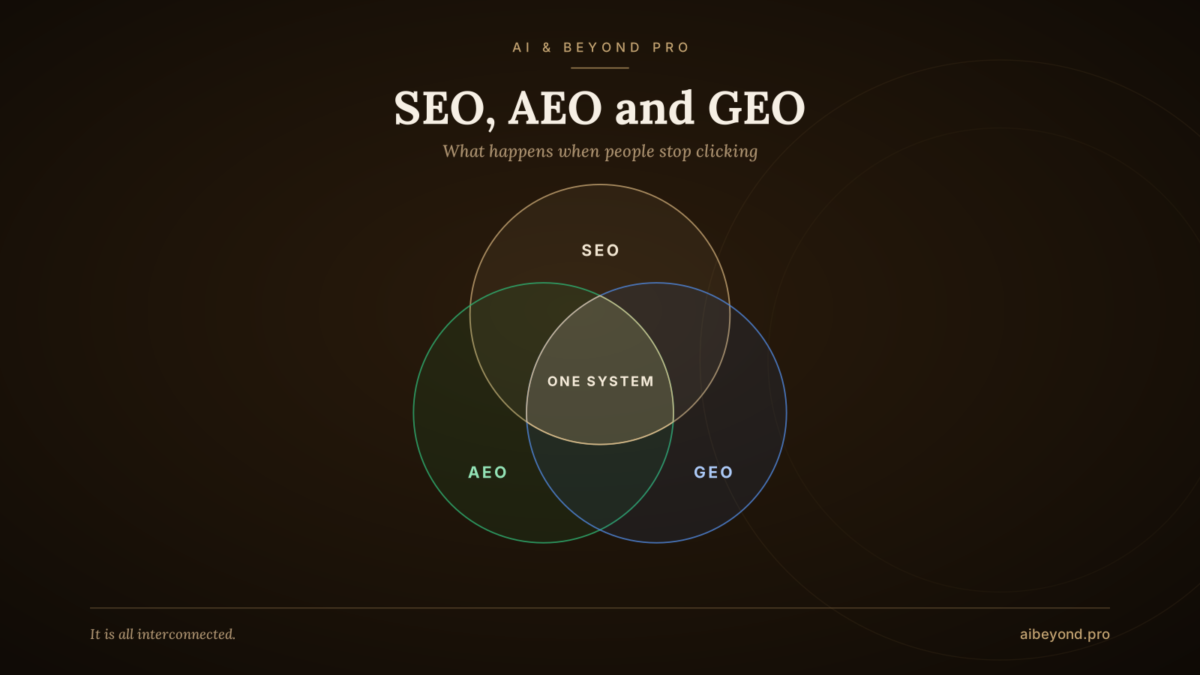
Learn how AEO and GEO are changing website visibility, why AI search reduces clicks, and how to earn citations in ChatGPT, Claude, and Google.
Think about the last time you needed a quick answer. Did you Google it? Or did you just ask ChatGPT or Claude?
More and more people pick the second one. They type a question into an AI tool, read the reply and move on. No scrolling. No ten blue links. Just an answer.
If you run a website, that changes everything about your job. To see why, it helps to start with how the old job worked.
How search works today
The system most of us grew up with is simple enough. Google sends out little programs called crawlers that read pages across the web. It stores what they find. When you search, Google sorts through that store and shows you a list, best guess first.
SEO, or search engine optimization, is the work of getting your page near the top of that list. You write something useful. You make the page easy for a machine to read. You get other respected sites to link to you, which acts like a vote of confidence. Do this well and you land on page one.
And page one was the whole prize. That was the finish line. Top of page one meant traffic, and traffic meant money.
How fast is this changing?
I went looking for a clean number here and could not find one worth repeating. You should be suspicious of anyone who hands you one.
There are plenty of articles with confident percentages and firm deadlines. Most of those numbers are guesses wearing a suit. What we can actually see is softer. AI answers now sit at the top of many Google searches. Fewer people click through when they do. A real chunk of questions that used to go to a search bar now go straight to an AI tool instead.
That is enough to act on. It is not enough to plan around a date.
Will it become all AEO and GEO?
This is the question most people get wrong, and I nearly did too.
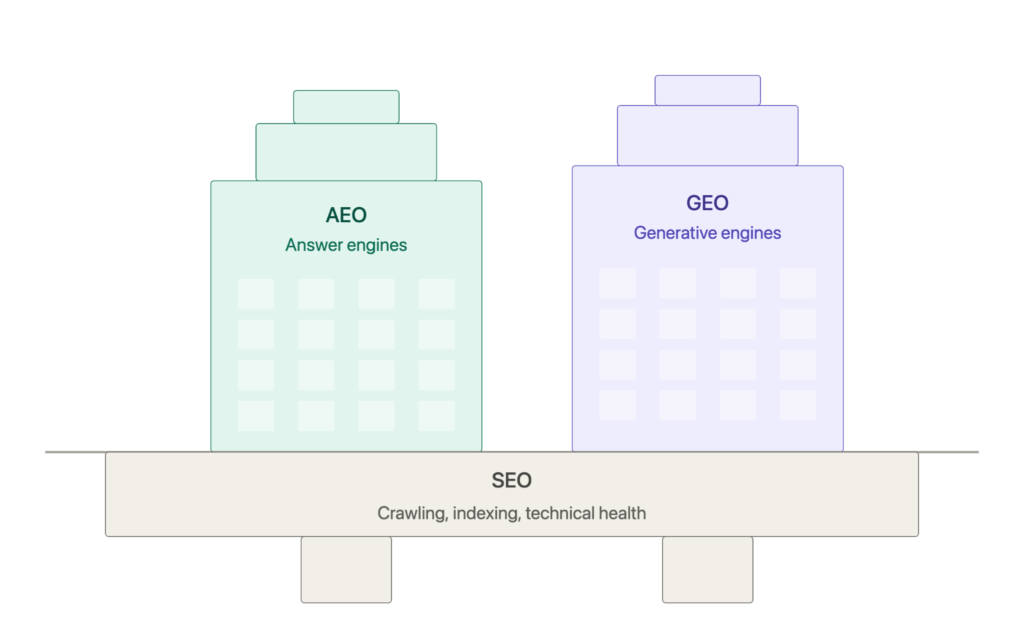
My first assumption was that SEO is dying and these new things replace it. But that is not how it works. An AI tool can only mention pages it can actually find and read. Finding pages on the web is the old problem. It is the exact thing search engines have always done.
So SEO is not being replaced. It is turning into the floor. If your SEO is broken, your GEO is broken too, because nothing can cite a page it cannot reach. The new work sits on top of the old work.
What changes is the reward. Not the foundation.
Decoding the terms: AEO vs GEO
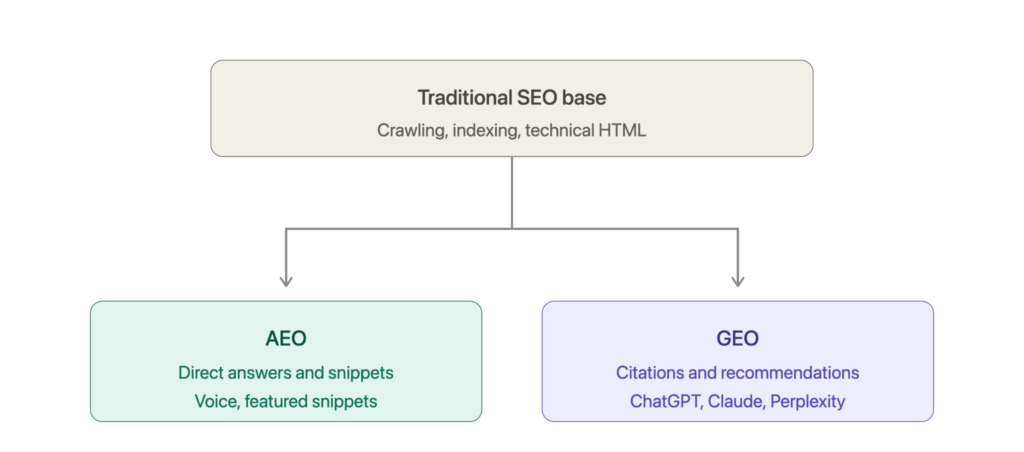
It helps to separate the two.
AEO, answer engine optimization, is about becoming the direct answer. Those boxes at the top of Google that reply before any website loads, or the sentence your voice assistant reads out loud. You win it by writing clean and plain, so a machine can lift one of your sentences and use it whole.
GEO, generative engine optimization, targets conversational AI tools like ChatGPT, Claude, Gemini and Perplexity. When one of them answers, it pulls from a handful of sources and names them. That mention is a citation, and GEO is the work of earning it.
The new rules of visibility
Traditional SEO had a finish line you could see. Rank in position one. Measurable, trackable, easy to screenshot.
GEO has nothing like it. The order of cited sources moves around. It changes between tools, and it changes when two people ask the same question an hour apart. You are not chasing a position. You are chasing a reputation.
Prompts are longer than keywords
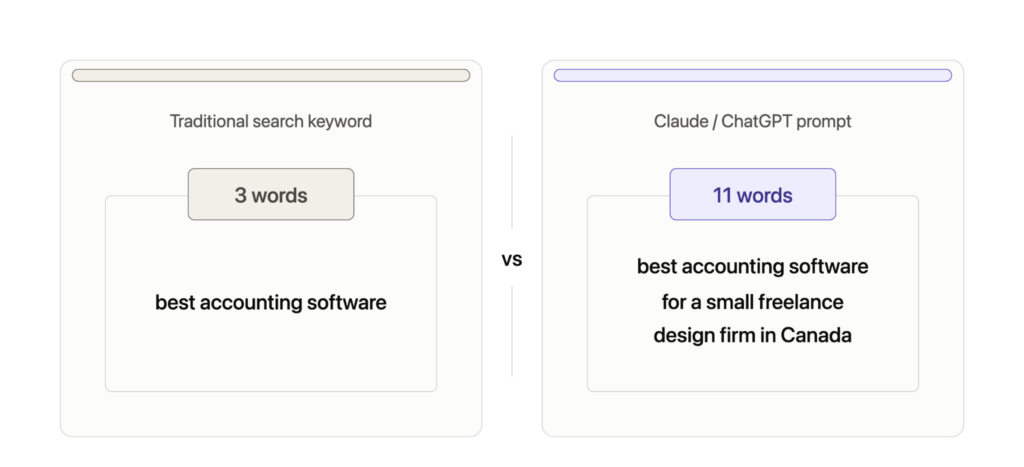
Searches are short. People type a few words and hit enter. Something like “best accounting software.”
Prompts are not. The same person writing to ChatGPT or Claude tends to write a full sentence. “Best accounting software for a small freelance design firm in Canada.” Three words became eleven, and those extra eight are doing real work. They carry the business size, the business type and the country.
That is the part worth sitting with. You cannot write a page targeting that exact sentence, because there are endless ways to phrase it. What you can do is state plainly who your tool suits, what size of firm, which countries and what it costs. Then the model has something to match against, whichever way the question arrives.
The shelf is smaller
What does this refer to? It refers to the links that AI cites for a specific query provided by a user
We assume at first, given AI tools read the whole web, surely there is more competition for a mention and we are competing with 50 other pages to get our page referenced.
However, it turns out they cite very little and the shelf is smaller. A typical answer names somewhere between 2 and 7 sources.
Why clicks are falling
So if the shelf is smaller, why are clicks still falling?
Because the reader already got what they came for. They asked, they were answered, they moved on. Your link sits right there, correctly cited, perfectly visible, completely ignored. It is not a competition for attention. It is the absence of any reason to click.
Once I saw it that way the question changed. It stopped being “how do I beat the other cited links” and became “what does the reader still want once the answer is finished.” Usually that is depth, a specific number or a real opinion that a short summary could not carry.
Clear beats comprehensive
Piling on words does not make a machine pick you. What seems to matter is being the clearest, most specific source on the exact question asked. If someone asks something narrow and your page answers it plainly and early, you have a decent shot.
Clear beats comprehensive. Specific beats broad.
How to earn AI citations
A few practical moves seem to beat chasing exotic tricks.
Write non-commodity content. Avoid generic roundups. Real experiences, firsthand data and original opinions give a model something it cannot produce on its own.
Lead with quotable statements. AI tools favour direct answers near the top of a page. State the main fact clearly before the background.
Consider video. Video transcripts hand models clean, original material to work from, and YouTube appears frequently in AI citations across a range of queries.
Watch for Reddit. If you ask an AI tool a question in your niche and it cites a forum thread, that is a gap. It means no authority site has published a clear answer, so the model reached for whatever was there.
Which AI are your readers actually using?
This matters more than any general tip here, and nobody can answer it for you.
A finance audience might live in one tool while a design audience lives in another. Getting cited by ChatGPT and getting cited by Claude are not the same job, and one probably matters far more for your particular readers.
The only honest way to find out is to test it. Take twenty questions your readers would genuinely ask, run them through each tool and see who gets named. That afternoon will teach you more than any article on GEO, this one included.
The uncomfortable truth
The part nobody wants to say out loud
If clicks keep falling, plenty of websites have a money problem. Ads, affiliate links and sponsorships all assume people arrive. If a tool answers the question and the reader never shows up, that assumption breaks. The value shifts from being visited to being recommended.
I do not have a solved answer for that one. I am not sure anyone does yet.
The data is still thin
Being honest about this means admitting the proof is thin. There is no proper dashboard showing how you perform inside an AI answer. The tools change behaviour often. Treat every rule here, mine included, as a reasonable guess rather than a law especially because it is a matter of fact that LLMs are constantly evolving and what’s important changes too.
Final thoughts
Run small tests on your own site, watch what moves, keep notes. This will get clearer as measurement improves.
But the people who show up early, while the rules are still loose, are usually the ones holding the space once the rules harden.
