
The AI Data Quality Problem: Why Better Models Can’t Fix Bad Data

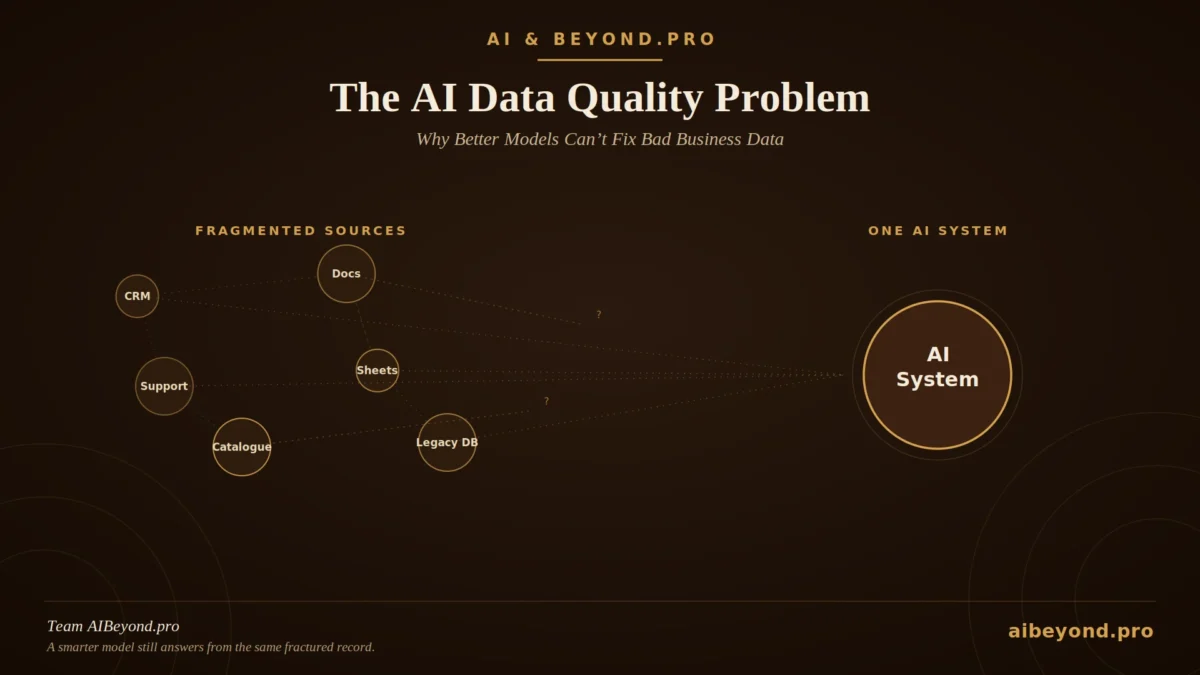
Upgrading your AI model won’t fix outdated, duplicated, or conflicting business data. Here’s why data quality not model choice is the real constraint on enterprise AI.
A mid-sized company connects an AI assistant to its internal systems: the CRM, the support desk, a shared drive of policy documents. Ask it a simple question: what’s our current return policy for enterprise customers and it gives three different answers across three different days.
The easy conclusion is that the model is wrong. The actual explanation is usually less interesting and more important: the model received conflicting information and had no way to know which version was current. One policy document still carried last year’s terms. A support ticket referenced a since-revised exception. The CRM field for “customer tier” meant one thing to sales and another to support. The model answered correctly, given what it was shown. What it was shown was the problem.
That distinction the model is wrong versus the information the model received was wrong is the one most AI rollouts skip past, and it’s the subject of this article.
An AI system can only work with the information available to it.
Better Models, Same Data
It’s tempting to treat inconsistent AI answers as a model problem and respond by upgrading: a newer version, a bigger context window, a more capable provider. Sometimes that helps at the margins. It does nothing about the data underneath, because the model isn’t the part that’s broken.
The patterns are familiar to anyone who has worked inside a CRM or a shared drive for more than a year:
- Outdated information. A pricing sheet, a policy document, or a product spec that was accurate last year and never got updated.
- Duplicate records. The same customer or product entered multiple times, under slightly different names, with no clear record of which one is current.
- Conflicting information. Two systems sales and finance, say that disagree about the same account, order, or contract term.
- Missing fields. Records that were created quickly and never completed: no industry, no renewal date, no account owner.
- Inconsistent naming. “Acme Corp,” “Acme Corporation,” and “ACME” treated as three separate entities because nothing forced them to match.
- Unstructured documents. PDFs, slide decks, and email threads holding real institutional knowledge, formatted for human skimming rather than reliable extraction.
- Disconnected systems. A CRM, a support platform, and a documentation wiki that evolved on their own timelines and were never meant to agree with each other.
None of these problems are new. What’s new is that a capable AI system doesn’t quietly route around them the way a careful employee might. It answers directly, confidently, and at speed using whatever it finds.
It’s worth being precise about what upgrading a model does and doesn’t change. A more capable model can reason better over ambiguity, write more fluently, and handle a wider range of phrasing in how a question is asked. None of that helps it decide which of two conflicting CRM records is the real one, or notice that a policy document is a year out of date, unless something in the data itself signals that. Reasoning ability and factual grounding are different capabilities, and only one of them improves when a company switches providers.
AI Amplifies Data Problems
A messy spreadsheet is a nuisance. A messy spreadsheet connected to an AI agent that queries it thousands of times a day is a nuisance operating at scale.
A human employee navigating a flawed CRM at least brings outside judgment: this duplicate looks wrong, let me check the right one; this document is from last year, I should ask someone. An AI system has no such instinct unless it’s explicitly built in. It treats a duplicate as two true facts, a stale document as current, and a missing field as a thing it should either ignore or quietly guess at. The data’s problems become the system’s problems reproduced instantly, consistently, and without the hesitation a person might show.
This shows up across the systems companies connect AI to most often:
- CRM data. Deal stages, contact ownership, and account history that drift out of sync the moment two reps update the same account differently.
- Product catalogues. Specifications, pricing, and availability that change faster than someone remembers to update every downstream copy.
- Support documentation. Help-center articles and internal runbooks that reflect how the product used to work, not how it works now.
- Internal policies. PDFs and wiki pages passed around by habit long after the policy itself was revised.
- Customer records. The same person represented differently across marketing, sales, and support, each with a partial and slightly different picture.
- Analytics data. Dashboards built on metrics defined differently by different teams, so “active user” or “qualified lead” means three things depending on who built the query.
Retrieval-augmented systems make the mechanism concrete. Researchers who studied three production RAG deployments catalogued failure points that trace directly back to the source material: content missing from the knowledge base, documents that technically contain an answer but weren’t written clearly enough to extract it, and information buried where retrieval doesn’t reliably find it. None of these are model failures. They’re data failures the model happened to expose.
The Difference Between Data Access and Data Quality
A common assumption is that connecting an AI system to more sources makes it smarter: plug in the CRM, then the support platform, then the documentation wiki, then analytics, and watch the picture get clearer.
That assumption breaks down the moment the sources disagree. A system wired into all four may have more access than ever and still produce a worse answer than a narrower system built on one clean, current source because it now has to choose between conflicting versions of the truth, and nothing tells it which one to trust.
Access is a connectivity question: can the system reach the data at all. Quality is a trust question: is what it finds there accurate, current, and unambiguous. The two get conflated constantly, because solving access the integration work, the APIs, the permissions is the part that looks like concrete progress. It’s also the part that, on its own, does nothing about whether the underlying information deserves to be trusted.
Consider a company that connects its AI assistant to four systems over a single quarter, treating each new connection as a milestone. By the end of the quarter, the assistant can technically see more of the business than any individual employee can. It still gives an answer about a customer’s contract terms that contradicts what the account team knows to be true, because two of those four systems disagree and nothing in the integration work ever asked which one should win. More access described the achievement. It never addressed the actual risk.
What “AI-Ready Data” Actually Means
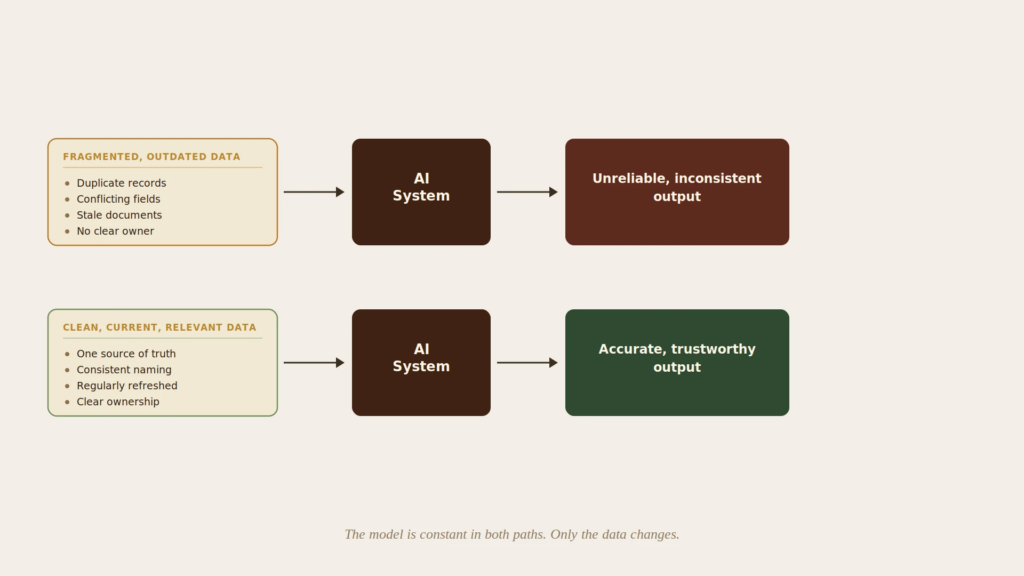
“AI-ready data” gets used as a synonym for “everything in one database,” which misses the point. Centralizing fragmented, outdated, and duplicated data just produces a single, large, fragmented, outdated, duplicated source instead of several small ones. Volume and location were never the issue.
What actually makes data usable for an AI system is closer to a short list of properties:
- Accurate. It reflects reality, not what was true at some point in the past.
- Current. It’s refreshed often enough to match how quickly the underlying facts actually change.
- Consistent. The same entity is represented the same way everywhere it appears.
- Relevant. It’s the information the AI system’s specific task actually requires not everything the company has ever stored.
- Traceable. Its source and recency can be identified, so a person can check where an answer came from.
- Structured enough for the task. Not necessarily a rigid database schema a well-organized document can be enough but organized enough that the system can reliably locate what it needs.
- Governed. Someone is accountable for its accuracy, and there’s a process for correcting it when it drifts.
Gartner’s framing of data quality names several of the same dimensions accuracy, completeness, consistency, timeliness, and validity among them and identifies inconsistency across sources as the single most common obstacle organizations report. That’s a general data management finding, not an AI-specific one. AI systems simply make the cost of ignoring it visible faster than a quarterly report would.
The Business Cost
Poor data quality doesn’t fail loudly. It shows up as a slow accumulation of smaller costs that are easy to attribute to the wrong cause:
- Unreliable answers, inconsistent from one query to the next, that erode confidence in the system faster than any outage would.
- Incorrect recommendations a suggested discount, a flagged risk, a next step built on a record that was wrong at the moment it mattered.
- Wasted human review, as staff learn to double-check AI output against the source systems, which quietly cancels out the time the AI was meant to save.
- Lower trust, which compounds: once a team stops believing the system, they stop using it for anything that actually matters.
- Failed automation, where workflows that worked in testing break in production because real data is messier than the test set ever was.
- Unnecessary cost, from licensing and running tools against the same unreliable data without ever addressing why the outputs were unreliable.
Gartner’s own research puts the average cost of poor data quality at $12.9 million a year per organization a pre-AI estimate, not built around AI projects specifically, but a useful floor. MIT’s 2025 study of enterprise generative AI pilots, widely discussed under the name “the GenAI Divide,” traced the gap between successful and stalled projects to a mismatch between flexible AI tools and the messier systems including the data that businesses actually run on. The pattern in both cases is the same: the shortfall traces back to the foundation, not the model sitting on top of it.
A Simple 5-Step Framework
01 Identify the data the AI actually needs
Start from the task, not the archive. A support assistant needs current policies and product documentation not the company’s entire historical file share.
02 Find the source of truth
For each piece of information the task depends on, name the one system that should be treated as authoritative when others disagree.
03 Remove or resolve conflicting information
Retire duplicate records, archive outdated documents, and reconcile fields that mean different things in different systems before connecting anything.
04 Establish ownership and freshness
Assign a person or team to each data source who is responsible for its accuracy, and set an expectation for how often it needs to be reviewed.
05 Continuously check whether the data still supports the task
Data that was clean at launch won’t stay that way. Build a habit of checking AI output against the source and treating a wrong answer as a prompt to ask what in the data made it wrong.
None of these steps require a data-engineering overhaul. They require someone to decide, explicitly, what the AI system is allowed to trust. Treated as a one-time setup task, this framework still leaves a company exposed the first time a document goes stale or two systems drift apart again which is why the fifth step is ongoing rather than a final box to check.
FAQ
Why does data quality matter for AI?
An AI system can only reason over the information it’s given. If that information is outdated, duplicated, or inconsistent, a more capable model will still produce unreliable answers, because the problem isn’t the model’s reasoning it’s what it was shown.
Can better AI models fix bad data?
No. A stronger model can reason more capably over what it’s given, but it can’t independently know which of two conflicting records is correct or which document is current. That judgment has to come from how the business manages its data.
What is AI-ready data?
Data that is accurate, current, consistent, relevant to the task, traceable to its source, structured enough to be reliably retrieved, and governed by someone accountable for its quality not simply all of a company’s information centralized in one place.
How does poor data affect AI accuracy?
Poor data leads AI systems to retrieve stale or conflicting information and present it with the same confidence as accurate information, producing inconsistent answers, wrong recommendations, and reduced trust in the system.
What should companies do before deploying AI?
Identify exactly what data the AI task needs, establish a single source of truth for it, resolve conflicting or duplicate records, assign ownership for keeping it current, and continuously check whether the data still supports the task.
The Bottom Line
Most conversations about enterprise AI still start with a single question: which model should we use? It’s a reasonable question, and an increasingly minor one. The question underneath it matters more: can the information behind our AI be trusted?
A better model can reason more capably over what it’s given. It cannot tell the difference between a current policy and a stale one, or know which of two conflicting customer records is right, unless the business has already done that work. The best model available cannot compensate indefinitely for unreliable business information and the companies that get real
