
From AI Agents to AI Systems: Why Connecting the Pieces Matters

Building an AI agent is the easy part. Learn why turning agents into reliable business systems with data, permissions, and oversight is the real challenge.
For the past two years, the defining question in enterprise AI has been: can we build an AI agent? Increasingly, the answer is yes. Frameworks are mature, models are capable, and a working prototype that reads a document, calls a tool, and drafts a response can come together in days.
That has quietly shifted the real question to something harder: can this agent actually work inside the business? Can it find the right information among a dozen disconnected systems, act within the permissions someone actually granted it, hand off cleanly to a person when it should, and keep doing all of that reliably after the demo ends?
The gap between those two questions shows up in the numbers. Gartner predicts that more than 40% of agentic AI projects will be canceled by the end of 2027, citing escalating costs, unclear business value, and inadequate risk controls not a shortage of model capability. MIT’s Project NANDA, in a widely discussed 2025 study, found that 95% of enterprise generative AI pilots were failing to show a measurable return, and traced the pattern to a “learning gap” between flexible AI tools and the more rigid systems a business actually runs on.
Building an agent is an AI problem. Making it work is a systems problem.
Neither figure is a verdict on the technology. Both are a description of where the difficulty has moved: from the model to everything around it.
An Agent Is Not a System
Four terms get used loosely and are worth separating.
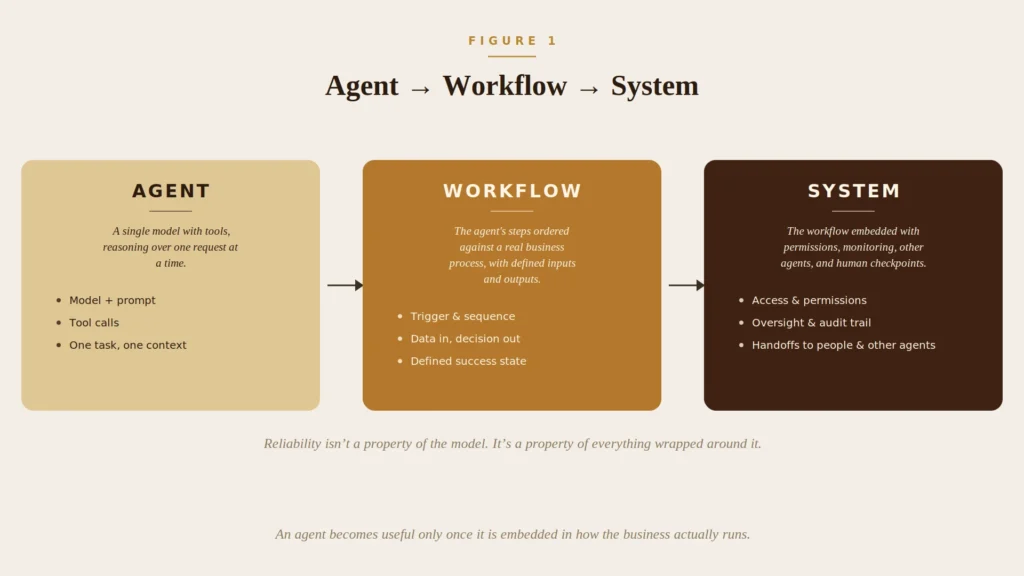
- An AI model predicts text. Given an input, it produces an output. It has no memory between calls and no access to anything outside what it’s given.
- An AI agent is a model given tools, a goal, and the ability to take multiple steps reasoning about what to do next, calling a tool, reading the result, and deciding again. It operates within a single task.
- An AI workflow is a defined sequence of steps, with or without an agent inside it, that takes a business input to a business output. A workflow has a trigger, a path, and a success condition.
- An AI system is a workflow embedded in the business: connected to real data and tools, operating within permissions someone set, observable by the people responsible for it, and able to hand off to a human or another process when it should.
A simple example makes the distinction concrete. A contract-review agent that reads a PDF and lists risky clauses is an agent. Wire it to a document-management system so it triggers automatically when a contract is uploaded, and it’s a workflow. Give it read access scoped to the right folder, a way to flag high-risk contracts to legal rather than approving them itself, a log of what it looked at and why, and a person who gets notified when it’s unsure and it’s a system.
Most of what gets built and demonstrated today is the second thing wearing the label of the fourth. The gap between them is where most agentic AI projects stall.
Where the Connections Break
The failures that keep agents from becoming systems are rarely about reasoning quality. They’re about plumbing.
- Fragmented business data. The information an agent needs is split across a CRM, a ticketing system, spreadsheets, and someone’s inbox, in formats that don’t agree with each other.
- Disconnected SaaS tools. Each tool has its own API, its own authentication, and its own quirks. Connecting an agent to five tools has historically meant building and maintaining five separate integrations.
- Limited system access. An agent that can’t reach the record it needs will either fail visibly or, worse, answer confidently from incomplete information.
- Incompatible workflows. The agent’s idea of a process and the business’s actual process its exceptions, its approval steps, its edge cases don’t match.
- Unclear permissions. Nobody has decided, in writing, what the agent is and isn’t allowed to do, so it either can’t do enough to be useful or can do more than anyone intended.
- Lack of shared context. The agent doesn’t know what a human colleague would know without being told: this customer is a VIP, this vendor is under review, this exception was already approved.
- Poor handoffs between agents and humans. Work passes to a person with no explanation of what was tried, what’s uncertain, or what to check so the handoff creates more work than it saves.
Each of these is solvable on its own. Together, they’re why a capable agent can still fail to become a dependable part of the business.
The Data, Tool, and Context Layer
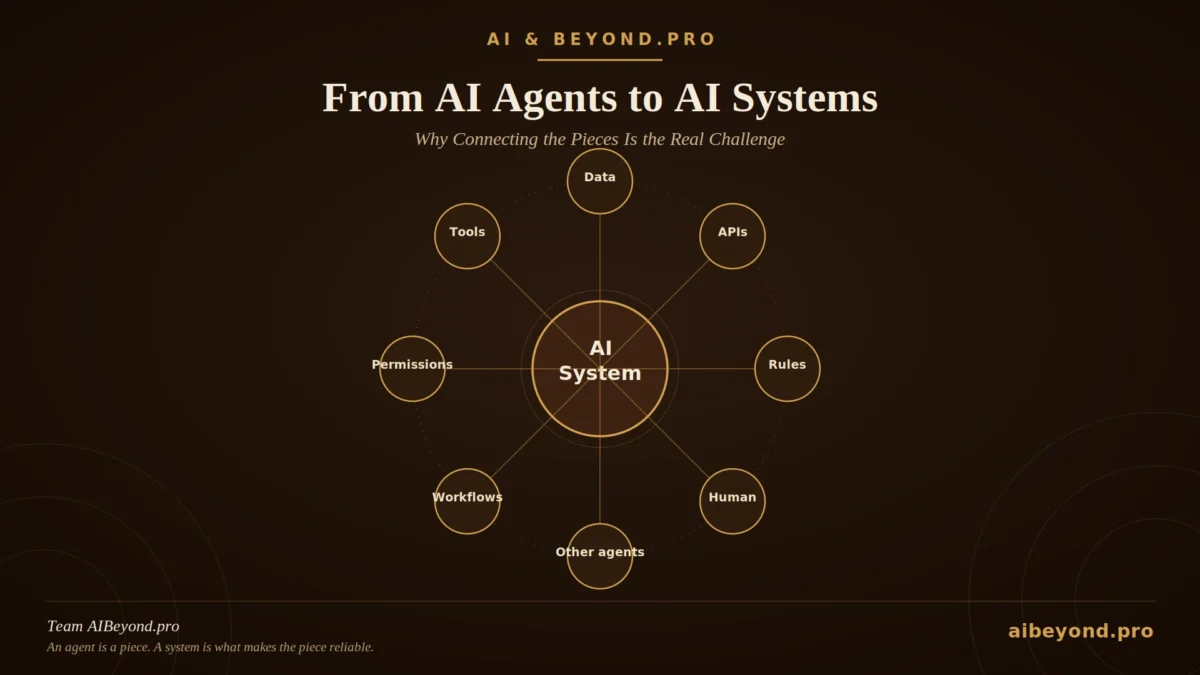
Underneath all of these problems is one requirement: a useful AI system needs access to the right data, the right tools, and the right context reliably, not as a one-time integration.
- Data means current, accurate information from the systems of record, not a stale export or a document someone remembered to attach.
- Tools are the actions an agent can actually take: look up a record, update a field, send a message, create a ticket each with clearly defined inputs and outputs.
- APIs are how the agent reaches those tools and data sources in the first place. Every additional system historically meant another custom connection to build and maintain.
- Business rules are the constraints a human employee would apply without thinking: which discounts need approval, which customers get escalated, which requests are out of scope.
- Context is the surrounding information that turns a correct answer into the right answer for this situation history, exceptions, and unwritten conventions.
This is the layer the Model Context Protocol was built to address. Anthropic introduced MCP in November 2024 as an open standard for connecting AI systems to external data sources and tools, replacing custom, one-off integrations with a shared protocol. Standards like this lower the cost of connection. They don’t remove the need to decide, for each connection, what an agent should see and what it should be allowed to do that decision still belongs to the business, not the protocol.
Why Multi-Agent Systems Add Complexity
Splitting work across several agents is often proposed as the natural next step: one agent for research, one for drafting, one for review. It can work well for some problems. It is not automatically better, and it introduces its own set of questions:
- Responsibility. When something goes wrong, which agent is accountable, and to whom does it report?
- Communication. What exactly does one agent pass to the next a full account of what it did and why, or a compressed summary that quietly drops details?
- State. Who holds the current, authoritative picture of where a task stands, and what happens when two agents disagree about it?
- Handoffs. How does work move from one agent to another, or from an agent to a person, without something getting lost?
- Errors. When one agent’s output is wrong, does the mistake stay contained, or does it propagate into every agent downstream that trusted it?
- Monitoring. Can anyone see the system as a whole, or only each agent’s slice of it?
- Permissions. Does each agent have its own scoped access, or does the whole system share one broad credential and what does that mean for the worst-case failure?
This is a genuinely contested question among the people building these systems, not a settled one. Cognition, the company behind the coding agent Devin, argued that running multiple agents in collaboration mostly produces fragile systems, because decision-making ends up too dispersed and context can’t be shared thoroughly enough between agents and recommended defaulting to a single agent unless a task clearly justifies more. Anthropic, describing the multi-agent system behind its own research product, reached a different conclusion for a different shape of problem: multi-agent works well for research-style tasks where subagents explore independent directions in parallel and don’t need to coordinate on a shared, conflicting decision.
The distinction both arrive at is useful on its own: agents that read and explore in parallel are comparatively safe to split up, because their outputs can simply be gathered and compared. Agents that write, decide, or act are riskier to split, because conflicting decisions made independently are hard to reconcile after the fact. The number of agents is a design choice with real trade-offs, not a mark of sophistication.
The Control Problem
As an agent’s scope grows, so does the need to see what it’s actually doing. Five questions define the baseline:
- What is the agent doing right now, and what has it done so far?
- Which systems and data can it reach, and which has it actually touched?
- What decisions has it made, and on what basis?
- What actions has it taken that have real consequences sent, changed, deleted, approved?
- At what point does a human need to step in, and how would anyone know that point had arrived?
This is a systems-design question, not a product feature to buy. It shows up as scoped permissions rather than one broad credential; as a log of actions and decisions that a person can actually read after the fact; and as defined checkpoints where the agent pauses for approval before anything irreversible happens. The OWASP Top 10 for LLM Applications names the failure mode directly as “excessive agency” traced to excessive functionality, excessive permissions, and excessive autonomy, where a system fails to independently verify high-impact actions before taking them. A guardrail written into a prompt doesn’t hold if the thing you don’t fully trust is the model’s own output; the check has to sit in a layer the agent can’t reason its way around. None of this is about distrust of AI in the abstract. It’s the same operational discipline any autonomous or semi-autonomous process earns before it’s allowed to touch production systems the same reasoning behind why human-in-the-loop checkpoints matter and why agent oversight belongs on the same footing as any other AI governance question a business already takes seriously.
From Prototype to Business System: A Practical Framework
Moving from a working demo to a dependable system doesn’t require solving every problem above at once. It requires sequencing them.
1. Start with one business process
Pick a single, well-understood process rather than an entire function. Narrow scope makes every later step easier to reason about.
2. Map the systems involved
List every tool, database, and document source the process actually touches today, including the ones nobody thinks to mention until something breaks.
3. Define what the agent can access
Decide, explicitly, which systems and data the agent can read and note what it should never need to touch at all.
4. Define what it can do
Separate actions the agent can take on its own from actions that require a person to approve first. Reversible and low-stakes actions belong in the first group; anything costly to undo belongs in the second.
5. Establish human intervention points
Decide in advance where a human checks the agent’s work not only where it fails, but where confidence should be verified even when it appears to succeed.
6. Test failure scenarios
Deliberately feed the system bad or missing data, conflicting information, and permission edge cases. A system that has only been tested on clean inputs hasn’t really been tested.
7. Monitor the workflow
Track what the agent did, what it decided, and what a human ultimately confirmed or corrected the record that later evaluation and audits depend on.
8. Expand only after reliability is demonstrated
Add scope, systems, or additional agents only once the current version has held up under real conditions for a meaningful stretch of time. Reliability earns expansion; it isn’t assumed in advance.
FAQ
What’s the difference between an AI agent and an AI system?
An AI agent is a model with tools that reasons through a single task. An AI system is that capability embedded in the business connected to real data and tools, operating within permissions, and monitored by the people responsible for it.
Are multi-agent systems always better than a single agent?
No. Splitting work across agents adds real complexity around responsibility, communication, and error propagation. It suits tasks where agents explore independently; it’s riskier where agents must make conflicting decisions.
What is the Model Context Protocol (MCP)?
MCP is an open standard, introduced by Anthropic in November 2024, for connecting AI systems to external data sources and tools through a shared protocol instead of custom, one-off integrations.
Why do most AI agent projects fail to scale?
Research from Gartner and MIT points to cost, unclear business value, and weak integration with existing workflows not a shortage of model capability as the main reasons agentic AI projects stall or get canceled.
The Bottom Line
The first phase of enterprise AI was about proving that agents could reason, plan, and act. That proof is largely in. The next phase is less glamorous and considerably harder: designing the infrastructure, permissions, shared context, workflows, and oversight that let those agents operate inside a business without supervision failing quietly in the background.
An agent that works brilliantly in isolation and fails silently in production hasn’t solved the problem a business actually has. The organizations that get real value from AI agents won’t be the ones with the most capable individual agents. They’ll be the ones that treated the system around the agent as seriously as the agent itself.
