
Small Language Models: Why Bigger Isn’t Always Better for Business

Small language models can cut AI costs and latency without sacrificing task performance. Learn when businesses should use SLMs, large models, RAG, and model routing.
For the past several years, the AI industry has run on a single, mostly unspoken assumption: bigger models are better models. Every major release competed on the same axis more parameters, broader capability, higher benchmark scores. If a company wanted the best AI, it bought the biggest one it could afford.
For a genuinely difficult reasoning task, that instinct is often correct. A model asked to synthesize conflicting research, debug an unfamiliar codebase, or reason through an ambiguous multi-step problem usually benefits from more capability, not less.
But a large share of what businesses actually ask AI to do isn’t that. It’s classifying a support ticket. Extracting a date and an amount from an invoice. Routing an email to the right team. Summarizing a document into three bullet points. Formatting unstructured text into a clean JSON object. None of these are reasoning problems in any meaningful sense; they’re narrow, repetitive, well-defined tasks.
That mismatch is where an increasingly important question lives, and it isn’t “what’s the smartest model available.” It’s: what is the smallest model that can reliably do this job?
This isn’t an argument that small models are simply better. Some workloads genuinely need a large, highly capable model, and no amount of clever engineering changes that. The argument is narrower and more useful: model capability and business value are different things, and treating them as the same thing leads companies to overpay, over-engineer, and over-complicate workloads that never needed frontier-level intelligence in the first place.
Bigger Models Solved a Problem Businesses Didn’t Always Have
The last several years of AI progress were driven substantially by scale, more training data, more parameters, more computation. Capability became the dominant metric because it was the easiest one to compete on publicly: a new model either beat the previous benchmark scores or it didn’t.
That race produced genuinely more capable systems. It also quietly established capability as a proxy for value, which is a different claim. A workflow’s actual requirements: predictable output format, low latency, high throughput, controlled cost, data residency, straightforward deployment are not things a bigger model automatically improves, and in several cases a bigger model makes them harder to satisfy. Larger models typically cost more per token to run, respond more slowly, and require more infrastructure to serve at volume.
NVIDIA Research made a version of this argument directly in a 2025 position paper, “Small Language Models Are the Future of Agentic AI,” arguing that language models inside agentic systems are frequently asked to perform “a small number of specialized tasks repetitively and with little variation” a description that fits a large share of enterprise AI workloads far better than “open-ended reasoning” does. The paper’s authors, a team from NVIDIA Research and Georgia Tech, argue that for this category of task, small models are “sufficiently powerful, inherently more suitable, and necessarily more economical.”
The point isn’t that capability doesn’t matter. It’s that capability is only one input into business value, alongside cost, speed, and reliability and a workflow’s requirements should determine which of those inputs actually matters most.
What Is a Small Language Model?
There’s no single, universally agreed parameter count that defines a small language model, and any source claiming otherwise should be read skeptically. “Small” is relative to the current frontier, not a fixed threshold. A 2026 guide from Turing Post put it plainly: SLMs “can range from under one billion parameters to larger mixture-of-experts models that activate only a small portion of their total parameters during inference” meaning even the definition of “small” now depends partly on architecture, not just raw parameter count.
What tends to distinguish small language models in practice isn’t one number, but a cluster of related characteristics: a parameter count generally in the hundreds of millions to low double-digit billions; training that emphasizes curated, high-quality data over raw web-scale volume; a narrower or more specialized capability profile; and deployment requirements modest enough to run on a single GPU, a workstation, or in some cases a phone.
Microsoft’s Phi-3-mini is a useful concrete example: a 3.8-billion-parameter model, released in 2024, small enough to run on a phone, that Microsoft positioned as delivering capability comparable to considerably larger models of the previous generation. Google’s Gemma family spans a similar range of small, openly available models designed for efficient deployment rather than maximum raw capability. Both illustrate the same underlying idea: “small” describes a design philosophy do more with less rather than a specific, fixed cutoff.
Is a small language model useful for business? Often, yes for narrow, well-defined, high-volume tasks where the model’s job is to perform reliably rather than reason broadly. The relevant question isn’t whether an SLM is capable in the abstract. It’s whether the specific task at hand actually requires the capability a larger model provides.
Small Doesn’t Mean Simple
It’s a mistake to treat “small” as synonymous with “basic” or “outdated.” A handful of specific techniques have meaningfully closed the gap between what small and large models can do on a given task, even though they haven’t eliminated the gap entirely.
Distillation trains a smaller model to mimic the behavior of a larger one, transferring much of what the larger model learned into a fraction of the parameter count. Quantization reduces the numerical precision a model’s weights are stored in, shrinking memory footprint and speeding up inference with a generally modest, task-dependent accuracy cost. Fine-tuning adapts a smaller model to a specific domain or task, often closing a meaningful portion of the capability gap for that narrow use case even though the model remains weaker on tasks outside it. Retrieval augmentation covered in more detail below lets a smaller model rely on retrieved information rather than everything it would otherwise need to have memorized during training.
None of this means a well-optimized small model matches a frontier model across the board. It means the honest comparison isn’t “small model versus large model” in the abstract it’s “this specific optimized small model versus a large model, on this specific task,” and the answer to that comparison varies considerably by task.
The Business Case for Smaller Models
Cost
Running a model at scale means paying, in some form, for every token processed whether that’s a direct API cost or the amortized cost of infrastructure. Smaller models are cheaper to serve per token, a difference that compounds meaningfully at high request volumes. The NVIDIA Research paper cites inference costs for small models running on the order of 10 to 30 times lower per token than large generalist models in real deployed systems a range worth treating as directional rather than a number that applies uniformly to every workload, since actual savings depend heavily on the specific models, infrastructure, and task being compared.
Latency
A model that responds in a few hundred milliseconds behaves differently inside a product than one that takes several seconds. For real-time workflows a chat interface, a live routing decision, an in-line content check latency isn’t a nice-to-have, it’s often the difference between a workflow that feels usable and one that doesn’t. Smaller models generally have lower inference latency than larger ones, largely because there’s less computation to perform per token generated.
Throughput
At low volume, the cost and latency differences between a small and large model may not matter much to the business. At high volume millions of classification calls, a support system fielding thousands of tickets daily the economics shift considerably, because the per-request differences multiply across every single call.
Deployment
Small models open deployment options that are impractical for frontier-scale systems: running on a single GPU, a standard workstation, or in specific cases directly on-device, rather than requiring a large, specialized cluster. This matters most for organizations with infrastructure constraints, air-gapped environments, or a strong preference for keeping inference on infrastructure they directly control.
Privacy
It’s worth being precise here: a smaller model is not automatically more private or more secure. Privacy is a property of the overall architecture where data is processed, how it’s stored, what access controls exist, which third parties (if any) see it not a property of parameter count on its own. What smaller models do enable, in some cases, is processing on infrastructure an organization directly controls rather than sending data to an external API, which can be a meaningful architectural choice for regulated industries. But choosing a small model doesn’t create privacy benefits by itself; the deployment decisions around it do.
Where Small Models Make Sense
Several categories of enterprise workload are well suited to smaller models, specifically because the task is narrow and the acceptable range of correct outputs is well defined.
Classification and intent detection. Sorting a support ticket into a category, or determining what a user is trying to do, rarely requires broad reasoning it requires consistent pattern recognition against a known set of categories.
Information extraction. Pulling a date, an amount, or a name out of a structured or semi-structured document is a narrow, well-bounded task where a smaller, fine-tuned model can perform reliably.
Document categorization and tagging. Assigning metadata or routing content to the right internal system is repetitive and high-volume exactly the profile that favors a fast, cheap model over a slow, expensive one.
Email and workflow routing. Deciding which team or system should handle an incoming request is a classification problem wearing a different hat.
Structured data extraction and formatting. Converting unstructured text into a defined schema benefits more from consistency and reliability than from broad general knowledge.
Simple summarization. Condensing a document into a few sentences, within a defined style, is a task many smaller models handle well, particularly when the summarization target is narrow and consistent.
Lightweight customer support. For a defined, bounded set of common questions, a smaller model can respond quickly and cheaply, with more complex or ambiguous queries escalated elsewhere.
Internal knowledge retrieval. Answering employee questions against a known, indexed knowledge base leans heavily on retrieval quality rather than the model’s own memorized knowledge which changes what the model itself needs to provide.
In each case, the underlying logic is the same: the task has a narrow, definable scope, and the model’s job is to perform that narrow task consistently not to demonstrate broad intelligence.
Where Large Models Still Matter
None of the above should be read as an argument against large models. Some tasks genuinely benefit from more capability, and no amount of optimization on a small model closes that gap.
Complex, multi-step reasoning the kind involved in working through an ambiguous problem with several interdependent parts still tends to favor larger models with broader training exposure. Open-ended research and synthesis, where the task is to draw connections across disparate, unstructured information without a predefined structure, plays to a large model’s strengths. Difficult or novel coding tasks, especially ones spanning unfamiliar codebases or requiring architectural judgment, generally benefit from a model with broader general capability. Ambiguous instructions, where the task itself has to be interpreted before it can be executed, tend to expose the limits of a narrowly specialized small model faster than a well-defined task does. Sophisticated agentic tasks requiring broad, general-purpose reasoning as opposed to the narrow, repetitive steps inside an agent workflow are exactly the case the NVIDIA Research paper itself carves out as still favoring large models, describing heterogeneous systems that combine both as “the natural choice” when general conversational ability is genuinely required.
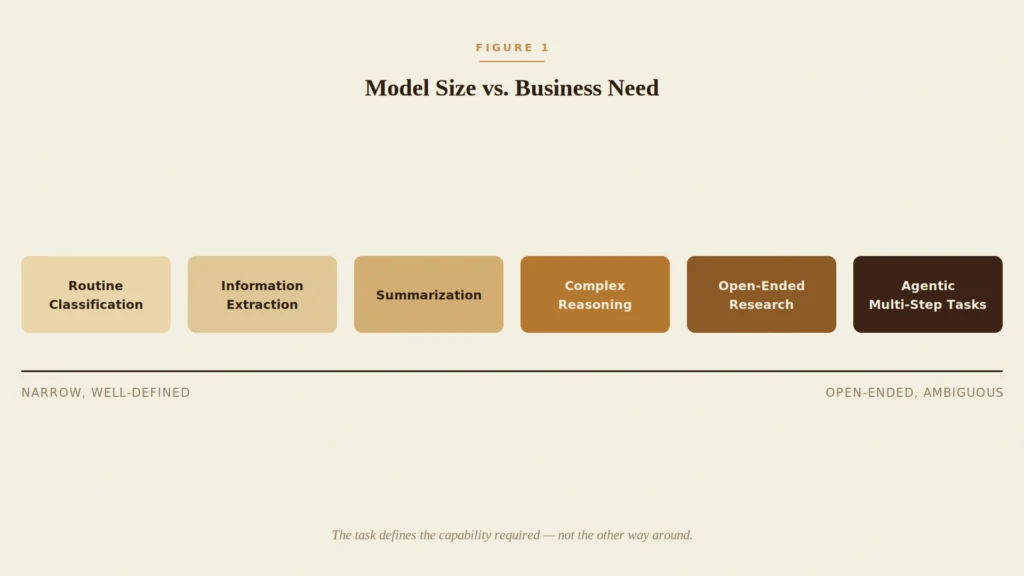
The pattern across all of these is the same: task openness. The less defined and bounded a task is, the more a larger model’s broader capability tends to earn its cost.
The Real Question Is Task Complexity
This is the article’s central idea, and it’s worth stating plainly: the right starting question is the task, not the model.
A useful way to think about it is as a simple chain: task complexity determines the model capability actually required, which determines cost and latency, which together determine business value. Skipping the first step starting instead with “what’s the most powerful model we can access” inverts that chain and optimizes for the wrong variable.
Are bigger AI models always better? Not for every task. A model’s capability ceiling matters when a task approaches that ceiling. For tasks well below it, the extra capability is unused overhead, not unused safety margin.
Framed as a question a business should actually ask before selecting a model: not “which model is the most capable one available,” but “what level of capability does this specific workflow actually require, and what does the next increment of capability beyond that cost in latency, price, and complexity.”
Small Models + RAG: A Different Kind of AI Stack
Retrieval-augmented generation changes this calculation in a specific way: it separates what a model needs to know from what it needs to be able to do.
A model doesn’t need to have memorized an organization’s entire knowledge base if the relevant facts can be retrieved and handed to it at the moment of the request. In that architecture, the retrieval layer becomes responsible for knowledge, and the model becomes responsible for reasoning over whatever it’s given and generating a coherent response a narrower job than holding all of an organization’s knowledge in its own weights.
This doesn’t make a small model equivalent to a large one. A large model still generally handles complex synthesis across retrieved material better than a small one does, and retrieval quality itself becomes a new dependency and a new potential point of failure a small model paired with poor retrieval performs worse than either component alone would suggest. What RAG does change is the specific burden placed on model size: an organization can separate the “knowledge” problem, addressed by retrieval, from the “capability” problem, addressed by the model and size the model to the reasoning task rather than to the scope of institutional knowledge.
Small Models Inside Agent Workflows
Agent workflows make the task-complexity argument concrete, because a single agent workflow typically contains several distinct steps with very different requirements. A representative sequence might run: a user submits a request, the system classifies intent, selects an appropriate tool, retrieves relevant information, reasons about how to respond, produces structured output, and executes an action.
Not every one of those steps demands the same capability. Intent classification and tool selection are narrow, repetitive decisions well suited to a fast, cheap model. Complex reasoning over ambiguous or conflicting information is where a more capable model earns its cost. Structured output generation, if the schema is well defined, is again a narrow task.
This is the foundation of model routing: directing different steps of a workflow to different models based on what each step actually requires, rather than running every step through the same model regardless of complexity. The NVIDIA Research paper frames this explicitly as its central practical recommendation proposing what it calls an LLM-to-SLM conversion process, where a large generalist model is used initially to map out a task, and specific repetitive steps are then handed off to smaller, specialized models once the pattern is understood, with the large model retained for the genuinely difficult cases.

The Model Portfolio Approach
Extending this idea across an entire organization’s AI usage, rather than a single workflow, produces something closer to a portfolio than a single model choice.
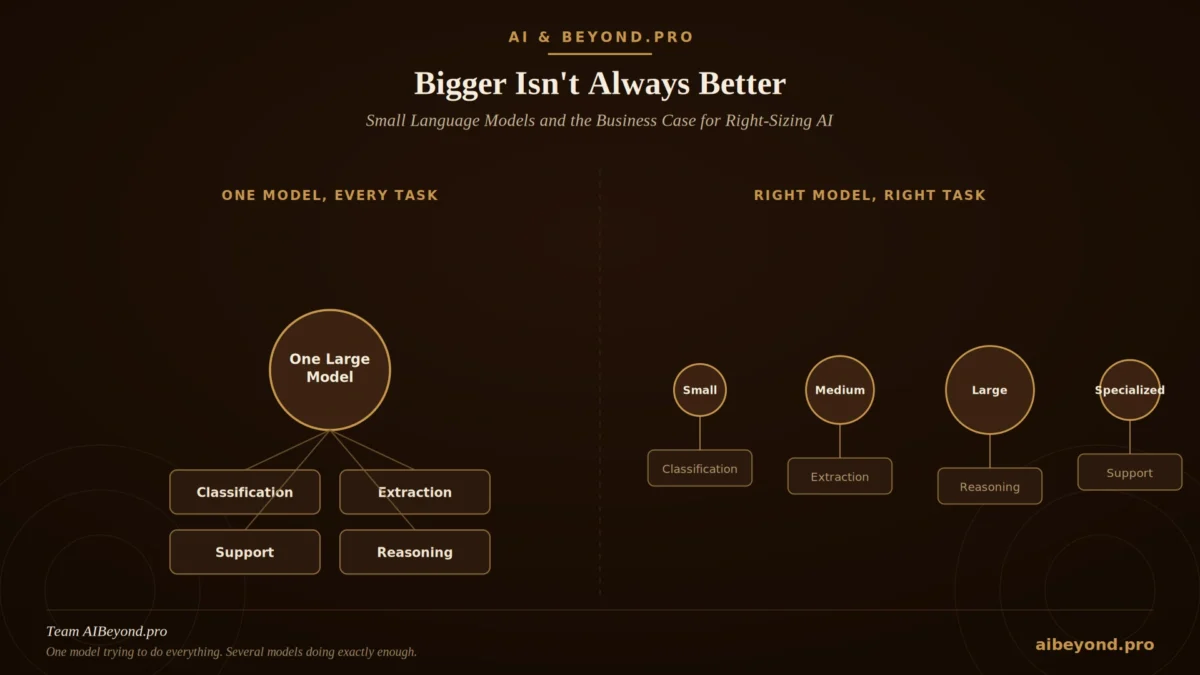
A small model handles high-volume, narrow, repetitive tasks classification, extraction, routing where speed and cost matter more than broad capability. A medium model handles moderate reasoning tasks that exceed a small model’s reliable range but don’t require frontier-level capability. A large model is reserved for complex reasoning, ambiguous instructions, and open-ended synthesis, where its cost is justified by the difficulty of the task. A specialized model, fine-tuned or trained for a specific domain legal document review, code generation in a particular framework, a specific industry’s terminology handles workloads where domain fit matters more than general capability.
This isn’t a claim that every organization needs all four tiers, or that this exact structure is universal. The actual right mix depends on workload variety, quality requirements, latency tolerance, cost sensitivity, and existing infrastructure. The underlying logic, though, generalizes: using one large, expensive, general-purpose model for every task inside an organization is rarely the most economically rational architecture once task variety and volume both increase.

A Practical Model-Selection Framework
This is an AI & BEYOND editorial framework, not an industry-standard methodology a structured way to evaluate a specific use case rather than a universal formula.
Evaluate a given AI workload against ten dimensions: task complexity (how open-ended or well-bounded is the problem), accuracy requirement (how much error can the workflow tolerate), latency requirement (does the task need a near-instant response), volume (how many requests run through this workflow), cost sensitivity (how much does per-request cost matter at this volume), privacy requirements (does data need to stay within controlled infrastructure), deployment constraints (what infrastructure is actually available), need for reasoning (does the task require synthesizing information versus following a defined pattern), need for domain specialization (does the task require deep expertise in a narrow area), and failure consequences (what happens when the model gets it wrong).
A task that’s narrow, high-volume, cost-sensitive, and tolerant of a defined error rate points toward a small model. A task that’s ambiguous, low-volume, and carries serious consequences for a wrong answer points toward a large model, a specialized model, or a workflow with more human oversight built in. A workflow with several distinct steps of varying complexity points toward model routing rather than a single model choice for the entire pipeline. None of these ten dimensions is decisive alone the framework is meant to be worked through together, not used as a single deciding factor.
The Hidden Cost of Using Too Much Model
There’s a cost to over-provisioning capability that doesn’t show up as clearly as an inference bill, but is real: unnecessary latency in workflows where speed matters, infrastructure requirements that exceed what the task justifies, harder-to-debug systems where it’s unclear whether a failure came from the task or the model, and a deeper dependency on external providers for workloads that didn’t need frontier-level capability in the first place.
This isn’t an argument that using a large model is always a mistake a more capable model can reduce engineering effort, particularly early on, and can improve output quality in ways that are hard to quantify but genuinely matter. The point is narrower: “use the biggest model available” is not a strategy, it’s a default, and defaults are worth examining rather than assuming. The actual goal isn’t maximum capability or minimum size. It’s using enough capability to reliably solve the problem no more, and no less.
What Businesses Should Do Now
Inventory AI workloads. Before optimizing model choice, establish what workflows are actually running and what each one is being asked to do.
Classify tasks by complexity. Separate narrow, repetitive tasks from genuinely open-ended or ambiguous ones this distinction drives most of what follows.
Establish quality thresholds. Define what “good enough” actually means for each workflow before testing alternatives against it.
Measure latency requirements. Determine which workflows are latency-sensitive and which can tolerate a slower response.
Measure actual inference costs. Understand current per-request and total costs before evaluating whether a change is worth making.
Test smaller models against real business data. Benchmark scores describe general capability; only testing against actual production-representative data reveals how a model performs on your specific task.
Evaluate failure rates, not only benchmark scores. A model’s published benchmark performance doesn’t necessarily predict its error rate on your specific, narrower task.
Consider model routing. For workflows with multiple steps of varying complexity, evaluate whether different steps warrant different models rather than a single uniform choice.
Monitor performance in production. Model behavior on a held-out test set doesn’t always predict production behavior once real, messier inputs arrive.
Revisit model choice as workloads evolve. A model selection that was correct a year ago may no longer be, as task volume, complexity, or available models change.
The common thread: choose based on the requirements of the specific workflow, not based on which model has the most impressive benchmark scores or the most attention in the market.
Conclusion
The AI industry’s defining race has largely been about maximizing capability a competition measured in parameters, benchmark scores, and breadth of what a single model can do. Enterprise AI has a different objective, and conflating the two is where a lot of unnecessary cost and complexity comes from.
The more useful measure isn’t raw capability. It’s useful intelligence per unit of cost, latency, and complexity a ratio that a large model wins for some tasks and loses for others. A large model may be exactly right for a workflow that genuinely requires broad reasoning over ambiguous information. A small model may be exactly right for a workflow that’s high-volume, narrow, and well-defined. Neither answer is universally correct, and a business that assumes one always is will overpay for some workloads and underperform on others.
The advantage, in the end, isn’t owning the biggest model. It’s knowing, task by task, which size actually fits.
