Everyone Deployed AI. Almost No One Transformed.
Open any all-hands deck from the last two years and you’ll see the same chart: AI adoption climbing toward 90%, maybe higher. Everyone’s using it. Sales has a copilot. Support has a chatbot. Marketing has a content assistant.
Walk the floor of most of these companies, though, and almost nothing has actually changed.
The support team still routes every ticket the same way it did in 2023 — the chatbot just answers the easy ones first. The sales copilot drafts emails a rep rewrites from scratch. The content assistant produces first drafts that go through the exact same seven-step approval chain as before.
AI got deployed everywhere. Work got redesigned almost nowhere.
That gap — between having the tool and actually changing how the job gets done — is the single biggest reason so many AI initiatives feel disappointing even when the technology itself works fine.
In this guide, we cover everything you need to know about that gap:
- What separates deployment from transformation
- How the gap forms, step by step
- Real-world examples of both
- The types of AI initiatives companies actually run
- A framework and checklist to diagnose your own program
- Common mistakes and how to avoid them
- Where this is headed next
What Is AI Transformation?
AI transformation is the redesign of a workflow, role, or process around what AI now makes possible — not just the act of giving a team access to an AI tool.
Deployment answers: “Can people use this?”
Transformation answers a harder question: “Has the way we do this job actually changed?”
You can succeed completely at the first and fail completely at the second. That’s what’s happening at scale right now. Companies measure success by login counts and license utilization — numbers that confirm adoption, not whether anything downstream is different.

How the Gap Forms, Step by Step
The gap doesn’t appear all at once. It builds in a predictable sequence, and most companies stop halfway through without realizing it.
Step 1: A team identifies a bottleneck. Support tickets pile up. Sales reps spend too long on first drafts. Someone says, “AI could help with this.”
Step 2: A tool gets purchased and connected. Procurement moves fast here. A license is bought, an API key is issued, the tool is live inside the existing system within days or weeks.
Step 3: The team is trained on the tool, not on a new process. Onboarding covers how to use the assistant — prompts, shortcuts, best practices. It rarely asks: what should we stop doing now that this exists?
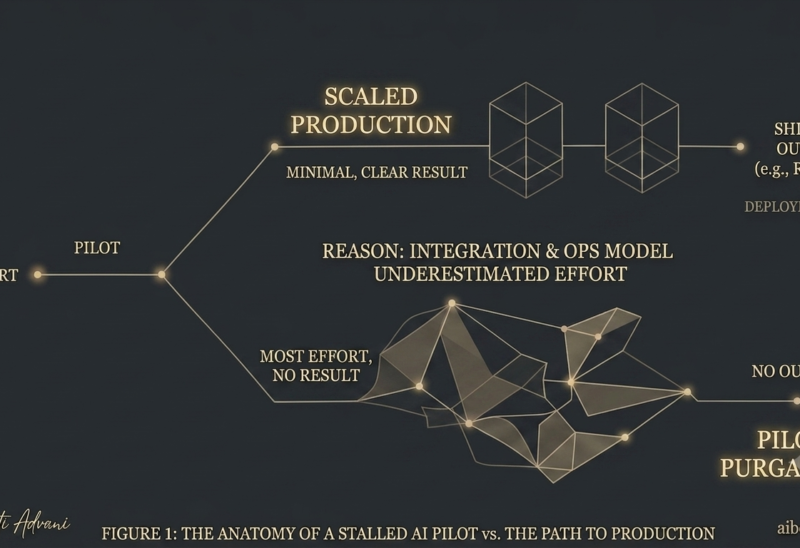
Step 4: The old workflow absorbs the new tool. This is where most initiatives quietly stall. The chatbot sits in front of the same ticket queue. The copilot sits inside the same approval chain. Nothing is removed — something is just added on top.
Step 5: Success gets measured by usage, not outcome. Dashboards show adoption rate, seats activated, messages sent. Nobody is tracking cycle time, cost per resolution, or headcount that got reallocated — because nothing about those numbers changed.
Step 6 (the step most companies skip): The workflow gets rebuilt. This is the actual transformation step — deciding what a human still checks, what runs without one, how approvals change, how the team is measured now that a two-hour task takes ten minutes. It requires input from the people who do the job daily, not just the people who bought the software.
Most initiatives make it to Step 5 and stop. The companies pulling ahead are the ones that treat Step 6 as the actual project — not an optional follow-up.
Real-World Use Cases
Let’s look at how this plays out inside two common functions.
Use Case #1: The Customer Support Team
The deployment version: A chatbot sits in front of the existing ticket queue. It answers FAQs. Anything harder escalates to a human agent, who handles it exactly as before — same macros, same escalation tiers, same average handle time once it reaches their desk.
The transformation version: The team rebuilds the queue itself. Tickets are automatically triaged by intent and urgency before a human ever sees them. Simple refunds and password resets resolve end-to-end without a person. Agents only see the fraction of tickets that genuinely need judgment — and their role shifts from “answer fast” to “resolve well,” with a new metric to match. The org chart changes. The job description changes.
Same underlying technology. Completely different outcome.

Use Case #2: The Sales Team
The deployment version: Every rep gets access to an AI email assistant. It drafts outreach and follow-ups. Reps still write their own emails most of the time, or lightly edit the draft — the assistant becomes a slightly faster typing tool bolted onto an unchanged process: same call volume targets, same manual research per lead, same pipeline stages.
The transformation version: Lead research, sequencing, and first-draft personalization are handled automatically for the entire funnel, not just top-of-funnel leads. Reps are re-measured on qualified conversations and closed deals, not on emails sent. Time that used to go into manual prospecting gets reallocated to the calls that actually need a human. The comp plan changes to reflect it.
Zero wasted licenses. Zero “we bought it but nobody really uses it differently.”
Types of AI Initiatives (Know Which One You’re Running)
Not every AI initiative needs to end in full transformation — but you should know which type you’re actually running before you set expectations for it.
Point Deployment. A single tool added to an existing workflow with no process change. Fastest to launch. Lowest risk. Lowest return. Best for: low-stakes, experimental use cases where you’re still validating whether AI helps at all.
Augmented Workflow. The tool is embedded into the process and some steps get faster, but the overall structure, roles, and metrics stay the same. Best for: teams not yet ready for structural change, or workflows where the process itself is already sound.
Redesigned Workflow. Specific steps are eliminated, not just accelerated. Metrics change. Some approvals or reviews are removed entirely. Best for: teams with a clear bottleneck and the authority to change how work is measured and assigned.
Full Transformation. Roles, org structure, and success metrics are rebuilt around what AI now makes possible. Usually spans multiple teams and requires leadership sign-off. Best for: functions where the volume and stakes justify the investment — support, sales ops, content production, claims processing.
Deployment vs. Transformation: Side by Side

Deployment vs. Transformation: Side by Side
| Deployment | Transformation | |
| Goal | Make the tool available | Redesign the workflow |
| What changes | Nothing about the process | The process itself |
| Success metric | Logins, licenses, usage rate | Cycle time, cost per outcome, quality |
| Who’s involved | IT / procurement | The team that actually does the work |
| Typical timeline | Days to weeks | Months, ongoing |
| Typical outcome | A faster version of the old way | A genuinely different way |
| Risk if done alone | Expensive tool, flat ROI | — |
A simple way to picture it: deployment hands someone a faster car. Transformation asks whether they still need to drive the same route.
Most companies stopped at the car.
The 80/20 Reality Nobody Budgets For
Here’s the part that trips up even well-run companies: the technology is the easy part.
Buying a license, connecting an API, or turning on a copilot inside an existing tool takes days. It’s a procurement decision. Rolling it out is a training session and a Slack announcement.
Redesigning the actual workflow — deciding what still needs a human, how approvals change, how the team is measured now that a two-hour task takes ten minutes — takes months and requires people who don’t normally sit in “AI strategy” meetings.
Roughly speaking, the technology accounts for a small slice of the total value an AI initiative can unlock. The redesign of the work around it accounts for the rest. Most budgets and timelines are built almost entirely around the small slice. That mismatch — not the model, not the vendor — is the actual problem.
A Framework for Closing the Gap
Run your own AI initiatives through these four questions. If you can’t answer all four with specifics, you’ve deployed — you haven’t transformed.
- What decision or step disappears entirely? Not “gets faster.” Disappears. If nothing is removed from the process, you’ve added a tool, not changed a workflow.
- Who owns the redesign — and is it the same person who owns the workflow? If the initiative is run entirely out of IT or a central AI team with no input from the people doing the job daily, it will optimize for rollout, not outcomes.
- What’s the new metric, and is anyone actually tracking it? “Usage rate” is a deployment metric. Cycle time, error rate, cost per resolved case, revenue per rep — those are transformation metrics.
- What would you stop doing if this failed tomorrow? If the honest answer is “nothing, we’d just go back to the old process,” the AI was bolted on, not built in.

Quick Self-Audit Checklist
- A specific step in the current workflow is being eliminated, not just accelerated
- The team that does the work daily is co-designing the new process, not just receiving training on it
- Success is measured in outcome terms (time, cost, quality), not adoption terms (logins, seats used)
- Roles or responsibilities are expected to shift as a result
- There’s a defined point at which the old process is retired, not just deprioritized
- Leadership has approved the org and metric changes — not just the software purchase
Checking two or three boxes: you’re mid-deployment. Five or six: you’re actually transforming.
Who Needs to Care About This Gap
Team Leads and Managers. You own the workflow. You’re best positioned to redesign it — and the person most likely to be left out of the conversation if the initiative is run purely out of IT.
Executives and Budget Owners. If ROI reporting stalls at adoption numbers, the initiative hasn’t actually been measured yet. Push for outcome metrics before the next renewal cycle.
IT and Platform Teams. Your job is enablement — access, security, integration. Recognize where your mandate ends and the workflow owner’s begins, and hand off deliberately instead of running the whole thing.
HR and People Ops. Role redesign, comp changes, and reskilling live here. Full transformation initiatives fail without early involvement from this team, not late-stage involvement.
Common Mistakes
Mistake 1: Buying the tool before deciding what changes. Procurement moves faster than process redesign, so the tool shows up before anyone agrees on what’s different afterward.
Mistake 2: Measuring adoption instead of outcomes. A 95% adoption rate looks like a win on a slide. It says nothing about whether the work got better, faster, or cheaper.
Mistake 3: Leaving the org chart untouched. If a role’s responsibilities and reporting lines look identical a year after rollout, the workflow almost certainly does too.
Mistake 4: Treating this as an IT project. The team best positioned to redesign a workflow is the team that runs it daily — not the team that manages the software license.
Mistake 5: Skipping the “stop doing” list. Transformation requires subtraction, not just addition. If nothing is being retired — a report, a manual review step, an entire role — the AI is additive, not transformative.
Where This Is Headed
Redesign becomes the deliverable, not the tool. Vendors are starting to sell workflow templates alongside the model itself, because customers keep stalling at the redesign step.
New job titles emerge around orchestration. “Agent manager” and similar roles are appearing — people whose job is explicitly to own the redesign, not just the rollout.
ROI reporting shifts from usage to outcome by default. Boards are starting to ask for cycle time and cost-per-outcome numbers directly, rather than accepting adoption rate as a proxy for value.
The gap becomes a competitive moat. As deployment becomes commoditized — every company has access to roughly the same models — the redesign work becomes the only real source of differentiation left.
Frequently Asked Questions
What’s the difference between AI adoption and AI transformation? Adoption measures whether people have access to and use an AI tool. Transformation measures whether the underlying process changed as a result.
How long does AI transformation actually take? Deployment can happen in days. Genuine workflow redesign typically takes several months to a year, depending on how many teams are involved.
Do all AI initiatives need to reach full transformation? No. Point deployments are appropriate for low-stakes, experimental use cases. Full transformation makes sense where volume and stakes justify the investment.
Who should own an AI transformation initiative? The team that runs the workflow daily, not IT or a central AI team alone. IT enables the tool; the workflow owner redesigns the process around it.
What metrics actually prove transformation happened? Cycle time, cost per outcome, error rate, and revenue or output per person. Login counts, seats activated, and usage rate are deployment metrics — necessary, but not sufficient.
Why do so many companies report AI initiatives with no measurable ROI? Because they’re measuring deployment metrics against transformation-level expectations. If the workflow itself never changed, there’s no mechanism for the ROI to show up.
What’s the first sign an AI initiative is stuck at deployment? Nothing in the process has been removed. If the AI tool sits alongside the old workflow rather than replacing part of it, it’s still in deployment.
The Bottom Line
Deployment is necessary. It’s just not sufficient — and treating it as the finish line is why so many AI programs quietly stall out at “everyone has access” instead of reaching “the work is genuinely different now.”
The companies pulling ahead aren’t spending more on AI. They’re spending differently — putting the harder, slower work of redesigning processes, metrics, and roles at the center of the initiative instead of treating it as an afterthought to the software purchase.
Next Steps
- Audit your current AI initiatives. For each one, run it through the four-question framework above.
- Identify what should be retired. Pick one workflow and name the specific step, report, or review that should disappear — not just speed up.
- Assign a workflow owner, not just a tool owner. Someone from the team doing the work should co-lead the redesign, not just receive training.
- Replace one adoption metric with one outcome metric. Cycle time or cost-per-outcome is a good place to start.
- Set a retirement date for the old process. If there isn’t one, the new one hasn’t actually replaced it.
Before your next AI rollout, ask one question up front: what are we going to stop doing?
If you don’t have an answer, you’re about to deploy another tool — not transform anything.