
The Prompt Engineering Skills Marketers Actually Need in 2026

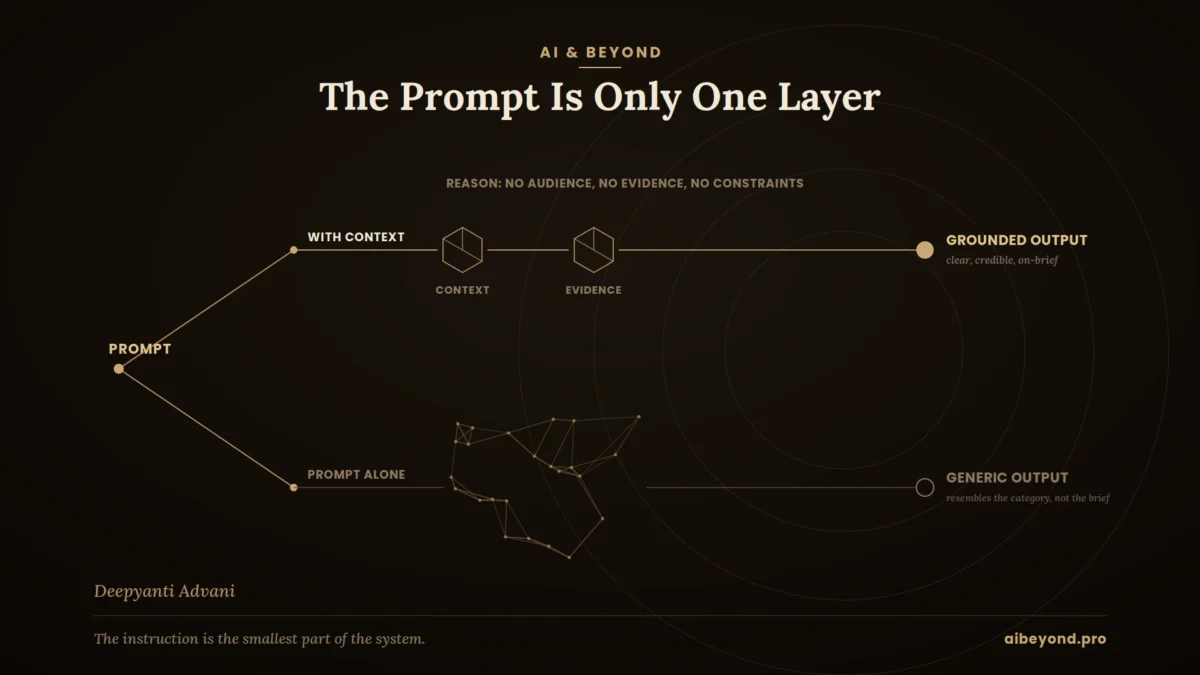
Why effective AI prompting is becoming less about clever instructions—and more about context, constraints, evaluation, and judgment
There used to be a market for the perfect prompt.
People collected them like coupons. A phrase that reliably produced a sharper headline would move through Slack channels and LinkedIn posts within a day. “Act as a world-class copywriter.” “Think step by step.” Entire newsletters existed to catalog the incantations.
Some of that instinct was reasonable at the time. Early models were capable but genuinely inconsistent, and the right phrasing could turn a mediocre answer into a usable one.
That market is closing.
Current models follow ordinary instructions well. Say what you want, in plain language, and a capable model will generally attempt exactly that. The magic phrase isn’t doing much magic anymore, because it was never really magic it was compensation for a limitation that’s shrinking.
So the question marketers actually need answered has changed. It used to be: what should I type? Increasingly, it’s: what does the model need to know to do this well?
Most teams haven’t caught up to that shift. They’re still typing requests into a chat window, still getting outputs that need heavy editing, and still not entirely sure why. The instruction reads fine. The result is generic anyway.
That gap a reasonable instruction producing an unremarkable answer is where this article starts. It isn’t a wording problem. It’s a design problem. The best prompt engineers in 2026 aren’t the ones with the most sophisticated instructions saved in a doc somewhere. They’re the ones who’ve gotten good at defining the problem, supplying the right context, and knowing how to tell a good output from a mediocre one before it reaches a customer.
In this guide:
- Why the bottleneck moved past the prompt itself
- The prompt’s new role as a brief, not a spell
- Seven skills that matter more than clever phrasing
- One framework worth remembering
- Four real marketing workflows, worked through in detail
- The mistakes still costing teams the most
- Where this is headed
Why Prompt Engineering Is Changing
Prompt engineering earned its reputation during a specific window: models were powerful but brittle, and a well-built prompt could be the difference between a usable draft and nonsense. Learning the tricks was a rational response to real unpredictability.
Model providers have been unusually candid that this bottleneck is moving. Anthropic’s applied AI team describes the field shifting away from finding the right words for a prompt, toward a broader question what configuration of context is most likely to produce the model’s desired behavior. OpenAI’s guidance for its newer models points the same direction: rather than writing longer, more elaborate system prompts, the current advice is to define the outcome, set the stopping conditions, and let the model work.
Neither company is saying the instruction stopped mattering. They’re saying it stopped being the main event. A clear instruction is closer to table stakes now than a competitive edge, because most people asking a capable model to do something will phrase it clearly enough to be understood.
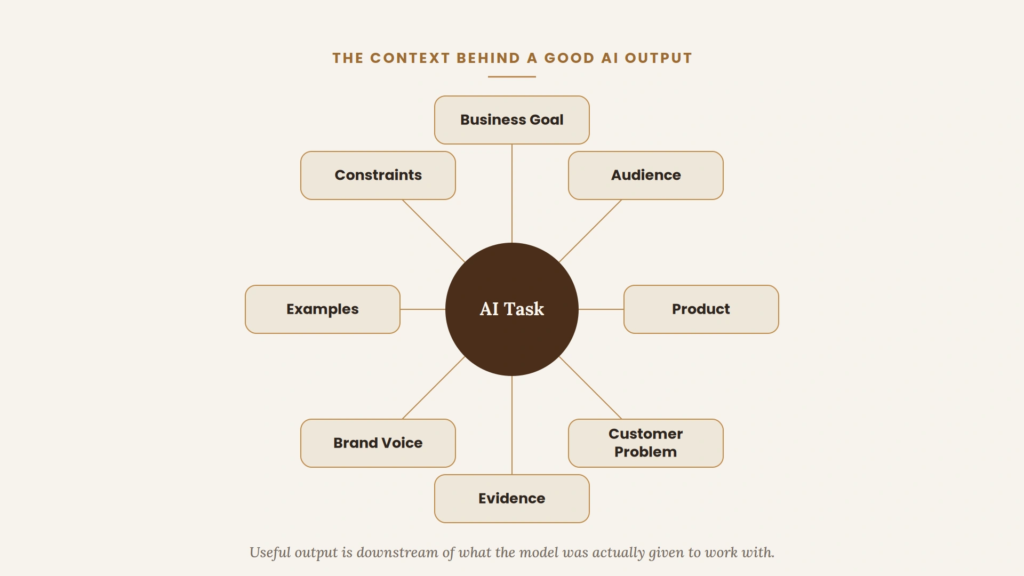
The real bottleneck sits one layer back: the quality of the problem definition behind the prompt. Marketers routinely respond to a disappointing result by adding more instructions, on the theory that more words mean more control. Sometimes that helps. Usually it doesn’t because the model wasn’t short on instructions. It was short on information: about the audience, the product, the evidence, the voice, or what “good” was even supposed to look like.
No amount of clever phrasing fixes a request that never told the model what it needed to know.
The Prompt Is Becoming the Brief
Here’s the reframe worth sitting with, because it connects prompting to something marketers already understand: briefing.
Traditional marketing work ran on a simple chain a business objective became a brief, and a person executed against it. Early generative AI collapsed that chain into something much thinner: a prompt went in, an output came out, and the thinking that used to happen inside the brief either got skipped or got left to the model to guess at.
Mature AI marketing work restores the chain, with AI doing more of the execution:
Business objective → structured context → AI workflow → evaluation → human decision
The skill that matters is moving upstream away from the wording of any single instruction, and toward the same discipline marketers have always needed for a good creative or media brief. That means being able to define, before typing anything:
- What actually needs to happen
- Who it’s for
- What information the model needs to know to do this credibly
- What constraints genuinely apply
- What “good” looks like, specifically
- What the AI should not be the one deciding
A prompt with no brief behind it is a guess dressed up as an instruction. A prompt built on a real brief is closer to what a sharp creative director hands a team on day one and the model, like the team, does better work because of it.
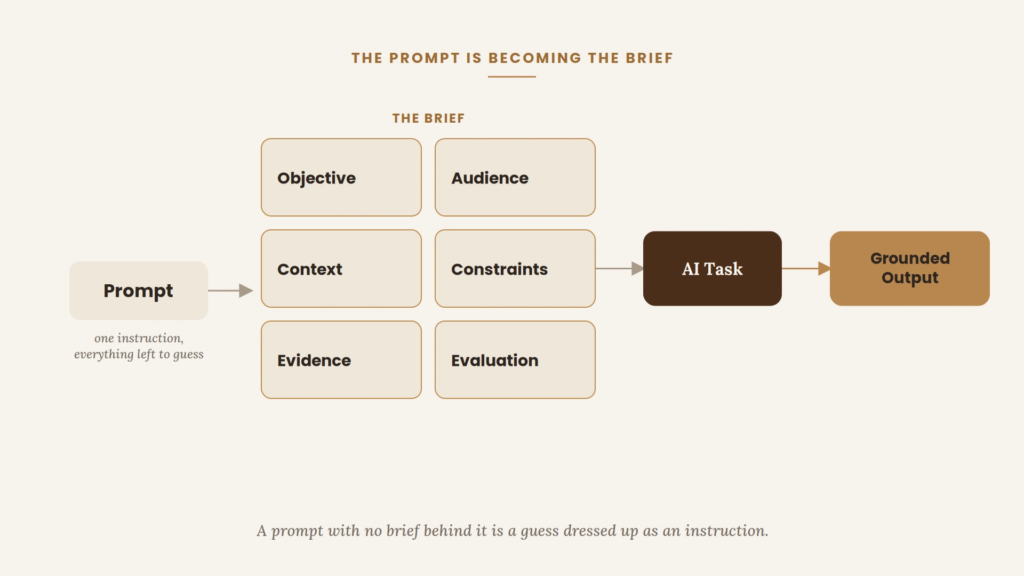
A prompt with no brief behind it is a guess dressed up as an instruction.
Skill 1: Problem Definition
Before context, before constraints, there’s a more basic failure point: many requests never define the actual problem.
Weak: “Create social media posts.”
Better: “We need five LinkedIn posts aimed at CFOs evaluating AI automation. The objective is qualified inbound interest, not impressions.”
The second version states an objective, an audience, and a success condition. The model can now make decisions about tone, emphasis, what to leave out because it knows what those decisions are in service of. AI cannot optimize for a goal it was never given. Left to guess, it produces something that resembles the category of thing you asked for, and “resembles the category” is exactly the generic output marketers keep complaining about.
Skill 2: Context Engineering
Prompt engineering asks: how do I phrase this instruction well?
Context engineering asks a broader question: what does the model need to know before I ask it anything?
For a marketer, that might mean product documentation, customer research, brand guidelines, historical campaign performance, competitor positioning, or examples of work that already represent the target quality. Anthropic frames the underlying discipline as curating and maintaining the optimal set of tokens during inference the full set of information the model draws on, not only the instructions typed into the prompt box. The practical version for a marketing team is simpler: decide which documents and data points should actually enter the conversation, instead of letting the model guess at context it was never given.
This is where the “why does it keep getting this wrong” frustration usually resolves. The model isn’t wrong. It’s uninformed.
Constraints, Examples, and Evidence
Three more layers do the rest of the heavy lifting, and they’re worth understanding together because they solve related problems.
Constraints replace “be creative” one of the least useful instructions a marketer can give with an actual operating boundary: word count, audience, tone, claims that require evidence, approved terminology, format, the specific call to action, compliance requirements. Anthropic’s own guidance describes the goal as finding the “right altitude” for a system prompt: specific enough to guide behavior effectively, but flexible enough to leave room for the model’s judgment, rather than hardcoding brittle, exhaustive rules. A model given a clear boundary tends to make better decisions inside it than one given open-ended encouragement to be original.
Examples do work that description often can’t. Anthropic’s guidance treats few-shot examples as a well-established practice, recommending a small set of diverse, canonical examples that clearly portray the desired behavior rather than an exhaustive list of edge cases in their framing, examples function as pictures worth a thousand words for a model. Two headlines that performed well, one example of copy the brand wants to avoid, a paragraph that captures the target voice each teaches a pattern faster than a paragraph of instructions. The caution worth adding: examples should illustrate a pattern, not hand the model something to imitate line for line.
Evidence is what keeps the output honest. A claim without evidence is a guess with good posture. Deciding what data, quotes, or specifics the model should ground its answer in before generating anything is what separates copy that sounds confident from copy that’s actually credible.
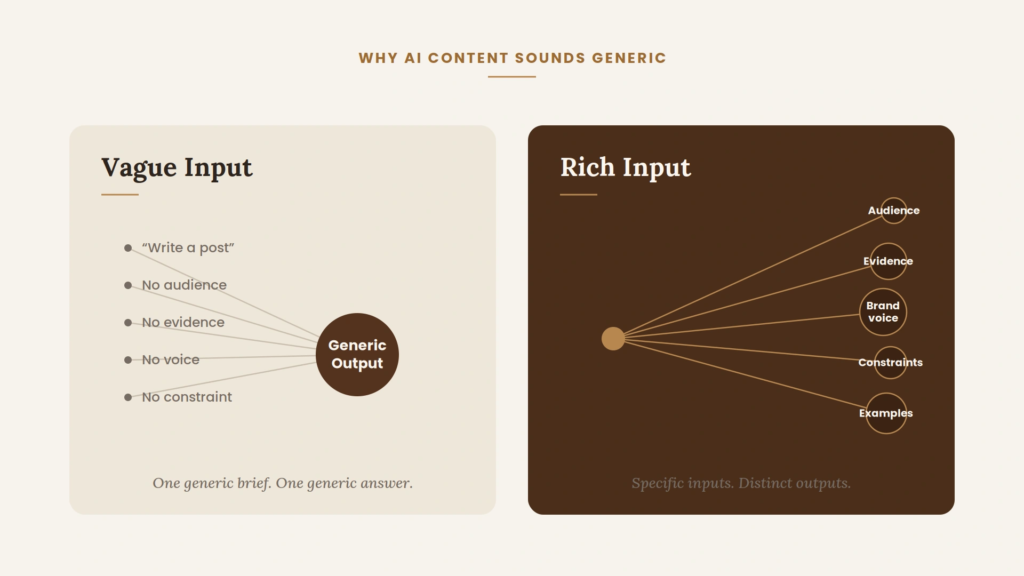
Thin inputs collapse toward the same answer. Rich ones don’t.
Skill 3: Evaluation
Producing an answer is easy. Knowing whether it’s a good answer is the harder, more valuable skill and it’s the one most prompting advice skips entirely.
Generation is only half the workflow. The other half is evaluation, and most marketers never build it deliberately. They read the output, decide it “feels right” or “feels off,” and move on. That works for one piece of content. It doesn’t scale, and it doesn’t transfer to anyone else on the team.
A more durable approach defines evaluation criteria before generating anything. A B2B landing page, for instance, might be judged against clarity, differentiation, evidence, audience relevance, credibility, CTA strength, factual accuracy, and brand consistency. Written down once, that becomes a rubric reusable for judging AI output, briefing freelancers, and training new hires on what the team actually means by “good.”
Skill 4: Iteration Instead of One-Shot Prompting
Strong AI workflows rarely depend on one enormous prompt producing a finished asset. They depend on a short sequence: brief → first draft → critique → revision → fact check → human judgment → final output.
Each step does one job. The brief defines the problem. The draft gets something concrete on the page. The critique from a person, or from the model itself against the rubric above identifies what’s actually wrong. The revision fixes it. The fact check catches what shouldn’t be trusted blindly. Human judgment makes the calls a rubric can’t make on its own.
Trying to compress all of that into one perfect prompt is usually why marketers end up writing prompts that run to several paragraphs of competing instructions. It’s more reliable to let the workflow carry weight the prompt was being asked to carry alone.
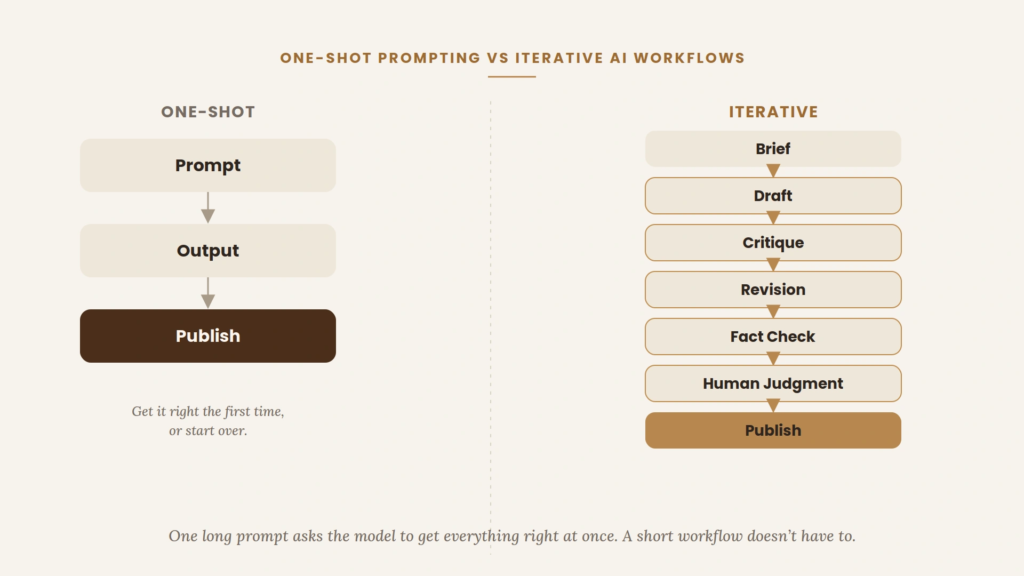
One long prompt asks the model to get everything right at once. A short workflow doesn’t have to.
Skill 5: Knowing What Not to Automate
AI is genuinely useful for variations, summarization, research organization, first drafts, classification, and ideation. It’s a poor substitute for judgment on questions that are actually about the business, not the words.
Humans still need to own strategic positioning, brand judgment on tone and risk, claims that could create legal or reputational exposure, factual accountability for what gets published, final editorial decisions, and a real understanding of the customer. The best AI workflow doesn’t try to eliminate judgment. It concentrates judgment where it actually matters, and automates the parts that don’t require it.
Prompt Complexity Is Not the Same as Prompt Quality
Here’s the contrarian part: a longer prompt is not automatically a better one.
Marketers often respond to a disappointing output by adding more instructions more formatting rules, more caveats, more “don’t do this” clauses until the prompt becomes a wall of competing demands. That instinct usually backfires. Piling on instructions introduces redundancy, conflicting requirements, and unclear priorities, forcing the model to silently decide which rule wins often not the one you’d have chosen. The direction model providers are pushing is toward less prescriptive prompting, not more, as models get better at inferring intent from a clear, well-scoped request.
The goal was never maximum instructions. It’s maximum useful signal the smallest set of information that actually changes the output for the better.
The 2026 Marketer’s Prompt Engineering Stack
One framework is worth keeping in your head, because most weak AI output traces back to a missing layer in it, not a badly worded prompt.
Objective: What outcome are we trying to achieve? Weak: “Write a LinkedIn post.” Better: “Create a LinkedIn post designed to generate qualified conversations with B2B marketing leaders.” The second version gives the model something to optimize toward a reason to choose one angle over another. Common mistake: skipping this and treating the content type itself as the objective.
Context: What does the model need to know about the product, audience, and situation? This is the product’s actual differentiator, who’s reading, and what they currently believe not a generic description of the category. Common mistake: assuming the model shares context it was never given.
Constraints: What must the output respect tone, length, claims, format? Constraints aren’t limits on quality; they’re what removes the guesswork that produces generic output in the first place. Common mistake: replacing real constraints with vague encouragement like “be creative” or “sound professional.”
Evidence: What should the output actually be grounded in data, a customer quote, a specific result? Common mistake: letting the model invent supporting detail because none was supplied.
Output: What, exactly, should it produce format, length, structure? Common mistake: leaving this implicit and being surprised by the shape of what comes back.
Evaluation: How will we know whether it’s good? Common mistake: relying on a gut reaction instead of criteria decided in advance.
Iteration: What should change after the first attempt? Common mistake: treating the first output as a final judgment rather than a starting point.
Seven layers, one sequence. Most weak output traces back to a missing layer.
What Good Prompt Engineering Looks Like in Real Marketing Work
Content Brief
The weak approach: “Write a blog post about our new feature.”
Why it fails: The model has no audience, no angle, no evidence, and no sense of what should be different in the reader’s head by the end. It fills the gap with generic explanation.
The stronger approach: Supply who the post is for and what they currently believe, what should change by the end, and what evidence a number, a customer example, a specific outcome should anchor the argument.
What the marketer is actually doing: Turning a topic into a brief. The skill isn’t writing a better instruction; it’s doing the strategic thinking that used to happen before a brief was handed to a writer, and making sure the model has access to it.
SEO Content
The weak approach: “Write an SEO article about [keyword]” and hope structure emerges from the phrase.
Why it fails: Keyword density was never the thing search systems or readers actually reward. Without a defined intent, the model defaults to padding a generic outline.
The stronger approach: Specify the actual search intent, the real questions a reader has at that stage, what a genuinely useful answer looks like versus a padded one, and what the page should let the reader do next.
What the marketer is actually doing: Substituting intent clarity for keyword instructions. This matters more now than it used to, as AI answer engines increasingly synthesize from multiple sources rather than ranking single pages a shift worth understanding on its own terms.
Advertising Creative
The weak approach: “Give me ten ad variations.”
Why it fails: Ten variations without a defined test hypothesis are just ten guesses. Nothing in the request tells the model or the human reviewing the output what a winning variation would need to accomplish.
The stronger approach: Define the platform, the exact audience segment, the single message being tested, and the criteria a winning variation would need to meet. Treat the ten outputs as raw material for evaluation, not ten equally viable finished ads.
What the marketer is actually doing: Designing a test, not requesting content. The prompt is the easy part; deciding what’s actually being tested is the actual work.
Customer Research
The weak approach: Treating an AI-generated summary of customer conversations as research.
Why it fails: A model summarizing what it believes customers think is not evidence it’s an inference layered on top of evidence, and that layer can quietly introduce assumptions nobody asked for.
The stronger approach: Use AI to organize and structure what customers actually said, while treating the underlying interviews, tickets, and transcripts not the AI’s summary of them as the real evidence base for decisions.
What the marketer is actually doing: Keeping the model in an organizing role rather than an evidentiary one. This is a boundary worth being strict about, because it’s easy to blur under deadline pressure.
Useful output is downstream of what the model was actually given to work with.
Common Prompt Engineering Mistakes Marketers Still Make
Asking AI to “sound human.”: This gives the model nothing concrete to act on. What actually produces natural-sounding copy is specific voice examples and constraints sentence rhythm, vocabulary, what the brand never says not a request to be less robotic.
Giving almost no context: A one-line request forces the model to guess at everything that differentiates the task. The fix is upstream of the prompt: assemble the context before asking for output.
Stacking conflicting instructions: Long prompts with competing demands force the model to silently prioritize one instruction over another. Fewer, clearer instructions outperform exhaustive ones.
Treating AI output as research: A model’s summary of what customers think isn’t the same as evidence from actual customers.
Optimizing for output volume: Ten mediocre variations aren’t more useful than two well-briefed ones. Volume without a rubric just moves the evaluation burden downstream.
Never defining quality criteria: Without a rubric, “good” is whatever felt right to whoever reviewed it last a standard that doesn’t transfer to anyone else on the team.
Assuming the first answer is the best answer: The first output from any prompt is a starting point for iteration, not a final judgment on what the model can produce.
The Skills That Will Matter More Than Prompt Tricks
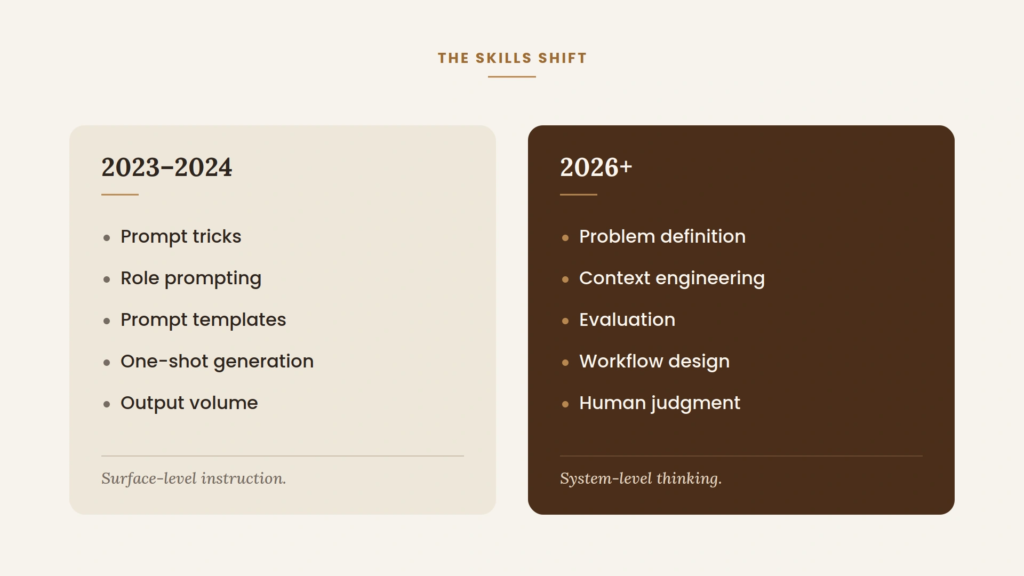
The tricks became table stakes. The judgment became the differentiator.
The Future of Prompt Engineering
A few directions are likely to matter more over the next couple of years, though none of this should be read as certain.
Workflows are increasingly agentic rather than single-shot models that use tools, retrieve information, and take multiple steps rather than answering one prompt in isolation. Anthropic’s own description of this shift centers on models autonomously using tools in a loop, with context curated and refreshed continuously rather than assembled once at the start. For marketing teams, that likely means fewer isolated prompts and more standing systems a research agent pulling from a shared knowledge base, a content agent that already knows brand voice and constraints without having them re-typed every time.
Persistent, structured context is likely to matter more than any single prompt. Reusable knowledge bases, documented voice guidelines, and shared evidence libraries are the difference between a team that has to re-explain its brand every time and one that doesn’t. Connected tools and protocols that let AI systems pull directly from a company’s own documents are likely to accelerate this.
Evaluation is likely to become more structured and less subjective, with teams building explicit rubrics rather than relying on a reviewer’s gut sense of quality.
None of this eliminates the need for people who understand marketing. It increasingly rewards the ones who also understand how to set an AI system up to do useful work.
Quick Checklist
- Is the business objective stated, not implied?
- Is the audience defined specifically, not generically?
- Does the model have the context it needs product, voice, prior work?
- Are the real constraints stated, not replaced with “be creative”?
- Is there evidence for the output to be grounded in?
- Is the exact output format and length specified?
- Does a quality rubric exist before generation starts?
- Is there a fact-check step before anything ships?
- Is there a defined point where a human, not the model, decides?
- Will what worked here be documented for next time?
FAQ
Is prompt engineering still a valuable skill in 2026?
Yes, as one layer of a broader skill rather than the whole discipline. A clear instruction still matters; it’s no longer sufficient on its own.
What’s the difference between prompt engineering and context engineering?
Prompt engineering is how you write and structure an instruction. Context engineering is everything else the model draws on background information, examples, evidence, and constraints assembled before or alongside that instruction.
Do marketers need to learn technical prompt engineering?
No. Marketers don’t need model architecture or prompting syntax. They need to get better at defining problems, supplying context, and evaluating output skills closer to good briefing than to engineering.
Are longer prompts better?
Not by default. A longer prompt with conflicting or redundant instructions often performs worse than a shorter, clearer one. The goal is useful signal, not instruction volume.
How can marketers improve AI-generated content?
Start further upstream than the prompt: define the objective and audience, supply real context and evidence, set explicit constraints, and evaluate against criteria decided in advance rather than gut feel.
Should marketers use prompt templates?
Templates for structure and process a checklist of what information to gather are useful. Templates that hand-craft exact wording for every task are a weaker investment than getting good at the surrounding brief.
What skills should marketers learn alongside AI prompting?
Rubric-based evaluation, structured briefing, and knowing which decisions require human judgment are at least as valuable as prompting mechanics.
Will AI agents make prompt engineering obsolete?
Unlikely to make it obsolete, but likely to make it a smaller share of the total skill. As systems handle more multi-step, tool-using work autonomously, the leverage moves further toward context, evaluation, and workflow design.
Bottom Line
The marketers pulling ahead in 2026 aren’t the ones with the cleverest prompts saved in a doc somewhere. They’re the ones who define the actual problem, supply the model with what it needs to know, set real boundaries, and know how to tell a good output from a mediocre one before it goes anywhere near a customer.
The prompt was never the whole job. It just used to be the visible part.
Next Steps
1. Take one recurring AI prompt your team uses and rewrite it starting from the business objective, not the instruction.
2. Add real context product specifics, audience research, brand voice examples before adding more words to the instruction itself.
3. Write a quality rubric for one content type before your next generation task, and use it to review the output.
4. Build a two-step review into your workflow: a critique pass before a revision pass, rather than publishing the first draft.
5. Document what worked as a reusable brief template your whole team can use, instead of keeping it in one person’s head.
