
From Pilot to Production: Why 80% of Enterprise AI Projects Stall

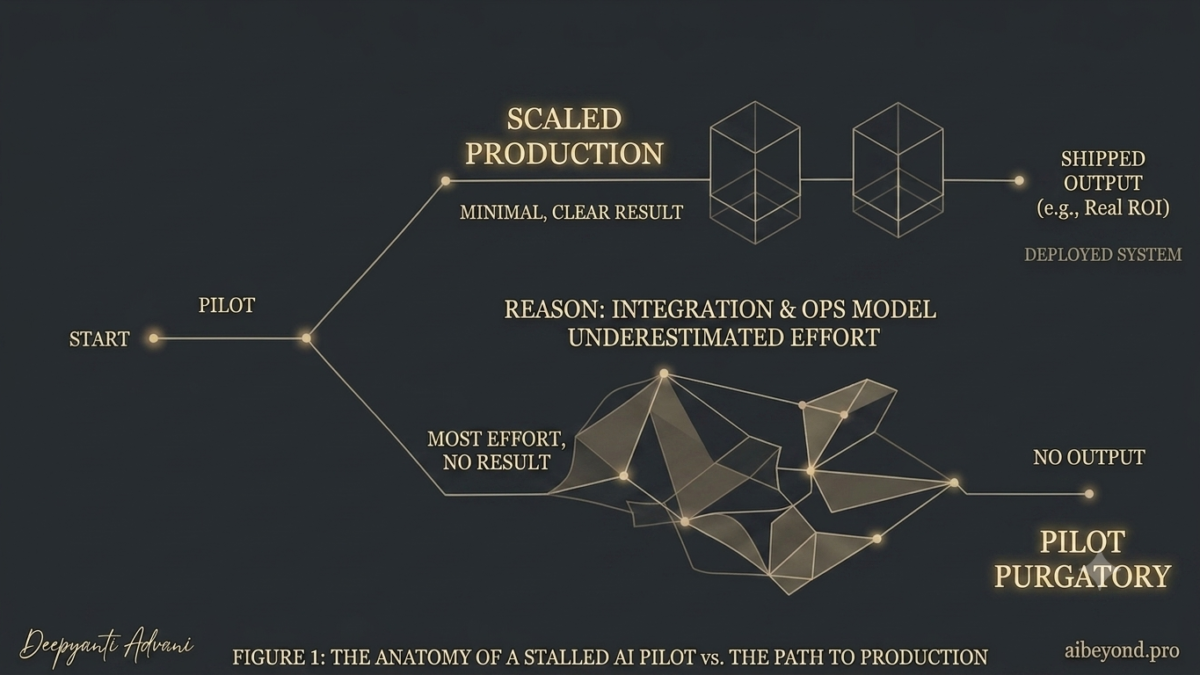
In every enterprise AI conversation this year, one number keeps surfacing. Depending on which analyst report you cite, somewhere between 70% and 85% of enterprise AI projects never make it from pilot to production. The exact figure is less important than the pattern: most AI investments produce a compelling demo, a promising internal test, a case study that gets shown at an all-hands — and then quietly stall before they ever touch a real customer or a real revenue line.
This isn’t a technology problem. The models work. The infrastructure exists. Vendors will happily point at reference customers who cleared the same hurdles. The stall is organizational, and it’s remarkably consistent across companies, industries, and use cases. Understanding why pilots die is the single most valuable strategic lens a marketing or business leader can develop right now, because AI budgets are still growing while the ROI question is getting sharper.
The Anatomy of a Stalled Pilot
Stalled pilots follow a recognizable arc. A team identifies a use case — often something visible and demo-friendly, like a customer service chatbot or a content generation tool. They build a proof of concept in six to eight weeks. The demo goes well. Leadership approves further investment. Then the project enters a strange middle state where it’s neither killed nor deployed. It gets called “in pilot” for another quarter. Then another. Eventually the champion moves teams, the budget gets absorbed into a different initiative, and the project quietly disappears from status updates.
What happened between the successful demo and the missing deployment? Almost always the same four things.
Reason One: The Pilot Didn’t Solve a Real Business Problem
Many AI pilots are chosen because they’re interesting, not because they matter. A team says “let’s try AI on customer support tickets” without first asking whether customer support ticket volume is actually a top-five business problem. The pilot succeeds — the AI does classify tickets well — but classification of tickets wasn’t a bottleneck to any outcome the CFO cared about. So when it’s time to fund the production deployment, there’s no natural budget owner, no operational team waiting to receive it, and no metric that will move.
The fix is upstream of the pilot itself. Before scoping the AI work, teams need to name the business metric that will change, who owns that metric, and what a realistic delta looks like. Pilots tied to owned metrics get championed. Pilots tied to “innovation” die when the innovation budget resets.
Reason Two: The Integration Cost Was Underestimated by an Order of Magnitude
The AI model is 10% of the work. The other 90% is data pipelines, access controls, monitoring, user interfaces, edge case handling, exception routing, retraining loops, and the compliance review. Most pilots skip most of this and produce a demo that works on curated data in a controlled environment.
When it’s time to go to production, someone realizes the model needs live access to Salesforce, Snowflake, and the customer data platform. Each of those integrations has an owner, a queue, and a risk review. The AI team, which was moving fast, suddenly hits infrastructure teams that operate on quarterly release cycles. Timelines slip. Costs balloon. Executive attention drifts.
Teams that get to production budget for this from the start. They involve platform and infrastructure leaders in the pilot scoping conversation, not after. They pick pilots where the integration surface is genuinely small, or they explicitly accept that the pilot’s real purpose is to build the integration muscle for later, larger deployments.
Reason Three: No One Owns the Operational Model
An AI system in production is not a piece of software you deploy once. It’s an operational asset that needs to be monitored, tuned, and governed. Someone has to watch for model drift, review flagged outputs, update prompts as products change, and answer to compliance when questions come up. This ongoing work isn’t glamorous, and in most pilots no one has agreed to do it.
When the pilot ends and the question becomes “who runs this in production?” the answer is often silence. The AI team was building it. The business team was consuming it. Neither team is set up to own the operational surface. The project stalls in the handoff.
Successful production deployments name the operational owner before the pilot begins. Sometimes it’s a new role — increasingly companies are creating “AI operations” or “AI product manager” functions specifically for this. Sometimes it’s an existing team that agrees, in writing, to inherit the system. Either way, the answer to “who runs this on Tuesday?” needs to exist before the pilot’s demo day.
Reason Four: The Success Criteria Were Too Vague to Trigger a Decision
Many pilots end without a clear verdict. Was it successful? Sort of. Did it hit the goal? The goal was fuzzy. Should we scale? Depends who you ask. In this ambiguity, the safest decision is to extend the pilot, which effectively means killing it slowly.
Executives who consistently get AI projects to production insist on decision-forcing success criteria before the pilot begins. Not just “the AI works” but a specific threshold: “if lead qualification accuracy exceeds 85% and cost per qualified lead drops by 20%, we deploy to the full inbound funnel in Q3.” These criteria force a yes/no decision at the end of the pilot period, which prevents the drift into permanent pilot purgatory.
The Pattern That Distinguishes the 20% Who Ship
Companies that consistently move AI from pilot to production share a set of habits. They pick pilots tied to real business metrics with clear budget owners. They involve platform and infrastructure teams in scoping. They name the operational owner up front. They set decision-forcing success criteria. And critically — they treat each pilot as an experiment with a clear falsifiable hypothesis, not as a proof that AI is generally good.
This last point matters more than it sounds. Many organizations run pilots to satisfy an implicit question: “should we be doing AI?” The answer is always yes, so the pilots always kind of succeed, and nothing gets decided. The 20% who ship run pilots to answer specific questions: “will this specific system, in this specific workflow, produce this specific outcome at this cost?” Those questions have real answers, and real answers drive real decisions.
What to Do If You’re Stuck in Pilot Purgatory
If you’re a marketing or business leader with pilots that seem stuck, three moves are worth making this quarter.
Audit every AI pilot currently running in your organization. For each, write down the business metric it will move, the owner of that metric, and the decision criteria that would trigger production deployment. Any pilot that can’t answer all three questions cleanly should either get restructured or killed. Ambiguity is the enemy — clarity, even if it results in cancellation, is progress.
Pick one pilot in your immediate area and rescope it against these principles. Bring in the platform team early. Name the operational owner. Write down the success threshold. This is harder than starting a new pilot but far more likely to produce a shipped system.
Finally, resist the temptation to fund new pilots faster than you close out old ones. Pilot sprawl is the leading indicator of a stalled AI program. A company running twelve simultaneous pilots is usually about to ship zero of them. A company running three focused pilots with clear ownership will ship two.
The gap between AI’s promise and its realized value in most enterprises isn’t a modeling problem. It’s a management problem — specifically, a management problem about how pilots are scoped, owned, and decided. Solving it doesn’t require better models or bigger budgets. It requires the same discipline that separates good product organizations from mediocre ones. Applied to AI, that discipline is what turns the 80% who stall into the 20% who ship.
