
The Context Window Trap: Why More Tokens Don’t Mean Better AI

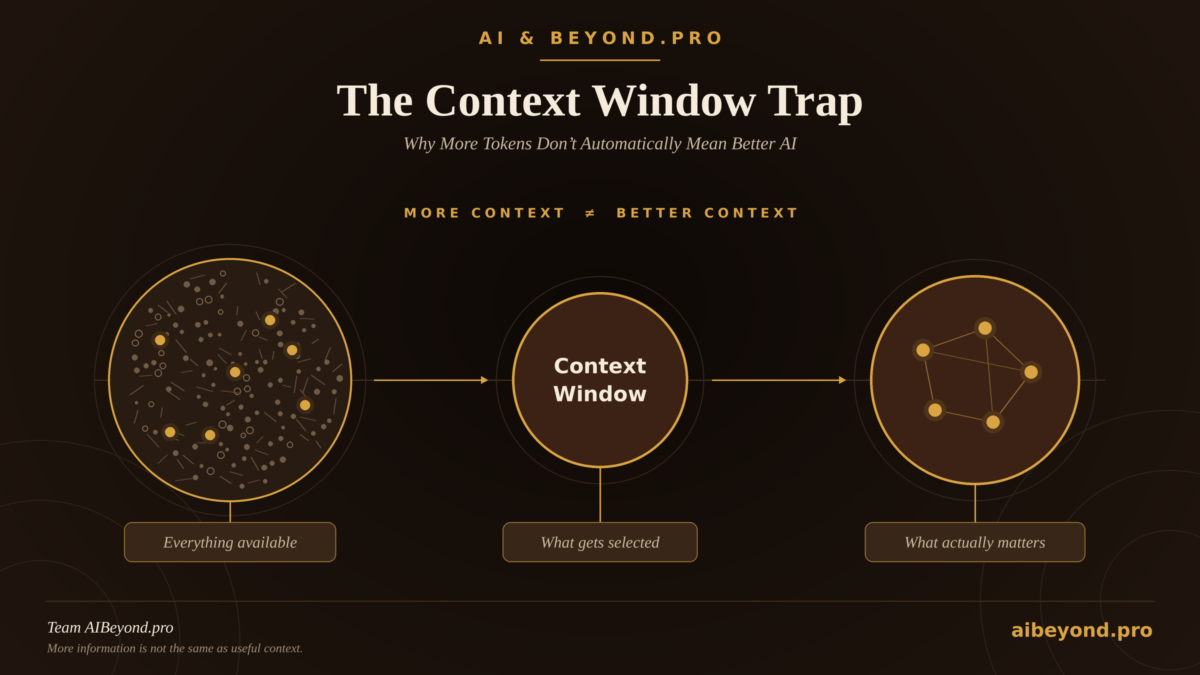
A bigger AI context window doesn’t guarantee better answers. Why relevance, structure and freshness matter more than token count, plus a 6-step framework.
A bigger context window sounds like a straightforward upgrade. If a model can read more, it should know more, and if it knows more, it should answer better. For companies, the appeal is obvious: stop deciding what the model needs and hand it everything.
That assumption is misleading. A context window sets how much a model can read at once. It says nothing about whether what it reads is relevant, current, consistent or well organized. The question worth asking is no longer “how much context can the model handle?” It is “what context should the model actually receive?”
What Is a Context Window?
An AI context window is the amount of text a model can consider in a single request, measured in tokens. A token is a small chunk of text, often a word or part of one. Everything the model works with has to fit inside that limit, and the model’s own answer draws from the same budget.
LLM context typically includes:
- Instructions: system rules and the task itself.
- Conversation history: earlier messages in the session.
- Documents: files, emails or data pasted in or attached.
- Retrieved information: passages fetched from a search index or database.
- Tool results: outputs from earlier steps, if the system is an agent.
Think of it as a desk rather than a filing cabinet. The model can only work with what is on the desk right now, and a bigger desk helps only if someone chooses well what goes on it.
The More-Context Problem
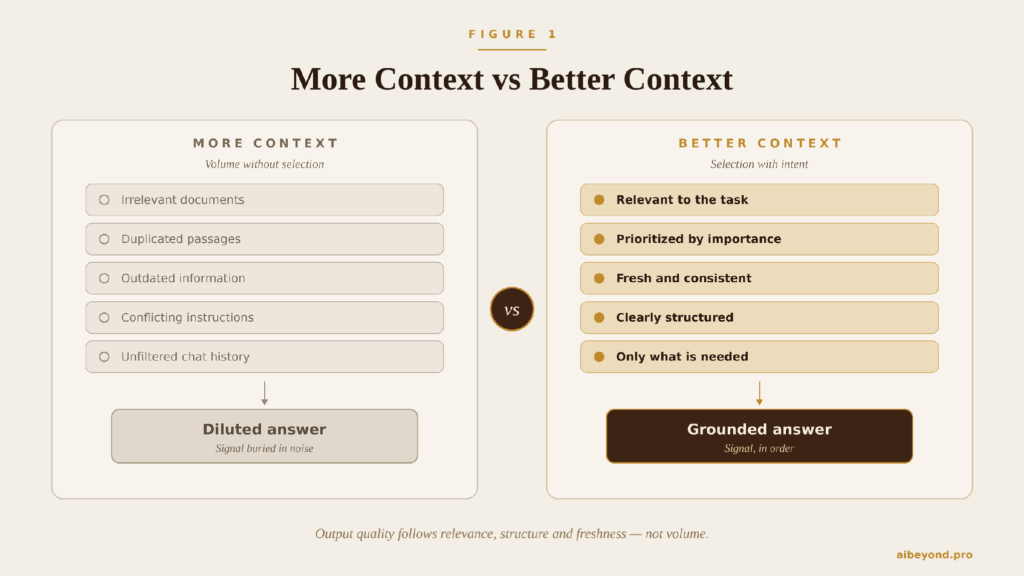
Larger windows raise the ceiling on what you can include. They do not guarantee the model uses it well. Researchers have shown that language models can be thrown off by irrelevant material in a prompt (Shi et al., 2023) and that accuracy can fall when the relevant passage sits in the middle of a long input instead of the start or end (Liu et al., 2023). Those findings come from specific models and tests, and newer models have improved, but the lesson holds: attention across a long input is not evenly distributed.
Irrelevant and duplicated information
Extra material competes with the passages that matter. Duplication is worse. A minor point repeated five times can look more important than it is, while consuming budget that something useful could have used.
Outdated and conflicting information
Superseded pricing, old policy documents and contradictory instructions leave the model to guess which to follow. It may guess wrongly, and it may not tell you there was a conflict at all.
Competing instructions
Prompts often grow by accretion: a new rule after every incident. Eventually rules pull in different directions, and the model has to resolve tensions nobody intended.
Signal-to-noise, cost and speed
All of this reduces to signal-to-noise. Every token has to earn its place. Larger inputs also generally mean higher cost and slower responses, so a bloated context is a recurring expense on every request, not a one-off.
Context Window ≠ Memory
Three ideas are often blurred together:
- Context: what the model can see right now, in this request.
- Memory: information stored beyond one request or session and deliberately brought back later.
- Retrieval: the mechanism that finds relevant information in a larger store and places it into context.
A large context window delivers only the first. Models are stateless by default; when the session ends, the context is gone unless something saves it. Pasting an entire history into every request is not memory. It is re-reading, with the cost and noise that come with it. Meaningful AI memory means deciding what to store, how to update or discard it, and when to recall it. AI retrieval, including the retrieval-augmented generation approach introduced by Lewis et al., is what connects that store to the window. Our earlier pieces on Agent Memory and RAG vs Fine-Tuning cover these choices in more depth.
The Context Engineering Shift
For a while the skill of the moment was prompt writing: phrasing a request well. That still matters, and our Prompt Engineering guide covers it, but a prompt is only one part of what the model sees. Context engineering is the broader job of curating everything in the window. Anthropic’s engineering team frames it as finding the smallest set of high-signal information that gets the result you want. In practice that comes down to five decisions:
- What to retrieve: which sources, and how many passages.
- What to exclude: the default should be out, not in.
- What to prioritize: put critical instructions and facts where they will be noticed, and rank retrieved material.
- How to structure it: labeled sections, a clear line between instructions and reference material, consistent formats.
- When to refresh: summarize or drop stale conversation turns and re-fetch data that changes.
Protocols such as MCP make it easier to connect models to tools and company data. That makes selection more important, not less, because easier access invites more input.
What This Means for Businesses
Customer support agents. The agent needs the current policy and the relevant part of this customer’s history, not the whole knowledge base. An outdated refund policy in context produces a confident wrong answer.
Research assistants. Breadth is tempting, but source quality and provenance matter more. Twenty loosely related papers can dilute the three that answer the question.
Marketing workflows. Brand guidelines from different eras give conflicting tone signals. One current brief usually beats an archive of past campaigns.
Internal knowledge assistants. Duplicate and stale documents are the main risk. Content hygiene is a context problem, and fixing it often improves results more than changing the model.
AI agents working with company data. Agents accumulate tool outputs and intermediate notes across many steps. Without pruning, early errors and clutter carry forward. Access control matters too: context should include only what the task, and the person asking, are permitted to see. Our AI Agents coverage looks at this in more detail.
A Simple Context Design Framework
Use these six steps whenever you build or review an AI workflow.
- Define the task. Write down what a good answer looks like and who it is for. Without this, relevance has no meaning.
- Identify required information. List the facts, policies, examples and constraints the model needs.
- Remove irrelevant information. Cut anything that does not serve the task, including duplicates and boilerplate.
- Prioritize important context. Order and label it, and state which source wins when two disagree.
- Check freshness and conflicts. Confirm dates, versions and ownership, and resolve contradictions before the model sees them.
- Evaluate the resulting output. Test on real examples and change one variable at a time. If added context does not improve results, remove it.
Conclusion
Bigger windows are a genuine capability gain, and they will keep growing. But capacity is not judgment. The organizations that get the most from AI will be the ones that treat context as something designed, tested and maintained.
The future of AI systems may not be about giving models everything. It may be about giving them exactly what matters.
