
Interview Scheduling Software: Why Getting Four People in a Room Is So Hard and Which Tools Actually Fix It

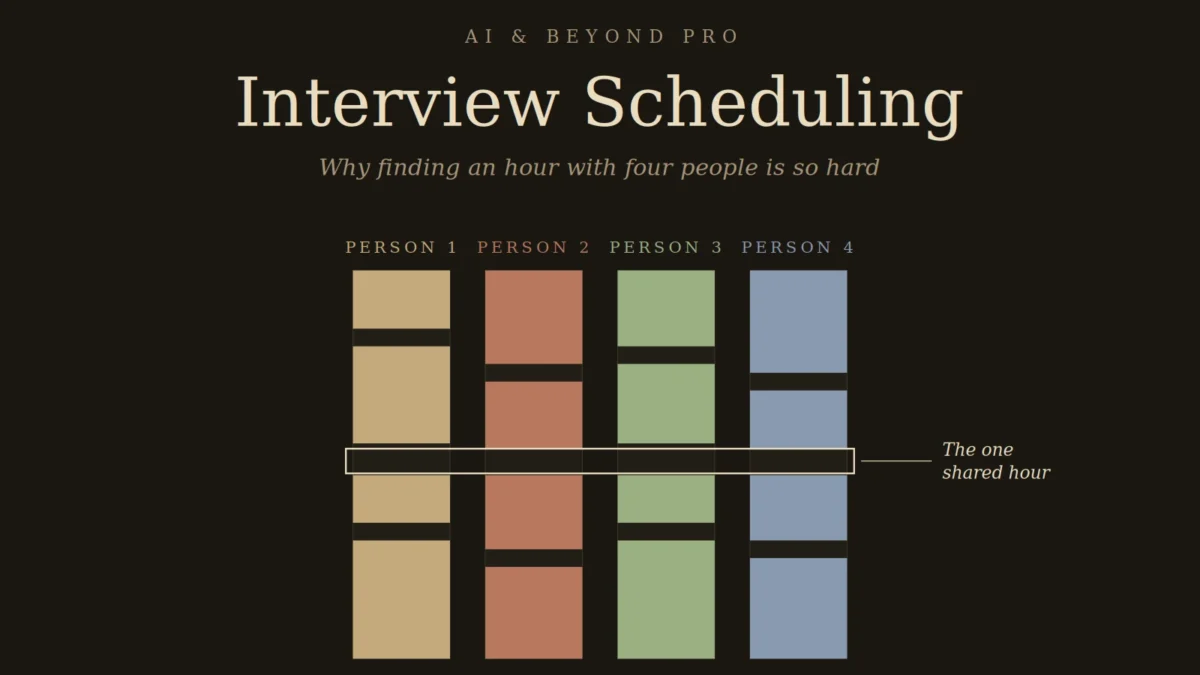
Panel scheduling collapses much faster than most recruiters expect. We ran the math on calendar overlaps and reviewed the tools that actually solve it.
Every recruiter knows this pain: you find a great candidate for a role, but booking their 4-person panel turns into an endless back and forth email chaos. By the time all four managers agree on a time, the candidate has already moved on. This is not an organizational failure; it is just the math of overlapping calendars.
Well, this is very intuitive but we actually ran numbers to illustrate this. Before we take a look into the numbers, we quickly want you to look into this term “Calendar Density”.
What Is Calendar Density and how does it make scheduling important?
Before looking at solutions, we need to understand why calendar coordination breaks down so quickly. It comes down to calendar density.
In simple terms, calendar density is just how full someone’s workday is with meetings and other work.
look at the figure below to see different calendar density schedules. We have assumed a 9 to 6 am schedule for this illustration.

Image 1: Three sample workdays showing 40%, 60% and 80% calendar density — the white gaps shrink fast as schedules become busier
A team member at 40% has a lot of free time and the white gaps in the column represent that.
As you move to the right, you will see more busier schedules corresponding to 60% and 80% calendar densities respectively. Here, you barely see any white gaps implying tighter schedules and less time for scheduling an interview.
Now, let’s look at how difficult scheduling gets when there are many people required for an interview panel and how busier individuals with busier calendars find it even more difficult to schedule a call.
The table thus found is attached below and each column represents the ease of finding a common slot. 100% implies finding a common slot is very easy while a 0% indicates that finding a common slot is not possible.
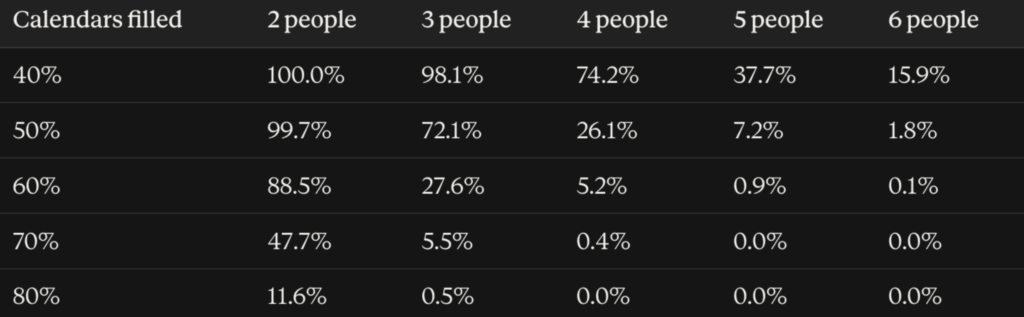
Image 2: Monte Carlo results showing the probability of finding a shared 60-minute slot across 2, 3, 4 and 5 interviewers at different calendar densities.(You don’t need to understand this Python part as its just added for context and you may skip simply to the interpretation below)
We ran a Monte Carlo simulation in Python. We took standard workdays divided into 30-minute slots, randomly filled them to test different calendar densities over five working days and calculated how often a continuous 60-minute window exists across multiple panel members.
So, If your team’s calendars are 60% full, finding a shared hour for a 4-person panel succeeds only 5.2% of the time.
Well, the numbers seem daunting at first but they are still exaggerated. In real life, managers cluster meetings together and leave open blocks, which can make scheduling slightly easier than random placement.
But it still stands materially true that more interviewers, especially the ones with busier calendars make it substantially more difficult to schedule a common time slot. Real calendars also have time zones, recurring syncs and candidate constraints which add extra complexity, too. Hence, this problem should certainly not be overlooked.
Well, now we are done with all the logical aspects of why scheduling becomes important, let’s look at various tools and their appropriateness for your situation.
Evaluating the Interview Scheduling Software by Category
Category A: Dedicated Panel Orchestrators (The Core Category)
These tools sit on top of your ATS and are built specifically for multi-person panel loops, load balancing and complex coordination.
- GoodTime: Best suited for enterprise recruiting teams conducting frequent multi-person panel loops across departments. It handles interviewer training and advanced load balancing well, though it comes with higher annual costs and administrative setup.
- ModernLoop: Designed for fast-scaling technology companies that need automated panel coordination, candidate portals and interviewer readiness tracking.
- candidate.fyi: Focuses heavily on candidate experience portals alongside automated panel scheduling, offering flexible options for mid-sized organizations.
What Do These Dedicated Interview Scheduling Tools Actually Do?
So, the above mentioned specialized tools tackle the scheduling dilemma as mentioned here:
- Searching Every Calendar at Once: Instead of a recruiter opening four tabs and cross-referencing availability manually, the software evaluates hundreds of potential calendar combinations in seconds to highlight genuine overlaps.
- Candidate Self-Scheduling: The software presents live, pre-validated overlapping times directly to the candidate via an interactive booking link. The candidate picks a slot, and invites are issued instantly, cutting out days of back-and-forth emails.
- Interviewer Pool Load Balancing: If one manager is at 80% calendar density, requiring them for every interview creates an instant bottleneck. The software keeps a list of people who can all run that interview and takes turns between them, picking whoever is free instead of always going back to the same person.
- Automated Replacement and Rescheduling: If an interviewer cancels at the last minute, the system automatically pulls an available replacement from the qualified interviewer pool, keeping the scheduled time intact without resetting the whole process.
Category B: High-Volume Conversational Tools (A Separate Use Case)
Tools like Paradox (Olivia) [Olivia is the assistant within Paradox just like Siri is Apple’s assistant] or SenseHQ are often brought up in scheduling discussions, but they solve a completely different problem.
(On a side note: Paradox was acquired by Workday in October 2025 and now appears in Workday’s HR product lineup as “Workday Paradox” but we would still call it Paradox for simplicity.)
Paradox uses SMS and WhatsApp chatbots to instantly screen and book single-interviewer slots for high-volume hourly, retail or frontline hiring. They are not designed to coordinate complex 4-person corporate or technical panel loops. If you are hiring retail staff at scale, Paradox is a category leader; if you are coordinating software engineering panels, look at panel orchestrators instead.
Can You Just Use What You Already Have?
Well, before buying specialized software, it is worth asking whether your current setup is actually broken.
1. The Baseline Layer (Google Calendar & Manual Invites)
For small teams hiring occasionally or conducting simple one-on-one screens, a shared Google Calendar and manual email invites are completely fine. It is free and takes no setup.
2. Lightweight Schedulers & Native ATS Tools
Tools like Calendly or native schedulers inside Applicant Tracking Systems (Greenhouse, Workday, Lever) are designed mainly for 1-on-1 interviews.
As the simulation data proves, booking two people is managing well across almost every density level. At 50% calendar density, 2-person availability is 99.7%. Your built-in ATS features or a basic Calendly link handle these 1-on-1 screens without needing dedicated software.
When Do You Need Standalone Interview Scheduling Software?
So, the tipping point happens where the numbers fall off the cliff. If your company routinely runs panels of 3, 4 or more busy interviewers, built-in ATS schedulers will create severe bottlenecks. That is when dedicated software justifies its cost.
Interview Scheduling Software Comparison Table
| Vendor | Primary Use Case | Key Capabilities | Pricing & Model |
| GoodTime | Usually Large companies running 4+ person panels | Finds slots across many calendars, rotates who interviews so the same people aren’t always picked | Custom fee by annual candidate volume (est. ~$25k+/yr per 3rd-party buyer reports) |
| ModernLoop | Mid-market & tech panel scheduling | Automated stage-change scheduling triggers, interviewer readiness & candidate portal | Custom subscription for Scheduling |
| candidate.fyi | Mid-sized companies that care about the candidate’s experience | Books panels and gives candidates their own page to track where they are | Custom annual subscription based on company size & requisitions; zero per-seat fees |
| Paradox | Companies hiring lots of people [High-volume] for similar roles | Automated SMS/WhatsApp chatbot booking for 1-on-1 screens | Custom quotes based on location count & message volume |
| Calendly | 1-on-1 screens & individual booking | Simple 1-on-1 booking links, meeting buffers & calendar sync | Free tier; Standard $10/seat/mo; Teams $16/seat/mo; Enterprise from $15,000/yr |
| ATS Native (Greenhouse / Workday / Lever) | Native 1-on-1 scheduling in ATS | Basic candidate self-scheduling for 1-on-1 screens & record tracking | Included with core ATS platform subscription |
FAQs
Q1) Can’t we just keep using our existing ATS or simply use Calendly?
Built-in ATS features and standard booking links work well for simple 1-on-1 screens. However, they lack automated peer rotation and will become a hassle when coordinating 3 or 4 busy interviewers. Standalone panel software is hence a viable option to make the process more clean and predictable.
Q2) How do panel schedulers like GoodTime, ModernLoop & candidate.fyi handle last-minute interviewer cancellations or candidate reschedule requests?
If an interviewer cancels, the panel software catches it immediately and swaps in an available teammate from a qualified peer pool so the interview stays on the books. If the candidate asks to change the time, the software finds fresh openings across everyone’s calendars and updates all invites automatically without a recruiter having to restart the email chain.
Q3) What calendar permissions will IT need to grant for the above panel schedulers?
The tool needs read access to interviewer calendars to find free times and write access to create events. That typically means an admin level connection to Google Workspace or Microsoft 365. Involve IT early, since granting organization wide calendar access is a security review in most companies.
Q4) Is it better to send candidates a booking link or have a recruiter arrange the time?
Usually the link, whether it’s a simple Calendly page for a first screen or a panel tool showing the few windows where all four interviewers are free. Candidates tend to prefer choosing a slot themselves over waiting days for options, and it removes the stage where a good slot disappears while everyone waits on replies. The exception is for senior candidates who you are actively trying to win and hence, personal coordination becomes a signal that the company is investing in them.
Q5) How do Paradox and SenseHQ fit in, and can they handle corporate panels?
Both are built for high-volume and hourly hiring. They let candidates screen and book one-on-one interviews in minutes through automated SMS or WhatsApp conversations. They’re strong at that, but they aren’t designed to coordinate multi-person technical or corporate panels.
